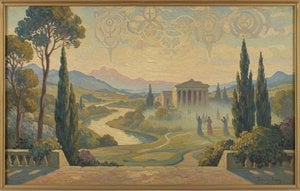
A Legacy in Shadows and Light
In the vibrant, bustling heart of seventeenth-century Paris, a period defined by the grandeur of the Baroque and the emerging elegance of the Classical era, lived the portraitist Martin Lambert. Born in 1630, Lambert emerged from the rich artistic tapestry of the French capital, a city that was rapidly becoming the epicenter of European culture. While much of his personal life remains shrouded in the mists of history, his presence is undeniably felt through the brushstrokes he left behind. As a student of the esteemed Beaubrun brothers—Henri and Charles—Lambert was immersed in a tradition of exquisite portraiture that demanded both technical precision and an intuitive understanding of human character.
The artistry of Lambert was deeply rooted in the pedagogical lineage of his mentors, inheriting a style that favored the sophisticated interplay of light and shadow. His work reflects the transition from the dramatic intensity of the Baroque to the more structured, poised sensibilities of the Classical period. This era required a painter to capture not just the physical likeness of a subject, but their social standing, their dignity, and the very essence of their nobility. Through his training, Lambert mastered the ability to render textures—the sheen of silk, the weight of velvet, and the subtle glow of skin—creating works that breathed with a quiet, aristocratic life.
The Academy and Artistic Achievement
Lambert’s ascent within the prestigious French artistic hierarchy was marked by his formal recognition by the Académie Royale. His acceptance into this elite circle was not merely a matter of status but a testament to his mastery of the portrait genre. One of his most significant historical markers is his reception into the Academy following the painter Guérin, a feat achieved through the presentation of a compelling work: a double portrait of Henri and Charles Beaubrun. This piece served as both a tribute to his teachers and a demonstration of his ability to compose complex, multi-figure narratives with grace and technical command.
The significance of his contributions can be seen in the enduring presence of his themes within the great collections of France. His work, characterized by its refined execution, found a permanent home in institutions such as the Palace of Versailles, where it stood alongside the most important works of the age. Even as centuries passed, Lambert’s ability to capture the spirit of the French court ensured his place in the annals of art history. His life, which concluded in Paris on February 28, 1699, represents a vital link in the chain of French portraiture, bridging the gap between the early seventeenth-century masters and the refined classicism that would define the following generations.
Spørgsmål og svar
Findes der en komplet liste over Martin Lamberts værker?
Se alle værker af Martin Lambert på denne hjemmeside på kunstnerens Alle kunstværker-side.
Findes der en kronologisk gennemgang af Martin Lambert?
En kronologisk gennemgang af Martin Lamberts værker er tilgængelig på kunstnerens Kronologi-side, hvor værkerne præsenteres i rækkefølge efter deres skabelse, kapitel for kapitel.
Hvor kan man finde Martin Lamberts kunstværker grupperet efter farvepalette?
For at finde værker af Martin Lambert i en specifik farvepalette kan du bruge kunstnerens Efter farvepalet side.
Findes der en tidslinje over Martin Lamberts værker?
Se en tidslinje over Martin Lamberts værker på siden Tidslinje for kunstværker, hvor kunstværkerne er sorteret efter dato.