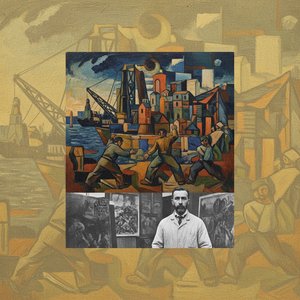
Early Life, Family and Training
Manuel Arellano was born on April 7, 1858, in Seville, Spain, into a lineage defined by the tactile arts. He was the son of Ana Campos y López and Manuel Arellano y Oliver, a man who balanced the disciplines of painting and ceramics. This domestic environment provided the boy with his first lessons, as his father acted as his primary instructor, introducing him to the nuances of form and material from a young age.
As his technical understanding matured, Manuel Arellano sought formal instruction beyond the family workshop. He attended night classes in drawing and painting at the Museo de Bellas Artes de Sevilla. Under the guidance of Eduardo Cano, he refined his ability to translate vision onto canvas and clay, bridging the gap between the domestic training of his youth and the disciplined academic traditions of the museum.
Professional Career and Workshops
Manuel Arellano established himself as a versatile practitioner, moving fluidly between the creation of genre scenes, formal portraiture, and the intricate demands of ceramic art. His professional life was deeply rooted in the workshops of Triana, where he refined his technical skill through years of practical application. He spent a decade working within the La Cartuja factory, a period that helped solidify his reputation as a skilled artisan. His career also included significant tenures at the workshops of Francisco Díaz and Manuel Soto y Tello.
His expertise in ceramics led him to collaborate with various prestigious establishments. In 1890, he worked at the workshop of José Mensaque y Vera, and he later contributed his talents to the Viuda de Gómez factory, which was also known as Cerámica Santa Ana. His reputation extended beyond the borders of Seville; he traveled to Segovia for a temporary collaboration with the Fábrica de Loza La Segoviana. This movement between different manufacturing centers allowed him to apply his painterly sensibilities to a wide array of ceramic forms, from functional vessels to architectural decorations.
Artistic Themes and Key Works
The breadth of Arellano’s output reflected a life lived between the canvas and the kiln. His interests were as varied as the surfaces he chose to decorate, ranging from intimate portraits to large-scale architectural elements. He applied his skill to friezes, facades, and altarpieces, while also producing more functional objects such as planters, plates, chimneys, amphorae, and jars. This versatility allowed him to move seamlessly from the delicate nuances of a portrait to the structural demands of ceramic decoration.
His early exhibitions signaled a growing command of genre painting. In 1875, he presented Una cigarrera, Un árabe, and Un herrero, works that demonstrated his ability to capture specific social types. By 1880, he had produced Mujer con guitarra, further establishing his presence in the Sevillian art scene. His later years saw a continued focus on portraiture, including a 1901 depiction titled Una monja.
In the realm of ceramic art, Arellano achieved a high level of distinction through his allegorical compositions. His work often integrated seamlessly into the urban fabric of Seville, most notably through the figures of El Trabajo and La Prudencia, which adorn the facade of Cerámica Santa Ana. These figures demonstrate how his artistic vision extended beyond the private collection into the public sphere.
Political Career and Later Years
Beyond the workshops and the kilns, Arellano sought to serve his community through civic engagement. He entered the political arena as a member of the Republican Party, eventually serving as a City Councilor of Seville from 1903 to 1906. This period of public service reflected a sense of vocation toward his neighbors, marking a significant chapter in a life otherwise defined by the tactile nature of clay and pigment.
His life reached a sudden and tragic conclusion in December 1906. While traveling to Badajoz, Spain, to visit his ailing father, he contracted an infectious pneumonia. He succumbed to the illness on December 9, 1906, at the age of forty-eight. His death was viewed by many in Seville as an unexpected loss of a modest and intelligent worker, a man deeply integrated into the social fabric of the Triana district.
Spørgsmål og svar
I hvilken historisk periode arbejdede Manuel Arellano?
Manuel Arellano var aktiv i 19th Century-perioden. Denne periode placerer kunstnerens virke i en historisk kontekst.
Hvor kan jeg finde statistik om Manuel Arellanos værker?
Se statistik over Manuel Arellanos værker på kunstnerens Statistik side.
Hvor kan jeg se farveprofilen i Manuel Arellanos værker?
Farvepalettens DNA for Manuel Arellano er en side, der præsenterer farveprofilen i kunstnerens samlede værk.
Findes der en kronologisk gennemgang af Manuel Arellano?
Kronologi for Manuel Arellano er en rullevenlig tidslinje, der præsenterer kunstnerens værker i kronologisk rækkefølge, opdelt i kapitler efter karriereperioder.