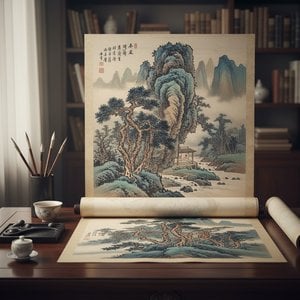
Lu Tieh-Chou: Echoes of Tranquility in Lunar Landscapes
Emerging from the vibrant and often tumultuous tapestry of early 20th-century China, Lu Tieh-Chou (1899–1942) carved a unique space in the annals of modern art. His life coincided with a period of profound political shifts and burgeoning artistic experimentation, where the weight of ancient tradition met the irresistible pull of global modernity. Born into a family steeped in cultural heritage yet yearning for the new, Lu developed a dualistic vision that would become his hallmark. While biographical records from this era remain somewhat sparse, scholars recognize him as a pivotal figure who helped establish Chinese gouache painting—specifically Eastern Gouache—as a distinct and sophisticated genre capable of expressing both profound stillness and modern technical mastery.
The foundation of Lu’s artistic language was laid through a rigorous and diverse education that bridged the gap between East and West. His formal training began at the Tianjin Fine Arts School, where he encountered prominent instructors who championed Impressionistic techniques. This exposure to Western light and color theory provided him with a revolutionary toolkit, allowing him to expand the traditional boundaries of Chinese composition. Seeking further refinement, Lu traveled to Japan, attending the Kyoto City School of Painting from 1928 to 1930. During this transformative period, he studied under masters such as Fukuda Heihachiro and was influenced by the works of legendary figures like Takeuchi Seiho. This international academic journey infused his work with a cosmopolitan sensibility, blending the delicate precision of Japanese aesthetics with the bold, atmospheric possibilities of Western Impressionism.
The Harmony of Light and Philosophy
At the heart of Lu Tieh-Chou’s oeuvre lies a deep-seated connection to Taoist philosophy, particularly the concept of Yin and Yang. His paintings are not merely visual representations of nature but are meditations on the harmonious balance between opposing forces. This spiritual equilibrium manifests in landscapes dominated by misty, ethereal mountains and tranquil lakes that mirror the soft glow of the moon. He mastered the art of subtle tonal gradations, using them to convey a sense of profound emotional depth and cosmic continuity. Through his brush, the physical world becomes a vessel for the metaphysical, inviting the viewer into a state of contemplative peace.
His technical prowess is most evident in his use of gouache, a medium chosen for its unique opacity and luminous qualities. Unlike the transparent washes of traditional ink painting, Lu utilized the layering capabilities of gouache to build texture and light. His 1931 masterpiece, 'Moon', serves as the definitive example of this approach. In this work, a solitary pine tree is silhouetted against a radiant, moonlit sky, achieved through meticulous layering that creates an almost otherworldly atmosphere. The painting captures the essence of a single, breathless moment, where the light seems to emanate from within the pigment itself, embodying the very "echoes of tranquility" for which he is celebrated.
Legacy and Historical Significance
Though his life was tragically short, Lu Tieh-Chou’s impact on the trajectory of modern Chinese painting remains significant. He stood at a historical crossroads, successfully synthesizing the ancestral traditions of China with the evolving techniques of Japan and the West. His ability to elevate Eastern Gouache into a medium of high artistic expression allowed for a new kind of landscape painting—one that was both culturally rooted and stylistically modern. Today, his works, held in prestigious institutions such as the National Taiwan Museum of Fine Arts, continue to resonate with collectors and historians alike, serving as a testament to a life dedicated to capturing the sublime beauty of the natural and spiritual worlds.