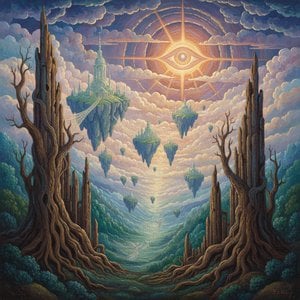
The Gömör Landscape and the Artist's Soul
István Dúdor was a man defined by the tension between his roots and his restless spirit. Born in Držkovce, he spent much of his life navigating the spaces between Prague, Bratislava, and Budapest, yet his eyes remained fixed on the hills of his homeland. He was a painter and a draftsperson who found his true voice in the quiet, heavy presence of the Gömör landscape. His work was not a pursuit of fame, but a deep, often solitary, commitment to the visual truth of the land that shaped him.
His education was a blend of private discipline and formal rigor. He began his training under Béla Bacskai and Gyula Szabó, developing a foundational strength before moving to the Secondary School of Applied Arts in Bratislava. This path eventually led him to the Academy of Fine Arts in Prague, where he studied under František Jiroudek. It was here that his technical precision met a more profound, expressive intent, preparing him for a life of intense creative output that often went unrecognized during his own lifetime.
A Life of Movement and Meaning
Dúdor’s existence was marked by a constant, almost frantic, movement between major European centers, even as he remained spiritually anchored to his birthplace. This duality is reflected in the themes of his work, where the physical landscape meets a deeper, more symbolic layer of human experience. His life was characterized by a certain struggle, a sense of being an outsider even within his own circles, which earned him the somber comparison to Icarus, a figure of fallen ambition and tragic beauty.
His artistic output included several notable explorations of form and color:
- The use of mixed media to capture the shifting moods of the seasons.
- A focus on the specific topography of the Gömör region.
- Graphic illustrations that appeared in Slovakian Hungarian-language publications.
His exhibitions were scattered across various cities, including Komárom, Pozsony, and Prague, yet he remained a figure of quiet persistence. He was a man who lived for the conviction of his art, often facing the hardship of being overlooked or having his work misappropriated, yet he continued to paint with a singular, focused intensity.
The Weight of the Image
The imagery in his work often transcended mere representation. His paintings, such as those depicting the colors of spring or the mythological weight of Icarus, suggest a preoccupation with the struggle of the individual against the vastness of nature and fate. He did not seek to decorate, but to record the essence of a place and the feeling of belonging to it. His death in Tornaľa in 1987 cut short a career that was only beginning to find its rightful place in the historical record.
Today, the recognition of his contribution is growing. What was once a private struggle for expression has become a recognized part of the regional artistic identity. His work remains a vital link to the landscape of Gömör, captured by a hand that understood both the lightness of a spring morning and the heavy, inevitable gravity of the earth.
Spørgsmål og svar
Hvor kan man finde István Dúdors værker grupperet efter teknik?
For at finde alle værker af István Dúdor inden for et bestemt medie, kan du bruge kunstnerens Alle medier side.
Findes der en komplet liste over István Dúdors værker?
Se alle værker af István Dúdor på denne hjemmeside på kunstnerens Alle kunstværker-side.
Hvordan finder jeg værker af István Dúdor inden for et specifikt tema?
For at finde værker af István Dúdor inden for et specifikt tema kan du bruge kunstnerens Efter nøgleord-side, som grupperer værkerne efter nøgleord.
Hvor populære er István Dúdors kunstværker?
Se statistik over István Dúdors værker på kunstnerens Statistik side.