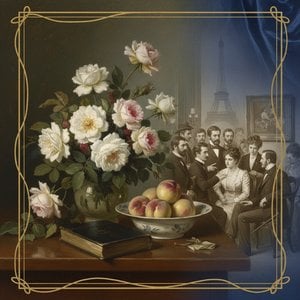
The Dandy of Montmartre: The Vibrant Life of George Bottini
In the smoky, neon-lit heart of Belle Époque Paris, where the boundaries between high society and the bohemian underworld were perpetually blurred, lived a man who embodied the very essence of Montmartre. Georges Alfred Bottini, though known to many by the more anglicized George Bottini, was far more than just a painter; he was a self-styled dandy, a creature of the night, and a chronicler of the city's most provocative corners. Born in Paris in 1874, the son of an Italian immigrant hairdresser, Bottini’s early years were steeped in the vibrant, bustling atmosphere of the Rue Fontaine. His upbringing placed him at the doorstep of the Butte, allowing him to witness firsthand the colorful tapestry of street life, from the elegant patrons of fine establishments to the gritty reality of the local dance halls and brothels.
Bottini’s artistic journey was not one of academic detachment but of deep, visceral immersion. After a brief period working as an art restorer—a vocation that allowed him to study the masters like Goya and Titian with intimate precision—he sought formal training in the studio of Eugène Cormon. This foundation in classical technique provided the structural backbone for what would become a remarkably expressive and graphic style. His early fascination with Old Master works infused his later, more modern compositions with a sense of weight and historical resonance, even as he turned his gaze toward the fleeting, ephemeral moments of contemporary Parisian life.
A Vision of the Bohemian Underworld
The work of George Bottini serves as a vivid, often startling, window into the nocturnal soul of Paris. He possessed a unique ability to capture the electric energy of the cafés, theatres, and dance halls that defined the era. His subject matter was unapologetically bold, frequently focusing on the provocative figures of the Place Blanche—the heavily made-up women and spirited characters who frequented the city's most notorious establishments. Through his use of watercolor, lithography, and illustration, Bottini rendered these scenes with a striking palette and a rhythmic, graphic quality that felt both immediate and legendary.
His artistic development was marked by several key milestones that cemented his place within the Parisian avant-garde:
- The Impressionist and Symbolist Connection: From 1896, Bottini participated in the prestigious Exhibitions of Impressionist and Symbolist Painters at the Galerie Georges Petit, placing him alongside the most influential movements of his time.
- The Press and Poster Art: His talent for bold, communicative imagery led to a successful career as an illustrator for publications like Le Rire. Here, he was celebrated as a "modern Constantin Guys," a title that recognized his ability to capture the pulse of urban life through sharp, evocative lines.
- The Montmartre Circle: His presence in the legendary haunts of the Butte, such as the Moulin de la Galette and the Bal Tabarin, allowed him to develop a visual language that was deeply intertwined with the social fabric of the era.
Legacy and the Lost Master of the Belle Époque
Despite his profound connection to the artistic zeitgeist, Bottini’s life was tragically short, ending in 1907 at the age of only thirty-three. He lived much of his adult life in a state of beautiful, albeit precarious, poverty, embodying the quintessential struggle of the bohemian artist. While he may not have achieved the enduring global fame of contemporaries like Toulouse-Lautrec, his influence was quietly profound. His expressive snapshots and colorful depictions of the Parisian underworld were noted by giants such as Pablo Picasso, suggesting a lineage of visual storytelling that bridged the gap between late nineteenth-century realism and the burgeoning modernism of the twentieth century.
Today, the work of George Bottini stands as a poignant tribute to a vanished world. His ability to find beauty in the seedy, the scandalous, and the transient remains a testament to his singular vision. To look upon a Bottini print or painting is to step back into the flickering gaslight of Montmartre, feeling the pulse of a city that was as much an art form as the canvases he produced. He remains a vital, if often overlooked, figure—a master of the ephemeral who captured the heartbeat of Paris before it faded into history.
Spørgsmål og svar
Hvilken by og hvilket land er George Bottini født i?
George Bottini blev født i 9th arrondissement of Paris, i France.
I hvilken historisk periode arbejdede George Bottini?
George Bottini var aktiv i Modern-perioden. Denne periode placerer kunstnerens virke i en historisk kontekst.
Hvor kommer George Bottini fra?
George Bottini blev født i France.
Hvor kan jeg se farveprofilen i George Bottinis værker?
Farveprofilen for George Bottinis værker kan ses på kunstnerens Farvepalettens DNA-side.