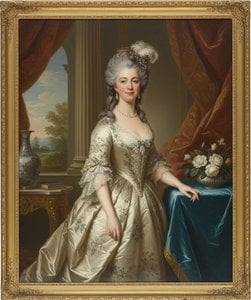
Francesco Bartolozzi: Life and Legacy
Early Life and Training
- Born: Florence, Italy in 1725.
- Initially destined to follow his father’s profession as a goldsmith and silversmith.
- Demonstrated exceptional artistic talent early on, leading him to study painting under Florentine artists Ignazio Hugford and Giovanni Domenico Ferretti.
- Spent three years dedicated to painting before turning his attention to engraving in Venice.
- Influenced by the work of Joseph Wagner, a prominent engraver, during his time in Venice.
Artistic Development and Style
- Bartolozzi’s early engravings were initially in the style of artists like Marco Ricci and Zuccarelli.
- He later developed a distinctive style, becoming renowned for popularizing the “crayon” method of engraving.
- The ‘crayon’ manner imitated the subtle effects of chalk drawings, creating soft, delicate textures and tones.
- His work often featured portraits and allegorical scenes, reflecting Neoclassical influences.
Career in London
- Moved to London in 1764 and remained there for nearly forty years.
- Quickly established himself as a leading engraver, appointed ‘Engraver to the King’ with an annual salary of £300.
- Elected a founding member of the Royal Academy in 1768, solidifying his position within the British art establishment.
- Contributed significantly to Boydell's Shakespeare Gallery, creating engravings based on works by prominent artists.
- Frequently collaborated with artists such as Cipriani and Angelica Kauffman.
Major Achievements and Works
- Notable works include engravings of “Clytie” after Annibale Carracci and the “Virgin and Child” after Carlo Dolci.
- His skill in reproducing paintings with a chalk-like quality made his engravings highly sought after.
- In 1802, he became the founding president of the short-lived Society of Engravers.
- Bartolozzi’s influence extended to numerous pupils, including Michele Benedetti and Luigi Schiavonetti.
Later Life and Historical Significance
- In 1802, Bartolozzi accepted the position of director of the National Academy of Lisbon.
- He died in Lisbon in 1815.
- Bartolozzi’s contribution to engraving lies in his mastery and popularization of the crayon manner, which significantly impacted the aesthetic qualities of engravings during his time.
- His work remains a testament to the skill and artistry of 18th-century engravers and continues to be appreciated for its delicate beauty and technical brilliance.
Spørgsmål og svar
Hvor mange kunstværker af Francesco Bartolozzi er tilgængelige at gennemse?
Du kan gennemse 2 kunstværker værker af Francesco Bartolozzi på siden Alle kunstværker.
Hvilke andre navne eller pseudonymer bruger Francesco Bartolozzi?
Francesco Bartolozzi optræder under de alternative navne Frao. Bartolozzi, F. Bartolozzi, R. A. Bartolozzi, Francisco Bartolozzi, François Bartolozzi.
I hvilke kunstretninger arbejdede Francesco Bartolozzi?
De kunstretninger, som Francesco Bartolozzi arbejdede inden for, kan findes på kunstnerens Alle kunstretninger-side, hvor værkerne er grupperet efter kunstretning.
Findes der en tidslinje over Francesco Bartolozzis værker?
Se kunstnerens Tidslinje for kunstværker for en kronologisk gennemgang af Francesco Bartolozzis værker, år for år.