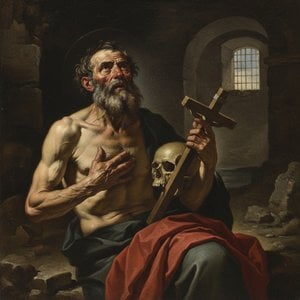
The Shadow and the Light: The Life of Filippo Vitale
In the vibrant, tumultuous heart of the Italian Baroque, a period defined by dramatic tension and profound emotional depth, the name Filippo Vitale emerges as a significant voice within the Neapolitan school. Born in Naples around 1585, Vitale came of age during an era when the city was a melting pot of artistic innovation and intense religious fervor. His life and work were deeply embedded in the caravaggista tradition, a movement that sought to bring a raw, visceral realism to the canvas through the masterful use of chiaroscuro—the stark, theatrical interplay between deep shadows and piercing light.
Vitale’s early artistic development was shaped by the prestigious workshops of his contemporaries. He is believed to have been a pupil of Carlo Sellitto, an artist whose influence provided Vitale with a foundational command over form and composition. The weight of responsibility even fell upon his shoulders early in his career; following Sellitto's death, Vitale was entrusted with completing the unfinished Crucifix for Santa Maria de Portanova, a task that speaks to his technical proficiency and the respect he commanded among his peers. This period of his life was marked by a rigorous adherence to the naturalistic style that was sweeping through Naples, preparing him for a career defined by dramatic storytelling.
A Legacy of Neapolitan Baroque
As Vitale’s career progressed, his work became inextricably linked to the influential circle surrounding José de Ribera, known as el Spagnoletto. This group of painters shared a profound commitment to a style that was both gritty and spiritually evocative. While Vitale's early brushwork possessed a certain hardness—a characteristic common to the intense realism of the time—his technique underwent a subtle evolution. Influenced by his familial and professional connections, particularly his relationship with his stepson Pacecco de Rosa, Vitale’s style began to soften, gaining a more fluid grace that allowed for even greater emotional nuance.
His contributions to the religious iconography of Naples were significant, as he sought to capture the divine through the lens of human suffering and triumph. His documented works, such as those created for the church of the Annunziata in Capua, demonstrate his ability to weave complex theological narratives into single, powerful images. Through his mastery of light, Vitale could transform a simple scene of a Nativity or Pentecost into a cosmic event, where every shadow held a secret and every highlight offered a glimpse of the celestial.
Artistic Influence and Historical Significance
The historical importance of Filippo Vitale lies not only in his individual canvases but in his role as a bridge within the Neapolitan artistic community. He stood at the intersection of several great masters, absorbing the rugged naturalism of Ribera and the emerging softness of the next generation. His life serves as a testament to the interconnectedness of Baroque workshops, where knowledge was passed through apprenticeship and familial bonds.
To reflect on Vitale's artistic landscape is to observe the following key elements of his era:
- The Caravaggist Influence: The use of dramatic lighting to create psychological depth and physical presence.
- Neapolitan Naturalism: A focus on the tangible, often rugged reality of human figures and religious subjects.
- Workshop Traditions: The collaborative nature of art production, seen in his completion of Sellitto's works and his mentorship of De Rosa.
- Spiritual Intensity: The use of art as a medium for profound religious devotion during the Counter-Reformation.
Though much of his early work has been lost to time or damage, the surviving fragments of Vitale's legacy continue to illuminate the brilliance of the Neapolitan Baroque. He remains a vital figure for understanding how the shadows of the 17th century were used to define the light of artistic genius.
Spørgsmål og svar
I hvilken historisk periode arbejdede Filippo Vitale?
Filippo Vitale var aktiv i Early Modern-perioden. Denne periode placerer kunstnerens virke i en historisk kontekst.
Hvor kan man finde Filippo Vitales værker opdelt efter emne?
Filippo Vitales værker kan udforskes efter emne på kunstnerens Emneoversigt-side.
Hvor kan jeg se Filippo Vitales værker i kronologisk rækkefølge?
Se en tidslinje over Filippo Vitales værker på siden Tidslinje for kunstværker, hvor kunstværkerne er sorteret efter dato.
Hvilken by og hvilket land er Filippo Vitale født i?
Filippo Vitale blev født i Naples, i Italy.