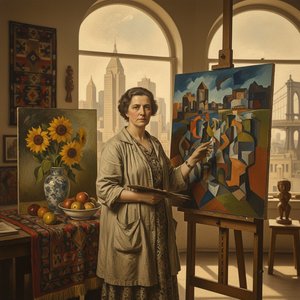
A Legacy of Line and Light: The Artistry of Ella Sophonisba Hergesheimer
In the golden era of American illustration and portraiture, few names resonate with as much technical precision and soulful grace as Ella Sophonisba Hergesheimer. Born in Allentown, Pennsylvania, in 1873, Hergesheimer carried within her a profound artistic lineage; she was the great-great-granddaughter of the legendary Charles Willson Peale, a connection that perhaps anchored her deep-seated devotion to the visual arts. Her journey began with the disciplined training of the Philadelphia School of Design for Women and continued through the prestigious Pennsylvania Academy of Fine Arts. It was here, under the watchful eyes of masters like Cecilia Beaux and the celebrated William Merritt Chase, that her talent truly began to bloom. Chase, recognizing her exceptional skill, regarded her as one of his finest pupils, a testament to the rigorous foundation upon which she built her illustrious career.
Her pursuit of excellence eventually led her across the Atlantic, where a three-year sojourn in Europe allowed her to refine her craft at the Académie Colarossi in Paris. This period of international exposure was transformative, as she exhibited her works at the prestigious Paris Salon, gaining the confidence to navigate the complex worlds of both fine art and commercial illustration. Upon her return to the United States, a pivotal commission in 1907—the portrait of Methodist Bishop Holland Nimmons McTyeire—prompted her relocation to Nashville, Tennessee. This move would define the remainder of her life, as she became an integral part of the Southern art scene, capturing the essence of Tennessee society with an eye for both elegance and character.
Mastery of Medium and the White-Line Revolution
Hergesheimer was far more than a mere observer of her era; she was a pioneer who reshaped the boundaries of printmaking. While many artists of her time were content with traditional methods, she became a vanguard of the white-line woodcut technique. This method, which requires the artist to carve fine lines that appear as light against the darker inked areas, allowed for a delicate, intricate detail that mirrored the precision found in her paintings. Her ability to manipulate light and shadow through the medium of wood was nothing short of revolutionary, leaving an indelible mark on the American printmaking tradition.
Her stylistic evolution was equally remarkable. In her earlier years, her palette was characterized by a subdued, almost somber restraint, reflecting the academic influences of her training. However, as she matured, particularly moving into the 1930s, her work underwent a vibrant metamorphosis. The muted tones were replaced by a bright, luminous coloration that breathed new life into her still lifes and landscapes. This shift toward more exuberant hues demonstrated an artist who was never stagnant, but rather one who continuously sought new ways to interpret the beauty of the world around her.
A Portraitist of Character and Society
As a portraitist, Hergesheimer possessed a rare gift for capturing the dignity and social standing of her subjects. She became the preferred painter for many of the most influential figures in the South, documenting the faces of Tennessee’s elite with a mixture of reverence and psychological depth. Her portfolio is a tapestry of historical significance, featuring:
- The Speaker of the House, Joseph W. Byrns, a monumental portrait that holds pride of place in the U.S. Capitol building.
- Commodore Matthew Fontaine Maury, whose likeness resides within the halls of the U.S. Naval Academy at Annapolis.
- Madeline McDowell Breckinridge, a powerful depiction of a leading figure in the women’s suffrage movement.
- Numerous unnamed members of Nashville society, whose portraits serve as a visual record of a bygone era of Southern elegance.
Beyond her formal portraits, Hergesheimer’s work extended into the intimate realms of still life and landscape, where she found beauty in the mundane and the magnificent alike. Through her illustrations and paintings, she bridged the gap between high art and popular media, ensuring that her vision reached a wide audience. When she passed away in 1943, she left behind a legacy defined by technical innovation, a vibrant coloristic spirit, and a profound ability to capture the human spirit through the delicate interplay of line and light.
Spørgsmål og svar
Hvor kan man finde Ella Sophonisba Hergesheimers kunstværker organiseret efter farve?
Siden Farveindeks organiserer Ella Sophonisba Hergesheimers værker efter farve.
Hvor mange kunstværker af Ella Sophonisba Hergesheimer er tilgængelige at gennemse?
Du kan gennemse 3 kunstværker værker af Ella Sophonisba Hergesheimer på siden Alle kunstværker.
Hvilke andre navne eller pseudonymer bruger Ella Sophonisba Hergesheimer?
Ella Sophonisba Hergesheimer optræder under de alternative navne E. Sophonisoz Hersesheimer, Элла Софонисба Хергешаймер.
Kan jeg udforske Ella Sophonisba Hergesheimers værker efter emne?
Ella Sophonisba Hergesheimers værker kan udforskes efter emne på kunstnerens Emneoversigt-side.