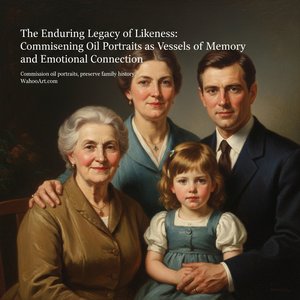
The Quiet Presence of Portraiture
Edward Gouge worked during a period when the likeness of a person was a matter of record and social standing. His hand is found in the faces of men from the early eighteenth century, captured in a way that suggests a steady, observant eye. He was active between 1690 and 1735, a time when the sitter's character was often conveyed through the stillness of their posture and the specific details of their attire. His work does not shout; it sits quietly on the wall, holding the gaze of those who look closely at the lines of a face or the fold of a collar.
There is a certain weight to the subjects he chose to paint. He focused on individuals of substance, men whose lives were documented in the ledgers of their time. His brushwork sought to pin down a specific moment in a life, capturing the way light fell across a brow or the texture of a heavy coat. He was a painter of the individual, concerned with the physical reality of the person before him.
Works and Subjects
The surviving traces of his hand show a preference for the formal portrait. His subjects were often men of influence, and his compositions reflect the dignity expected of their positions. We see his hand in several specific likenesses that have been preserved in collections like Lyme Park and Dyrham Park.
- Colonel John Blathwayt (1690-1754)
- William II Blathwayt (1688-1742)
- Robert Vansittart (1679-1719)
- Sir John Stonehouse, 3rd Bt (1673-1733)
These works show a consistent interest in the way a person carries themselves. In the portrait of Robert Vansittart, for instance, there is a connection to the literary world through the inclusion of Matthew Prior's 'Poems'. This detail places the sitter in a specific intellectual context, moving the portrait beyond a mere likeness into a study of a man's interests and environment.
The Legacy of the Image
Gouge's influence extended beyond the original oil on canvas. His likenesses were translated into other forms, such as mezzotints and line engravings, which allowed his subjects to be seen by a wider audience. These reproductions, some appearing decades after his death, show that the faces he captured remained relevant to the visual language of the era. He was a painter whose work was used as a basis for the printmaking that defined the era's portraiture.
He died in 1735, leaving behind a body of work that remains tied to the specific social fabric of the early 1700s. His paintings are not mere decorations; they are the visual remains of a specific group of people, preserved through the careful application of pigment and the steady hand of a man who understood the importance of a clear, honest likeness.
Spørgsmål og svar
Kan jeg udforske Edward Gouges værker efter emne?
Edward Gouges værker kan udforskes efter emne på kunstnerens Emneoversigt-side.
Hvor kan man finde Edward Gouges kunstværker organiseret efter farve?
Farveindeks for Edward Gouge er en side, der organiserer kunstnerens værker efter farve.
Hvor kan jeg se Edward Gouges værker opdelt efter stemning?
Stemningsfulde rum for Edward Gouge er en side, hvor kunstnerens værker er organiseret efter stemning.
Hvor mange kunstværker af Edward Gouge er tilgængelige at gennemse?
Du kan gennemse 4 kunstværker værker af Edward Gouge på siden Alle kunstværker.