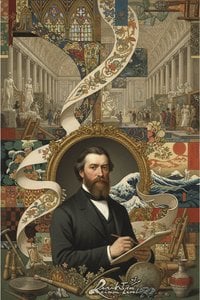
A Life Painted in Rome and London
Born amidst the warmth of Rome in 1822, Eduard Ender entered a world already steeped in the traditions of his father, Johann Ender. Growing up within the walls of an artistic household, he was immersed in the language of pigments and light from his earliest days. This early exposure allowed him to develop a hand that was both versatile and precise, capable of moving between the delicate touch of watercolor and the structured discipline of graphite on paper. His upbringing provided more than just technical instruction; it offered a direct lineage to the academic traditions of Europe.
As he matured, his path led him through the great centers of European art, eventually finding himself in London, where he passed away in 1883. His life was a movement between cities, much like the subjects he chose to depict. While his roots remained tied to the Austrian tradition, his spirit wandered through historical eras and literary landscapes, seeking to capture the drama of the past through a lens of Romantic Classicism.
The Drama of History and Legend
Ender possessed a particular fondness for scenes that breathed with the weight of history and the tension of literature. He did not merely paint figures; he reconstructed moments of profound significance. In his work, one might find Francis I within the studio of Cellini, or the quiet intensity of Shakespeare reading Macbeth before the court of Elizabeth. These were not simple portraits but staged dramas where every shadow and gesture contributed to a larger narrative of power and intellect.
His repertoire also extended into the realm of genre painting, capturing the intimacy of human interaction. Works such as A Game of Chess and La Corbeille de Mariage reveal an interest in the quiet, domestic complexities of life. Even when dealing with scientific figures, his approach remained deeply human. He once painted the German scientist Alexander von Humboldt alongside his companion Aimé Bonpland, though this particular endeavor met with a critique from Humboldt himself, who found the depiction of his scientific instruments to be lacking in technical accuracy.
Technique and Academic Discipline
The foundation of Ender's skill lay in the rigorous academic training that was the hallmark of his era. He mastered the ability to use light to define form, a skill evident even in his early studies. His graphite drawings, some executed on blue paper when he was but a young boy, show a grasp of proportion and depth that suggests a precocious talent. This discipline allowed him to navigate various mediums with ease, whether he was working on the fine details of a watercolor or the broader strokes of an oil painting.
His artistic output can be categorized by several distinct focuses:
- Historical Reconstructions: Bringing legendary figures and courtly scenes to life through meticulous detail.
- Genre Scenes: Exploring the social nuances of everyday life and domesticity.
- Portraiture: Capturing the likenesses of notable individuals, from royalty to naturalists.
- Academic Studies: Utilizing classical forms and sculptural references to refine his understanding of the human figure.
Spørgsmål og svar
Hvor kan man finde Eduard Enders kunstværker grupperet efter farvepalette?
Siden Efter farvepalet grupperer Eduard Enders kunstværker efter deres farvepaletter.
Hvilke kunstværker af Eduard Ender har flest visninger?
Der findes en Statistik-side for Eduard Ender, som præsenterer statistikker om kunstnerens værker på denne hjemmeside.
Kan jeg gennemse Eduard Enders værker efter stemning?
På kunstnerens Stemningsfulde rum side kan du finde Eduard Enders værker sorteret efter stemning.
Hvor kan jeg opleve Eduard Enders kunstværker i et 3D-galleri?
Besøg galleriet virtuelt: 3D-galleri-siden for Eduard Ender præsenterer kunstnerens værker i et tredimensionelt galleri.