The Shadow of a Name
In the quiet annals of the Dutch Golden Age, the name David de Hooch exists in a space defined more by suggestion than by certainty. Born in The Hague, he moved through a period of intense artistic production, though the specific contours of his life remain obscured by the fog of history. Scholars often find themselves tracing his lineage through the many painters who shared his surname, debating whether he was a son or perhaps a brother to the more celebrated figures of the era. He operated during a time when the distinction between family members and stylistic imitators was often blurred, leaving his personal biography to be reconstructed from the brushstrokes he left behind.
His presence in the art world is marked by a specific, focused intent. He did not wander through various genres but instead found his niche in the depiction of the Mediterranean spirit. His work suggests a mind preoccupied with the light and structure of the south, even while working in the northern climates of the Netherlands.
Italianate Landscapes
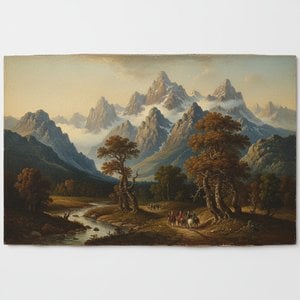
The subject matter of his canvases reveals a preference for the classical and the rugged. He specialized in Italianate landscapes, a style that sought to bring the warmth and dramatic topography of Italy to a Dutch audience. His compositions often featured the following elements:
- Southern mountain ranges set against expansive skies.
- Classical ruins partially reclaimed by nature.
- Figures such as travelers, shepherds, and peasants navigating rocky terrain.
- The presence of livestock and cattle amidst ancient stone.
- Grottoes and cascades that provided a sense of depth and mystery.
His technique focused on the interplay between the permanence of stone and the movement of life. In works like Landscape with Travellers in a Grotto, there is a sense of discovery, as if the viewer is stumbling upon a hidden corner of a vast, ancient world. He utilized light to define the textures of weathered rock and the soft forms of animals, creating a sense of space that felt both inhabited and remote.
A Fragmented Legacy
Because so little is known of his private life, his historical significance is measured by the survival of his imagery. His paintings have passed through the hands of major auction houses and into the collections of state galleries, serving as markers of a specific aesthetic movement. He remains a figure of interest for those studying the evolution of landscape painting, representing a bridge between the domestic Dutch tradition and the grander, more dramatic visions of the Mediterranean. His work survives as a collection of glimpses—fragments of a life and a style that continue to invite scrutiny from those seeking to place him within the wider family tree of Dutch art.
Spørgsmål og svar
Hvor kommer David de Hooch fra?
David de Hooch blev født i Netherlands.
Hvordan udviklede David de Hoochs kunst sig over tid?
Kronologi for David de Hooch er en rullevenlig tidslinje, der præsenterer kunstnerens værker i kronologisk rækkefølge, opdelt i kapitler efter karriereperioder.
Kan jeg gennemse David de Hoochs værker efter kunstretning?
De kunstretninger, som David de Hooch arbejdede inden for, kan findes på kunstnerens Alle kunstretninger-side, hvor værkerne er grupperet efter kunstretning.
Hvor mange kunstværker af David de Hooch er tilgængelige at gennemse?
Du kan gennemse 2 kunstværker værker af David de Hooch på siden Alle kunstværker.