A Life Shaped by Light and Shadow
Born in Kiev in 1858 to a merchant family, Konstantin Yakovlevich Kryzhitsky possessed an early inclination toward the pencil that even his mathematics teacher could not ignore. This talent found its first formal structure at the drawing school of Mykola Murashko, where the foundations of landscape observation were laid. In 1877, he moved to St. Petersburg to enter the Imperial Academy of Arts, placing himself under the tutelage of Mikhail Clodt. His time at the Academy was marked by both academic rigor and a certain youthful volatility. There is a recorded moment of intense devotion when, driven by a sudden passion for the works of Arkhip Kuindzhi, he chose to destroy years of his own preliminary sketches to pursue a more direct, observational method of painting.
His academic progression was marked by tangible success, earning him several silver medals and a small gold medal for his work The Oaks. By 1889, his reputation had reached the highest levels of Russian society when his painting Forest Vista was acquired by Tsar Alexander III, an event that led to his designation as an Academician. He was a man of significant professional standing, eventually serving as the first chairman of the Society of Artists named after A. I. Kuindzhi between 1909 and 1911.
The Art of the Natural World
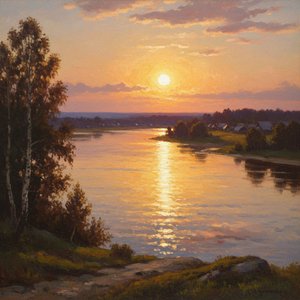
Kryzhitsky’s technical focus remained rooted in the traditions of Russian realistic landscape painting. He possessed a particular skill for capturing the subtle shifts in atmosphere, whether through the clarity of a frosty morning or the heavy stillness before a storm. His work often sought to translate the physical properties of light onto canvas, using oils and watercolors to render the textures of water, foliage, and ice.
His repertoire included a variety of seasonal and environmental studies:
- Forest Stream (1909): A study in depth and tranquility, focusing on the movement of water through dense woods.
- A Whiff of Spring (1910): A work that became central to a period of intense public scrutiny regarding his use of photographic references.
- Ice Cutting in a Warm Afternoon Light (1886): An early demonstration of his ability to balance light and shadow.
- Coastal Scene with Sailboat (1893): A broader view of maritime landscape.
A Final, Tragic Chapter
The later years of Kryzhitsky’s life were shadowed by a controversy that the press of the time handled with great severity. In 1910, accusations of plagiarism emerged when critics noted similarities between his work and that of Yakov Brovar, specifically regarding a tree in the Białowieża Forest. The debate centered on his use of photography as a tool for composition—a practice that, while common, was viewed by some contemporaries as a breach of artistic integrity. The weight of this public disgrace proved too heavy to bear.
In April 1911, the same year he presided over the Kuindzhi art society, Kryzhitsky ended his life in his office. He left behind a suicide note and a body of work that remains held in significant collections, such as the State Russian Museum and the State Tretyakov Gallery. His career stands as a complex portrait of an artist who navigated the tension between traditional academic training and the evolving photographic realities of the early twentieth century.