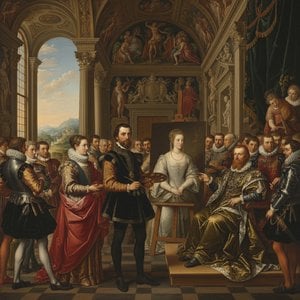
The Courtly Path of a German Painter
Augsburg, 1700. The son of silversmith Johann Heinrich Mannlich enters a world of precise craftsmanship. His early training begins under Johann Kupetzky in Vienna, where the foundations of his technique take shape. He moves through Hungary before the trajectory of his life shifts toward the centers of European power.
The year 1725 brings him to the court of Duke Eberhard Ludwig of Württemberg in Ludwigsburg. Here, he produces portraits that capture the likenesses of the nobility. His reputation expands as he moves toward Strasbourg, finding a protector in Cardinal de Rohan. This connection opens doors to the heart of French culture.
Paris becomes his reality between 1726 and 1732. The city provides a backdrop for his development during these years. He is no longer merely a student of the Viennese tradition but an artist navigating the sophisticated atmosphere of the French capital.
Service and Legacy
A new summons arrives in 1732 from Elector Christian III of Pfalz-Zweibrücken. The artist follows the court to Zweibrücken, settling into a role as a court painter. He remains a fixture of the ducal household, serving not only the Elector but also the widowed Princess Karoline and Christian IV of Pfalz-Zweibrücken.
His output is focused and specific. The works that remain are characterized by particular genres:
- Portraits of the ruling class
- Still lifes
- Hunting scenes
The lineage of his skill continues through his son, Johann Christian Mannlich. Born in Strasbourg in 1741, the younger Mannlich receives his training directly from Conrad, ensuring the continuation of this specific painterly tradition. Conrad dies in Zweibrücken on September 13, 1758, leaving behind a body of work held primarily in public collections.
Spørgsmål og svar
Hvor mange kunstværker af Conrad von Mannlich er tilgængelige at gennemse?
Du kan gennemse 4 kunstværker værker af Conrad von Mannlich på siden Alle kunstværker.
Hvordan kan jeg følge Conrad von Mannlichs værker kronologisk?
Se en tidslinje over Conrad von Mannlichs værker på siden Tidslinje for kunstværker, hvor kunstværkerne er sorteret efter dato.
Hvor kan man finde Conrad von Mannlichs værker grupperet efter teknik?
Se Conrad von Mannlichs værker opdelt efter medie på kunstnerens Alle medier side.
I hvilke kunstretninger arbejdede Conrad von Mannlich?
De kunstretninger, som Conrad von Mannlich arbejdede inden for, kan findes på kunstnerens Alle kunstretninger-side, hvor værkerne er grupperet efter kunstretning.