Carla Accardi (October 9, 1924 – February 23, 2014) stands as a monumental figure in the history of Italian art, particularly recognized for her contribution to Arte Informale and Arte Povera movements. Born in Trapani, Sicily, Accardi’s artistic journey began with formal training at Palermo and Florence academies before establishing herself in Rome in 1946—a pivotal moment that propelled her into the heart of Italy's avant-garde landscape. Her formative years were marked by exposure to Futurism, an influence that would permeate her early explorations of abstraction and materiality.
Early Artistic Development: Accardi’s initial self-portraits served as a crucial stepping stone toward her groundbreaking embrace of abstract expressionism. These introspective works foreshadowed the bold experimentation that characterized her subsequent artistic endeavors.
Influence of Surrealism & Expressionism: Accardi's artistic vision was profoundly shaped by the works of Alberto Magnelli and Hans Hartung during her Parisian sojourns, inspiring her to delve into black and white painting and experimenting with Sicofoil—a translucent plastic material that she utilized to create “tendas,” or tents of clear plastic adorned with painted forms.
The Rise of Monochrome & Color Exploration
During the 1960s, Accardi embarked on a significant stylistic shift, prioritizing monochromy and color palettes—a deliberate reaction to the dynamism of her contemporaries. Her black and white “Integrazione series” reflected a contemplative engagement with artistic tradition while simultaneously pushing boundaries. Simultaneously, she embraced vibrant hues like Stella and II Stella (Star I & II), capturing luminous energy and embodying the spirit of the era. Accardi’s use of Sicofoil was revolutionary; she described it as "like something luminous, a mixing and a fluidity with the surrounding environment: perhaps in order to take away the totemic value of the painting."
Sicofoil Sculpture: Accardi's innovative application of Sicofoil resulted in sculptural installations that challenged conventional notions of artistic form and materiality.
Feminist Engagement & Rivolta Femminile: Accardi’s commitment to feminist ideals extended beyond her art practice, culminating in the founding of Rivolta Femminile (Feminine Revolt) alongside Carla Lonzi—one of Italy's earliest feminist collectives and publishing houses.
Arte Povera & Legacy
Accardi’s artistic contributions cemented her place within Arte Povera, a movement that championed humble materials and processes as vehicles for conveying profound emotional resonance. Her work resonated deeply with critics like Michel Tapie who recognized the significance of Accardi's exploration of materiality and its connection to the environment. Accardi’s solo exhibition at MoMA PS1 in 2001 marked a triumphant return to the United States stage, showcasing her enduring influence on contemporary art. Carla Accardi remains an indelible symbol of Italian avant-garde artistry—a testament to creativity, innovation, and unwavering dedication to artistic expression.
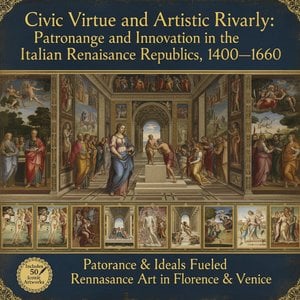
Explore the Italian Renaissance! Discover how competitive patronage & humanist ideals fueled artistic innovation in republics like Florence & Venice. Expert insights for art lovers and collectors.
Explore the captivating world of monochrome painting! Discover its rich history, from Renaissance chiaroscuro to contemporary minimalism. Uncover the emotional power and artistic techniques behind this enduring art form.
Findes der en kronologisk gennemgang af Carla Accardi?
Kronologi for Carla Accardi er en rullevenlig tidslinje, der præsenterer kunstnerens værker i kronologisk rækkefølge, opdelt i kapitler efter karriereperioder.
Hvor kommer Carla Accardi fra?
Carla Accardi blev født i Italy.
Kan jeg udforske Carla Accardis værker via nøgleord?
Udforsk Carla Accardis værker via nøgleord på kunstnerens Efter nøgleord-side, hvor hvert nøgleord samler de relaterede kunstværker.
Hvilke kunstværker af Carla Accardi har flest visninger?
Der findes en Statistik-side for Carla Accardi, som præsenterer statistikker om kunstnerens værker på denne hjemmeside.
Kan jeg gennemse Carla Accardis værker efter stemning?
Carla Accardis værker kan udforskes efter stemning på kunstnerens Stemningsfulde rum-side, hvor kunstværkerne er sorteret efter deres registrerede stemninger.
Hvilken by og hvilket land er Carla Accardi født i?
Carla Accardi blev født i Trapani, i Italy.
Findes der en virtuel 3D-tour af Carla Accardis værker?
Besøg galleriet virtuelt: 3D-galleri-siden for Carla Accardi præsenterer kunstnerens værker i et tredimensionelt galleri.
I hvilken historisk periode arbejdede Carla Accardi?
Carla Accardi var aktiv i Modern-perioden. Denne periode placerer kunstnerens virke i en historisk kontekst.
Hvordan finder jeg alle værker af Carla Accardi inden for et bestemt medie?
Siden Alle medier grupperer Carla Accardis værker efter teknik.