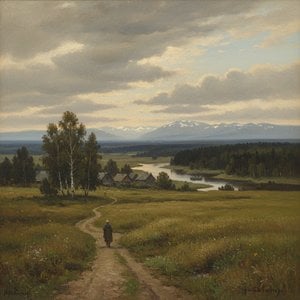
The Quiet Majesty of the Swedish Landscape
In the heart of the nineteenth century, a period defined by a profound connection to the natural world, Carl Ferdinand Hernlund emerged as a sensitive observer of the Swedish wilderness. Born on August 17, 1837, in the historic town of Eksjö, within the Småland region, Hernlund’s early life was steeped in the rugged beauty of the Scandinavian landscape. This environment, characterized by dense forests and tranquil vistas, would later become the primary protagonist in his artistic narrative. As a painter and illustrator, he possessed a rare ability to translate the silent, breathing essence of the North onto canvas, capturing not merely the topography of his homeland, but its very soul.
Hernlund’s journey as an artist was one of meticulous observation and a deep-seated reverence for light and texture. His work often invites the viewer to step into a moment of stillness, where the rustle of pine needles or the soft glow of twilight feels almost tangible. Through his mastery of landscape painting, he documented the shifting moods of the Swedish countryside, ranging from the intimate details of woodland scenes to broader, more sweeping vistas. One of his notable works, Among the Pines (1865), serves as a testament to his ability to weave light through dense foliage, creating an atmosphere that is both immersive and contemplative.
A Legacy Written in Light and Earth
The technical prowess of Hernlund lay in his delicate handling of the natural elements. He was not merely a recorder of scenery but a poet of the earth, utilizing a palette that reflected the organic tones of the Swedish terrain—deep mossy greens, somber browns, and the ethereal, cool blues of Nordic skies. His development as an artist saw him refining the art of illustration alongside his oil paintings, allowing him to explore both the grand scale of nature and the fine, intricate details of its smallest components. This duality gave his body of work a unique depth, making him a significant figure in the nineteenth-century Swedish art tradition.
Throughout his life, Hernlund’s presence was felt in the quiet corners of the Swedish provinces, eventually finding a peaceful end in Medevi, Östergötland, in 1902. While he may not have sought the global spotlight of the more avant-garde movements of his era, his contribution to the preservation of the Swedish landscape aesthetic remains invaluable. His paintings continue to resonate with collectors and art enthusiasts alike, offering a window into a vanished era of pastoral serenity. Today, his works are remembered for their:
- Atmospheric Depth: The ability to evoke specific times of day and seasonal shifts through subtle tonal variations.
- Naturalistic Precision: A commitment to representing the flora and terrain of Sweden with authentic, unadorned beauty.
- Emotional Resonance: A profound sense of nostalgia and peace that connects the modern viewer to the historical landscape.
Spørgsmål og svar
Hvor kommer Carl Ferdinand Hernlund fra?
Carl Ferdinand Hernlund blev født i Sweden.
Hvor kan jeg opleve Carl Ferdinand Hernlunds kunstværker i et 3D-galleri?
Carl Ferdinand Hernlunds værker kan opleves i et 3D-galleri på kunstnerens 3D-galleri-side.
Hvordan er Carl Ferdinand Hernlunds karriere opdelt i perioder?
En kronologisk gennemgang af Carl Ferdinand Hernlunds værker er tilgængelig på kunstnerens Kronologi-side, hvor værkerne præsenteres i rækkefølge efter deres skabelse, kapitel for kapitel.
Hvor kan man finde Carl Ferdinand Hernlunds kunstværker grupperet efter farvepalette?
Siden Efter farvepalet grupperer Carl Ferdinand Hernlunds kunstværker efter deres farvepaletter.