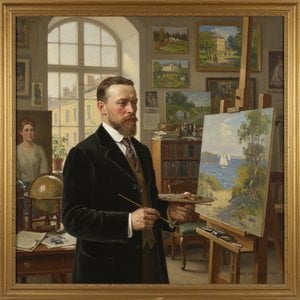
The Life and Career of Albert Kinert
Albert Kinert was a multifaceted Yugoslav artist whose career spanned several decades and multiple disciplines. Born in Vinkovci, Croatia, on April 6, 1919, he developed a practice that refused to settle into a single medium. He operated as a painter, graphic artist, illustrator, sculptor, and comic artist. This breadth of activity was not a sign of indecision but a deliberate engagement with the visual language of his time. He died in Zagreb, Croatia, on July 4, 1987, leaving behind a body of work that bridged the gap between commercial illustration and fine art.
His professional output was defined by a constant movement between the concrete and the abstract. As an illustrator, he contributed to various magazines and books, often working under the pseudonym Toma Božić when producing comics. This ability to navigate between the structured demands of graphic design and the expressive freedom of painting allowed him to maintain a presence in both the literary and fine art spheres. His work was not confined to the canvas; it extended into the realm of graphic maps and sculptural forms.
Kinert’s legacy is rooted in this versatility. He was a significant figure in the Yugoslav art scene, moving from the practicalities of illustration into the academic rigor of higher education. His career was a continuous negotiation between different modes of expression, ensuring his influence reached through both mass-produced media and museum collections. He remained active in the cultural life of Zagreb until his death, maintaining a presence that was as much about technical skill as it was about visual experimentation.
Early Life and Artistic Training
Kinert’s path was far from linear. After interrupting his schooling in 1934, he spent several years navigating the practical realities of life in Zagreb. From 1934 until 1939, he worked various jobs, a period of labor that preceded his formal entry into the fine arts. This interval of manual or commercial work provided a stark contrast to the academic rigor that would eventually define his professional identity.
His formal training began at the Academy of Fine Arts in Zagreb. He studied under T. Krizman, a period that shaped his technical foundation before he entered the professional sphere. He completed his studies and graduated from the Academy in 1946. This academic grounding provided the necessary discipline for a career that would eventually span painting, graphic arts, and sculpture.
Professional Career and Teaching
Kinert’s professional trajectory was defined by a relentless output across multiple disciplines. Following his studies, he entered the workforce in 1945, establishing himself through work as an illustrator and a freelance artist. This period was not merely a phase of experimentation but a sustained engagement with the visual demands of the era. His ability to navigate between the commercial necessity of illustration and the rigor of fine art established a foundation for his later academic influence.
His transition into formal pedagogy was direct and decisive. From 1954 to 1956, he held a teaching position at the School of Applied Arts in Zagreb. This practical experience in the classroom preceded a long-term commitment to higher education. By the early 1960s, he had ascended to the rank of assistant professor at the Academy of Fine Arts in Zagreb. His influence within the institution grew steadily over the following decades, culminating in his appointment as a full professor from 1974 until his retirement in 1984. During this tenure, he also founded the postgraduate study program for graphics in 1969, a move that solidified his impact on the technical standards of the medium.
Artistic Style and Technique
Kinert’s visual language is defined by a persistent tension between the recognizable and the non-representational. He achieved a specific synchronization between his chosen media and a dual expression that bridged the gap between concrete, figurative forms and abstract signs. This was not a simple transition from one mode to another, but a deliberate effort to maintain a balance between the two. His work avoids the trap of pure abstraction, instead using figurative elements to anchor his more experimental impulses.
In his later period, this equilibrium became even more pronounced. He refined the relationship between figurative and abstract pictorial signs, creating a sophisticated visual dialogue that remained grounded in structural clarity. This technical control allowed him to move fluidly between different modes of expression without losing the essential character of his subjects. His mastery of graphic form is particularly evident in his prolific output of graphic maps, which demonstrate a precise command of line and spatial organization.
- Bezimeni oblik (1961)
- Prokletnik u svom raju (1980)
- Apoteoza (1974)
- Pasija po Sizifu (1980)
- Povratak iz pakla (1981–82)
Artistic Groups and Collaborations
Kinert’s presence in the mid-century Yugoslav art scene was defined by his active participation in collective movements that challenged existing structures. He was part of the first exhibition of the Mart group in 1957, a move that signaled his engagement with the evolving contemporary landscape. This involvement was not merely peripheral; it was a core component of his professional identity. He later moved from participation to leadership by co-founding the Zagreb 58 group. Alongside figures such as Zlatko Prica, Edo Murtić, Nikola Reiser, Ivan Picelj, Vojin Bakić, Kosta Angeli Radovani, and Dušan Džamonja, he helped establish a distinct direction for the era's visual language.
Beyond the formal boundaries of fine art groups, Kinert maintained a prolific presence in the world of graphic narratives and book illustration. He operated under the pseudonym Toma Božić to produce a series of comics, including works like The Perished City and The Explorers of the West. This dual identity allowed him to navigate different cultural spheres, from high-concept graphic art to popular magazine publications. His collaborative reach extended into literature, where his illustrations provided the visual framework for several significant texts, such as Bakonja fra Brne and Priče iz davnina (Tales of Long Ago).
Major Awards and Recognition
Kinert’s technical precision in graphic arts earned him early international validation. In 1957, he received an Honorary Award from an international jury at the 2nd International Exhibition of Graphic Arts in Ljubljana. This recognition arrived during a period when his work was establishing a distinct presence in the regional art scene. His ability to navigate the complexities of printmaking and drawing was further confirmed in 1960 when he was granted the JAZU (Yugoslav Academy of Sciences and Arts) Cabinet of Graphics Award.
His versatility extended beyond the graphic medium into the realm of book illustration. In 1970, he was honored with the Grigor Vitez Award for Illustration, a distinction that acknowledged his significant contributions to the field of narrative visual art. This period of his career demonstrated a capacity to balance commercial illustration with high-level artistic intent. His later years saw continued critical attention, culminating in the Grand Prix at the 7th Slavonija Painting Biennale in 1979.
Notable Works and Museum Collections
Kinert’s output reflects a persistent tension between the concrete and the abstract. His 1948 oil on canvas, Omladinac, remains a significant marker of his early development. This work is held in the permanent collection of the Nacionalni muzej moderne umjetnosti. It represents a period where his figurative foundations were still being established before his later shifts toward more complex graphic and abstract forms.
The artist’s later years saw a continued focus on graphic maps and works that balanced figurative signs with abstract expression. His 1974 work Apoteoza and the 1980 piece Pasija po Sizifu demonstrate this established equilibrium. These works highlight his ability to navigate between different media and visual languages throughout his career. His presence in major collections and his involvement in the Zagreb 58 group ensure his technical contributions to Yugoslav graphic arts remain documented.
Spørgsmål og svar
Hvor mange kunstværker af Albert Kinert er tilgængelige at gennemse?
Du kan gennemse 1 kunstværker værker af Albert Kinert på siden Alle kunstværker.
I hvilken historisk periode arbejdede Albert Kinert?
Albert Kinert var aktiv i Modern-perioden. Denne periode placerer kunstnerens virke i en historisk kontekst.
Findes der en kronologisk gennemgang af Albert Kinert?
Kronologi for Albert Kinert er en rullevenlig tidslinje, der præsenterer kunstnerens værker i kronologisk rækkefølge, opdelt i kapitler efter karriereperioder.
Hvor kan man finde Albert Kinerts værker grupperet efter teknik?
Siden Alle medier grupperer Albert Kinerts værker efter teknik.