

Émile Munier: Capturing 19th-Century French Life with Tender Realism
Indholdsfortegnelse
Introduction: Émile Munier – A Painter of Intimate Moments
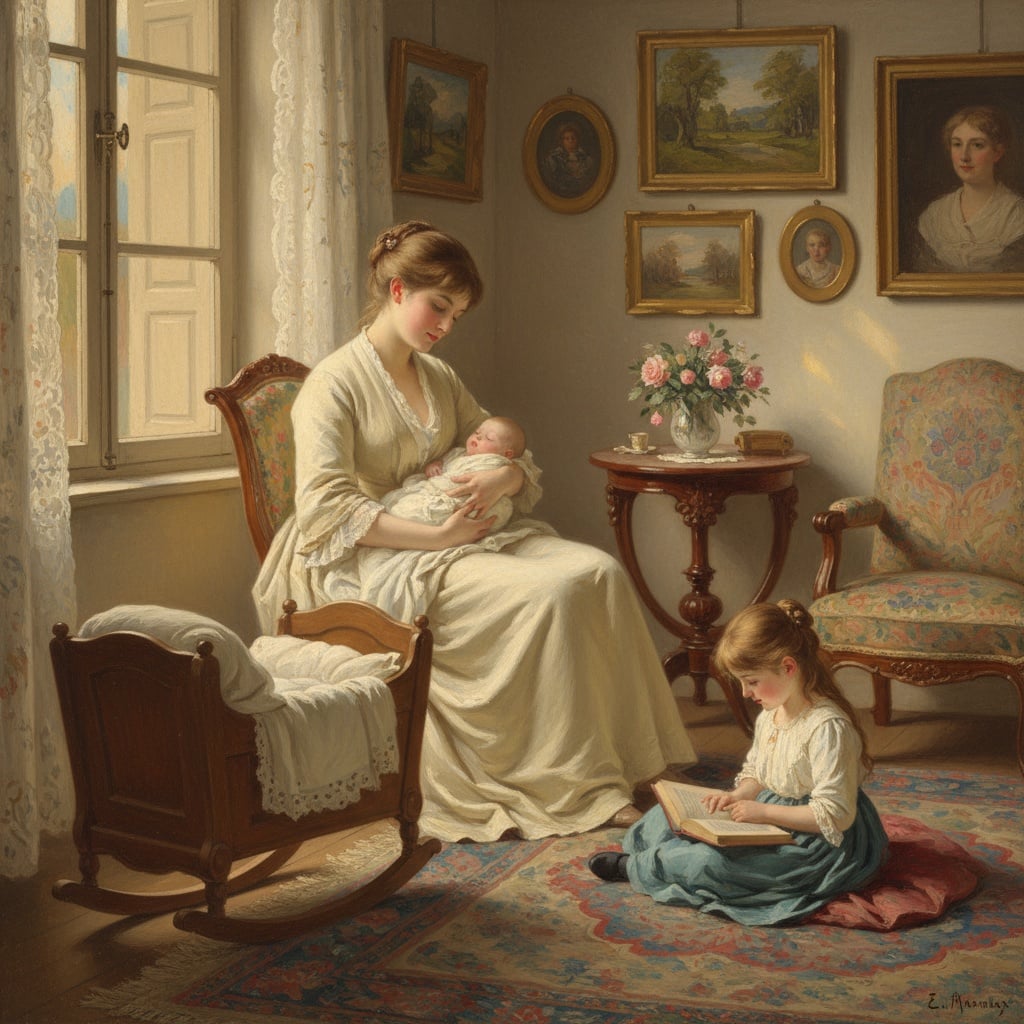
Émile Munier (1840-1895) occupies a unique and cherished space within the pantheon of 19th-century French painting. While not as widely celebrated as some of his contemporaries, Munier’s work resonates deeply with those who appreciate tender portrayals of domestic life, childhood innocence, and the quiet beauty found in everyday moments. He wasn't striving for grand historical narratives or revolutionary statements; instead, he meticulously crafted scenes that offered a glimpse into the warmth and sentimentality of middle-class French society. His canvases are imbued with a gentle realism, softened by a romantic sensibility inherited from his mentor, William-Adolphe Bouguereau, creating an aesthetic that continues to captivate audiences today.
The Rise of Realism: Contextualizing Munier’s Artistic World
Realism was an artistic movement that emerged in France in the 1840s. Realists rejected Romanticism, which had dominated French literature and art since the early 19th century. The artist Gustave Courbet, the original proponent of Realism, sought to ...
To understand Munier's artistic choices, one must first consider the broader context of 19th-century Realism. Emerging as a reaction against the idealized Romanticism that had dominated French art for decades, Realism sought to depict life as it truly was – unvarnished and often unflattering. Artists like Gustave Courbet rejected mythological or historical subjects in favor of contemporary scenes and ordinary people. However, Munier’s approach differed subtly from the more overtly critical strain of Realism championed by Courbet. While he embraced a truthful depiction of his subjects, he infused them with an undeniable warmth and optimism. He wasn't interested in exposing social ills so much as celebrating the virtues of family, education, and simple pleasures. This nuanced position places him within a softer branch of the movement, one that prioritized emotional resonance over stark social commentary.
Munier's Signature Style: Soft Brushwork and Romantic Charm
Munier’s technical skill is immediately apparent in his meticulous brushwork and masterful use of light. He possessed an exceptional ability to render textures – the delicate folds of a child’s dress, the soft fur of a kitten, the sheen on polished wood – with remarkable accuracy. Yet, it wasn't merely technical proficiency that defined his style; it was the way he employed these skills to create a sense of idyllic beauty. Influenced by Bouguereau, Munier favored smooth, blended brushstrokes and a harmonious color palette, often dominated by earthy tones and subtle gradations of light and shadow. This technique lends his paintings a dreamlike quality, softening edges and creating an atmosphere of tranquility. Works like “Best of Friends” exemplify this approach – the serene forest setting, detailed brushwork, and gentle lighting all contribute to a feeling of peaceful intimacy.
Children and Pets as Subjects: Exploring Themes of Innocence and Domesticity
 Childhood Friends
Emile Munier’s "Childhood Friends" captures idyllic innocence with soft realism & romantic charm. Explore this oil painting's details – style, technique & timeless appeal.
The recurring motifs in Munier’s oeuvre—children and pets—are not accidental. They served as vehicles for exploring universal themes of innocence, affection, and the joys of domestic life. His paintings often depict children engaged in everyday activities – reading lessons, playing with animals, or simply enjoying quiet moments of contemplation. These scenes weren't merely sentimental; they reflected a growing Victorian fascination with childhood as a period of purity and moral development. The inclusion of pets further enhanced this sense of warmth and companionship. A playful kitten or loyal dog served as symbols of loyalty, affection, and the simple pleasures that enriched family life. “Childhood Friends,” for instance, beautifully captures this idyllic innocence, portraying two young companions lost in their own world of play.
Beyond Sentimentality: Social Commentary in Munier’s Works
While often categorized as a sentimental painter, to dismiss Munier's work solely on these grounds would be a disservice. A closer examination reveals subtle layers of social commentary woven into his seemingly idyllic scenes. “The Reading Lesson,” for example, isn’t simply a charming depiction of education; it also reflects the growing emphasis on literacy and the importance of knowledge in 19th-century French society. The painting subtly promotes the value of learning and the opportunities it afforded to both boys and girls. Furthermore, his focus on middle-class domestic life offered a glimpse into the aspirations and values of a burgeoning social class. He captured a moment in time—a period of relative prosperity and stability—and immortalized it on canvas.
Legacy and Influence: Munier’s Place in 19th-Century Art History
Though he may not be a household name, Émile Munier left an indelible mark on the landscape of 19th-century art. His tender depictions of childhood and domestic life continue to resonate with audiences today, offering a poignant glimpse into a bygone era. While his style was heavily influenced by Bouguereau, Munier developed a unique voice characterized by its warmth, optimism, and meticulous attention to detail. He successfully captured the spirit of his time—a period of social change and artistic innovation—and created works that continue to evoke feelings of nostalgia, affection, and quiet beauty. At ArtsDot, we are proud to offer high-quality reproductions of Munier’s masterpieces, allowing art enthusiasts to experience the charm and sentimentality of his work firsthand. Explore our collection today and discover the enduring appeal of this remarkable French painter.
Relaterede artikler

The Enduring Legacy of Classicism: Harmony, Reason & Ideal Form in Western Art
Explore the enduring legacy of Classicism in Western art. Discover Renaissance & Neoclassical masterpieces, key artists, and build a timeless collection with ArtsDot's expert guidance.

Det 19. Århundredes Realismes Tidløse Appel: Samfundsspejl og Kunstnerisk Innovation
Dyk ned i realismens verden! Udforsk 1800-tallets kunstneriske revolution med Courbet, Millet og Daumier. Lær om samfundskritik, hverdagens skildringer og inspirationen til moderne kunst.

Det 19. Århundredes Mestre: Top 10 Kunstværker til Din Bolig
Oplev 19. århundredets kunst gennem 10 ikoniske mesterværker! Fra Monet og Manet til Courbet – udforsk romantik, impressionisme & realisme. Find museumskvalitets reproduktioner og inspiration til din bolig på ArtsDot.com

