
 Se i rummet
 Del som kort
 Del
Del
 Detaljer
 Guide
Guide

 Download
 Lignende værker
 Røntgenundersøgelse
 Diasshow
 Spørgsmål og svar
 Statistikker
Male nude studies

 Vis mere
Giclée / Kunsttryk
Giclée- eller lærredstryk i museumskvalitet med hurtig produktion og fleksible muligheder for finish. ( Køb håndmalet maleri Skift til digitalt billede)




P118B Dkr10

P118H Dkr10

P118W Dkr10

P438Z Dkr10

P508JH Dkr12

P508YH Dkr12

P805H Dkr10

P805Z Dkr10

P919BZ Dkr10

P919G Dkr10

P919XJ Dkr10

P959ZH Dkr10

P968JZ Dkr12

W106C Dkr8

W218G Dkr10

W218JH Dkr8

W218Y Dkr10

W307PJ Dkr10

W316G Dkr10

W316PJ Dkr8

W316Y Dkr10

W398PJ Dkr8

W4111J Dkr10

W500HY Dkr15

W500JH Dkr15

W692G Dkr12

W849H Dkr8

W940BG Dkr15

W953PJ Dkr8




Vælg mellem vores forudindstillede størrelser, der matcher kunstværkets originale proportioner.

Indtast den bredde og højde, du har brug for, så det passer til din ramme eller din væg. Et print kan kun beskæres, aldrig gøres større end selve billedet, så en størrelse med et andet format vil medføre, at dele af motivet går tabt. Vi sender dig en digital mockup til godkendelse, før vi printer noget. Billedet vist på denne side viser ikke den faktiske beskæring — det er kun mockuppen, der gør.
Verdensomspændende levering () på 2 uger i stedet for de sædvanlige 4/5 uger. (5 november)

Gratis ekspresforsendelse til hele verden

Lærred af linned i høj kvalitet

Fuld transportforsikring

Garanti for refusion af told og importafgifter

Garanti for præcis farvegengivelse

100 dages returret ved fabrikationsfejl

100% fuld returret

Mængderabat ved flere køb
 Glasmulighed er kun tilgængelig i størrelser under 110 cm

Male nude studies
Giclée / Kunsttryk
Størrelse på reproduktion
-


Samlet pris
Dkr 421
A Window into Blake’s Anatomical Exploration
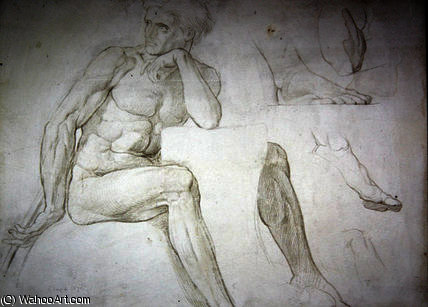
William Blake's "Male Nude Studies" stand as a testament to the Romantic artist’s unwavering dedication to observation and artistic experimentation. Captured in charcoal on paper, this series of drawings represents more than just depictions of the human form; they embody Blake’s profound engagement with anatomy, spirituality, and the very essence of creative impulse. The photograph itself conveys an immediacy—a glimpse into a working process rather than a polished final product—reflecting Blake's belief that true artistic insight emerges from spontaneous exploration.The Anatomy of Vision
Blake’s meticulous anatomical studies are rooted in his conviction that understanding the human body was crucial to unlocking spiritual truths. Unlike many artists of his era who prioritized idealized beauty, Blake approached the nude figure with a scientist’s curiosity alongside an artist's sensitivity. The drawings showcase remarkable accuracy, capturing subtle musculature and bone structure—a feat achieved through painstaking sketching and shading techniques. Each pose is carefully considered, inviting viewers to contemplate not only physical form but also the underlying principles of existence.Technique: Charcoal – A Language of Line
The technique employed in these studies exemplifies Blake’s mastery of charcoal drawing. The artist utilized hatching and cross-hatching with remarkable precision, layering tones to build up volume and create a palpable sense of depth. Energetic lines define the contours of the body, conveying movement and dynamism—a characteristic that distinguishes Blake's work from more static representations. Variations in line thickness contribute to the overall textural quality of the drawings, mirroring the artist’s desire to capture both form and feeling. The paper surface itself bears witness to this process, retaining subtle marks that speak to the immediacy of Blake’s creative vision.Historical Context: Romantic Reverie
Created during the height of the Romantic movement—a period characterized by an intense fascination with emotion, imagination, and individualism—Blake's "Male Nude Studies" resonate deeply within the broader artistic landscape of his time. The Romantic preoccupation with exploring the sublime—the awe-inspiring grandeur of nature and the mysteries of consciousness—finds expression in Blake’s unflinching portrayal of human anatomy. These drawings stand apart from prevailing academic conventions, prioritizing expressive gesture and tonal nuance over formal perfection. They represent a bold assertion of artistic freedom and a celebration of the artist's ability to perceive beauty beyond conventional standards.Symbolic Resonance: Beyond Representation
While ostensibly depicting nude figures, Blake’s studies transcend mere anatomical representation. The poses themselves are imbued with symbolic significance—suggesting contemplation, vulnerability, and an openness to spiritual revelation. Blake’s drawings invite viewers to consider the human body as a microcosm of the universe, mirroring the Romantic belief in interconnectedness between humanity and nature. They represent not just physical form but also psychological depth and moral aspiration—elements that elevate these studies beyond simple visual observation into profound meditations on the human condition.Spørgsmål og svar
Har "Male nude studies" stærke lys-mørke kontraster?
Lys-mørke-kontrasten i "Male nude studies" er registreret som Bold. Kontrast beskriver, hvor kraftigt lyse og mørke områder adskiller sig fra hinanden.
Hvor kan jeg købe en håndmalet reproduktion af "Male nude studies" af William Blake?
"Male nude studies" er tilgængelig som en håndmalet oliereproduktion på lærred af hør. Du kan bestille den på dens Håndmalet reproduktion-side, hvor du kan vælge mellem forskellige størrelser.
Er en højtopløselig download af "Male nude studies" tilgængelig?
"Male nude studies" er tilgængelig som et højopløseligt digitalt billeddownload og kan købes direkte på dens Digitalt billede-side.
Lignende kunstværker


Kunstnerbiografi
William Blake (1757–1827): En Visionärs Färd
William Blake, född i London den 28 november 1757, var en figur som förblött steg över sin tid, ändå bestående av att bli en av romantikens mest hyllade konstnärer och poeter. Hans liv utspelades mot bakgrunden av ett snabbt förändrande England – en värld kämpandes med industrialisering, politisk uppror och skiftande religiösa övertygelser. Från enkla början som son till en hosier var hans tidiga år präglade av en intensivt livlig fantasi och en benägenhet för visionära erfarenheter som skulle djupgående påverka hans konstnärliga bana. Även om han i stort sett självlärt inom formella akademiker fick han teckningsinstruktion i ung ålder och avslöjade snabbt ett talent som antydde den extraordinära vägen framför honom. Hans lärlingskap med graverare James Basire var avgörande, vilket gav honom inte bara teknisk maestri utan också en förståelse för trycktekniker han senare revolutionerade. Dessa tidiga influenser – Westminster Abbey:s gotiska prakt och Rafael och Michelangelos klassiska former – tjänade som grundläggande element i hans utvecklande estetik, även om Blake aldrig var någon att hålla sig bunden av konvention.Teknik och Innovation: Illuminerad Tryckning
Blakes konstnärliga innovation låg inte bara i ämnet utan fundamentalt i *hur* han skapade. Missnöjd med konventionella graveringstekniker utvecklade han en unik metod kallad ”illuminerad tryckning”. Detta innebar att både text och illustration etsades på kopparplattor och sedan färglades plattorna för hand – ett arbetsamt men djupt personligt tillvägagångssätt som gjorde det möjligt för honom att uppnå fullständig konstnärlig kontroll. Detta var inte bara illustration som följde poesi utan en integrerad konstform där bild och vers var oskiljaktigt sammanlänkade, varje förstärkande betydelsen av den andra. Hans reliefetsningsteknik född från ett påstått visionärt möte efter sin brors död skiljde ytterligare hans verk åt och gav det en distinkt textil kvalitet samt större konstnärlig frihet än traditionella metoder. Detta var inte bara ett sätt att skapa bilder utan också ett sätt att förmedla komplexa idéer och känslor genom ett medium som kombinerade visuellt och litterärt uttryck. Han var pionjär inom tryckteknik och utvecklade en teknik som skiljde sig från andra konstnärer av sin tid, vilket gjorde hans verk till något verkligen speciellt. Detta var särskilt viktigt eftersom det möjliggjorde honom att skapa bilder som inte bara berättade historier utan också väckte känslor och uppmanade till reflektion.Första Inspirationskällorna: Gotik och Klassicism
Blakes konstnärliga utveckling påverkades starkt av de estetiska ideal som rådde i hans tid. Han studerade intensivt verk från stora mästare som Michelangelo och Raphael, vilket gav honom en grundläggande förståelse för klassisk komposition och användning av ljus och skugga. Dessa influenser märktes särskilt i hans tidiga målningar och illustrationer där han försökte återskapa den majestätiska atmosfären hos Westminster Abbey och återuppliva klassisk elegans. Detta var inte bara ett estetiskt val utan också ett sätt att väcka uppmärksamheten kring viktiga frågor om konstnärlig stil och teknik. Han ville skapa bilder som skulle vara både vackra och betydelsefulla, vilket återspeglade hans egen världsbild och hans förståelse för människans plats i universum. Dessa första influenser gav honom verktyg för att skapa konst som var både tekniskt avancerad och känslomässigt engagerande – något som skulle komma att präga hela hans konstnärliga karriär.Songs of Innocence & Experience: En Kontrastfull Vision
Blakes första stora verk, *Songs of Innocence & Experience* (1794), är ett exempel på denna kontrastfyllda vision. Samlingen presenterar två världsbilder som är diametralt motsatta – en värld av oskuld och renhet där barnen lever i harmoni med naturen och gudomligheten, och en värld av erfarenhet och korruption där människan förtrodda av sina impulser och begär efter makt förlorar kontakten med sin egen moral. Dessa dikter är skrivna med ett språk som är både enkelt och poetiskt och använder symboliska bilder för att förmedla komplexa idéer om rättvisa, kärlek och ansvar. Detta var inte bara berättelser utan också en utforskning av människans psykologi och religiösa övertygelse – något som skulle komma att påverka många senare konstnärer och författare. Blakes användning av språk och bildspråk är innovativ och känslomässigt laddad, vilket gör hans verk till ett mästerverk inom romantisk poesi. Han ville skapa dikter som skulle väcka uppmärksamheten och stimulera tanken – något som han lyckades med på ett sätt som var ovanligt för sin tid. Detta är särskilt tydligt i användningen av allegoriska figurer och berättelser där Blakes mål var att förmedla viktiga moraliska och filosofiska budskap till sina läsare.Eftermäle: Ett Förnyande Av Konstnärlig Stil
William Blake var en konstnär som skiljde sig från sina samtida på många sätt. Han vägrade följa konventionella estetiska regler och utvecklade en egen stil som präglades av fantasi, symbolik och ett starkt engagemang för religiösa och filosofiska idéer. Detta är något som skulle komma att inspirera senare konstnärer och författare och skapa ett verk som fortsätter att vara relevant än idag. Hans konstverk är inte bara tekniskt imponerande utan också känslomässigt djupgående och erbjuder en unik perspektiv på människans plats i världen. Han var en pionjär inom konstnärlig stil och utvecklade ett sätt att skapa bilder som skiljde sig från andra konstnärer av sin tid – något som skulle komma att påverka hela den romantiska rörelsen och skapa ett verk som fortsätter att inspirera oss än idag. Detta är särskilt tydligt i användningen av komplexa symboler och berättelser där Blakes mål var att förmedla viktiga moraliska och filosofiska budskap till sina läsare och skapa konstverk som skulle vara både vackra och betydelsefulla.
William Blake
1757 - 1827 , Storbritannien
Kort om kunstneren
- Artistic Movement Or Style: Romantikken
- Artists Who Influenced This Artist:
- Rafael
- Michelangelo
- Date Of Birth: 1757
- Date Of Death: 1827
- Full Name: William Blake
- Nationality: Britisk
- Notable Artworks:
- Sange om Uskyld og Erfaring
- Ægteskab mellem Himmel og Helvede
- Tyggen
- Jerusalem
- Place Of Birth: London, UK
Relaterede artikler

The Enduring Allure of the Nude: A Historical & Artistic Exploration of the Human Form
Explore the captivating history of nude art! Discover iconic paintings & artists from classical to modern eras. Uncover symbolism, techniques & find museum-quality reproductions at ArtsDot.

Sir William Blake Richmond: A Visionary of Aestheticism & Symbolism
Explore the life & art of Sir William Blake Richmond, a pivotal figure bridging Pre-Raphaelitism and Aestheticism. Discover his stunning portraits, mosaics at St Paul's Cathedral, and lasting influence on Victorian art.

Romantic Realism's Finest: 10 Masterpieces for Your Home | ArtsDot
Explore 10 defining masterpieces of Romantic Realism! Discover Courbet, Millet & Daumier's powerful paintings—capturing emotion and social realities. Find museum-quality reproductions for your home at ArtsDot.com.

John Varley I: Intimate Observation & the British Romantic Landscape
Explore the serene landscapes of John Varley I, a key figure in British Romanticism. Discover his unique watercolour style, collaboration with William Blake & lasting artistic legacy. Learn about collecting Varley's work.

William Blake: Romantic Visionary & Mystical Genius of the Imagination
Explore the mystical art & poetic genius of William Blake (1757-1827). Discover his revolutionary illuminated printing, rich symbolism, and lasting influence on Romanticism. Find handmade reproductions at ArtsDot.


