


 Se i rummet
 Send
Send Del
Del
 Detaljer
 Studieguide til kunstværker

 Download
 Lignende værker
 Røntgenundersøgelse
 Se diasshow
 Statistik
Crowing Cock
 Realism
 26.0 x 18.0 cm
 Læs mere
Kunstværket vist på denne side er beskyttet af ophavsretsloven, hvilket betyder, at vi ikke lovligt kan skabe eller sælge en identisk reproduktion. Denne beskyttelse håndhæves i henhold til internationale aftaler som f.eks. den Bernerkonventionen og af nationale love, herunder de bestemmelser, der er fastlagt i Amerikansk ophavsretslov - Titel 17.
Denne metode overholder fuldt ud ophavsretsreglerne, da den ikke indebærer kopiering eller duplikering af det beskyttede kunstværk. I stedet er der tale om en kreativ nytolkning – et nyt maleri, som er inspireret af det oprindelige, men ikke identisk med det.
Giclée / Kunsttryk
Giclée- eller lærredstryk i museumskvalitet med hurtig produktion og fleksible muligheder for finish. ( Bestil håndmalet reproduktion Skift til digitalt billede)




P118B Dkr10

P118H Dkr10

P118W Dkr10

P438Z Dkr10

P508JH Dkr12

P508YH Dkr12

P805H Dkr10

P805Z Dkr10

P919BZ Dkr10

P919G Dkr10

P919XJ Dkr10

P959ZH Dkr10

P968JZ Dkr12

W106C Dkr8

W218G Dkr10

W218JH Dkr8

W218Y Dkr10

W307PJ Dkr10

W316G Dkr10

W316PJ Dkr8

W316Y Dkr10

W398PJ Dkr8

W4111J Dkr10

W500HY Dkr15

W500JH Dkr15

W692G Dkr12

W849H Dkr8

W940BG Dkr15

W953PJ Dkr8




Vælg mellem vores forudindstillede størrelser, der matcher kunstværkets originale proportioner.

Indtast den bredde og højde, du har brug for, så det passer til din ramme eller din væg. Et print kan kun beskæres, aldrig gøres større end billedet, så en størrelse med en anden form vil miste en del af motivet. Vi sender dig en digital mockup til godkendelse, før vi printer noget. Billedet vist på denne side viser ikke den faktiske beskæring — det er kun mockuppen, der gør.
Verdensomspændende levering () på 2 uger i stedet for de sædvanlige 4/5 uger. (23 oktober)

Gratis ekspresforsendelse til hele verden

Lærred af linned i høj kvalitet

Komplet transportforsikring

Garanti for refusion af told og importafgifter

Garanti for autentisk farvegengivelse

100 dages returret ved fabrikationsfejl

100% fuld returret

Mængderabat ved flere køb
 Glasmulighed er kun tilgængelig i størrelser under 110 cm

Crowing Cock
Giclée / Kunsttryk
Reproduktionsstørrelse
-


Samlet pris
Dkr 414
Lignende kunstværker


Om kunstneren
Sir Robin Philipson: A Visionary of Scottish Colour and Dramatic Intensity
Born Robert James Philipson in Broughton-in-Furness, Lancashire, in 1916, Sir Robin Philipson’s artistic journey led him from the industrial landscapes of his childhood to become one of Scotland's most distinctive and enduring figures in 20th-century art. His career, spanning over seven decades, was marked by a restless exploration of subject matter – from intimate domestic scenes and evocative portraits to monumental depictions of cockfights and the grandeur of cathedral interiors – all rendered with a bold palette, dynamic brushwork, and a distinctive impasto technique that imbued his canvases with palpable energy.
Philipson’s early artistic education began at Dumfries Academy before he enrolled at Edinburgh College of Art in 1936. This formative period exposed him to the influences of the Edinburgh School, a group of Scottish artists who sought to capture the spirit and character of their homeland through vibrant colour and expressive brushwork. Key figures within this movement included William Gillies and John Maxwell, whose work profoundly shaped Philipson’s approach to composition, colour theory, and the depiction of landscape.
The Rise of a Distinctive Style
Following World War II, during which he served with the King's Own Scottish Borderers in Burma, Philipson returned to Edinburgh and began to develop his own unique artistic voice. He initially focused on landscapes and still lifes, but it was his fascination with cockfights – a deeply ingrained part of Scottish culture – that truly propelled him to international recognition. Beginning in the early 1950s, he created a series of powerful paintings depicting these brutal yet captivating spectacles, capturing not just the physical action but also the raw emotion and underlying drama of the event. These works were characterized by their intense colours, dynamic compositions, and a willingness to confront uncomfortable truths about human behaviour.
Beyond cockfights, Philipson’s artistic interests expanded to encompass a wide range of subjects, including portraits, religious scenes (particularly crucifixions), and architectural interiors – notably the magnificent cathedral at Amiens in France. His depictions of these spaces were not merely observational; they sought to convey a sense of awe and spiritual intensity through the manipulation of light, colour, and perspective. The influence of Impressionist masters like Monet is evident in his treatment of light and atmosphere, particularly in his studies of cathedrals.
Technique and Innovation
Philipson’s artistic technique was as distinctive as his subject matter. He employed a liberal use of impasto – applying paint thickly to the canvas – creating a textured surface that seemed to vibrate with energy. His colour palette was bold and often unconventional, utilizing vibrant hues alongside darker tones to create dramatic contrasts and heighten emotional impact. He frequently worked in oil on canvas, but also experimented with other media, including watercolour and gouache. He was known for his willingness to break from traditional artistic conventions, embracing a more expressive and gestural approach to painting.
Recognition and Legacy
Throughout his career, Philipson received numerous accolades recognizing his contributions to Scottish art. He was elected to the Royal Scottish Academy in 1962, President of the Royal Scottish Academy from 1973 to 1983, and a Fellow of the Royal Society of Edinburgh in 1978. He also held positions on various committees and commissions, including the British Council’s Scottish Advisory Committee. His work has been exhibited extensively throughout Scotland and internationally, and is now housed in major public collections across the UK and beyond. Sir Robin Philipson died in Edinburgh in 1992, leaving behind a rich and influential body of work that continues to captivate viewers with its dramatic intensity, vibrant colours, and profound insights into the human condition.
Key Works
- Crowing Cock (1954) – A seminal example of his cockfight series, capturing the frenetic energy and primal drama of the event.
- Cathedral (1960) – An evocative depiction of Amiens Cathedral, showcasing Philipson’s masterful use of light and colour to convey a sense of grandeur and spiritual awe.
- A Family Dispute (1948) - A powerful expressionist painting capturing raw emotion and drama.
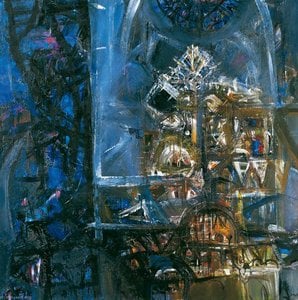
Sir Robin Philipson
1916 - 1992
Hurtige fakta
- Full Name: Robin James Philipson
- Nationality: Scottish
- Date Of Birth: 1916
- Date Of Death: 1992
- Place Of Birth: Broughton-in-Furness, UK
- Notable Artworks:
- Cathedral
- Crowing Cock
- A Family Dispute
- Artistic Movement Or Style: Expressionism, Scottish School
- Artists Who Influenced This Artist:
- Oskar Kokoschka
- Gillies
- Maxwell
- Artists Or Movements Influenced By This Artist:
- Monet
- Kokoschka
Relaterede artikler

Dante Gabriel Rossettis 25 Mesterværker: Skønhed, Symbolik & Kunst til Dit Hjem
Oplev Dante Gabriel Rossettis 25 mest ikoniske værker! Fordyb dig i romantikkens symbolik og prærafaelitternes skønhed. Find museumskvalitets kunsttryk & inspiration til dit hjem på ArtsDot.com.

Beyond Imitation: The Cultural Resonance of Fine Art Reproduction & Discerning Collectors
Explore the cultural significance of fine art reproduction & its appeal to discerning collectors. Discover how reproductions enhance aesthetics, build collections, and signal status. Expert insights & museum-quality artistry.

Sir Alfred James Munnings' Top 25 Værker: En Hyldest til Heste og Engelsk Landskab | ArtsDot.dk
Oplev Sir Alfred James Munnings' 25 mest ikoniske værker – fra betagende hestemalerier til engelske landskaber. Lær om kunstnerens historie, teknik og stil. Find luksus reproduktioner & inspiration til dit hjem på ArtsDot.com
Beyond Imitation: The Strategic Role of Fine Art Reproductions in Contemporary Gallery Practices
Explore the strategic role of fine art reproductions in today's galleries. Discover how they cultivate collectors, enhance education & expand access to art. Expert insights for discerning buyers and professionals.

Sir Joshua Reynolds' Mesterværker: 25 Ikoniske Portrætter & Historiemalerier | ArtsDot.dk
Oplev Sir Joshua Reynolds' 25 mest ikoniske værker – fra elegante portrætter til storslåede historiemalerier. Lær om rokokostilen, engelsk malerkunst og find inspiration til din indretning med ArtsDot.dk. Udforsk samlingen online!