


 Se i fuld skala
 Del
Del Del
Del
 Detaljer

 Download
 Lignende værker
 Røntgenundersøgelse
 Diasshow
 Statistik
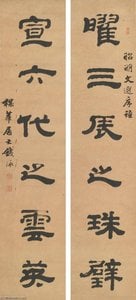
CALLIGRAPHY IN RUNNING SCRIPT
 Traditional Chinese Art
 173.0 x 41.0 cm
 Se mere
Håndlavet oliereproduktion
Håndmalet olie på lærred i din valgte størrelse og ramme, udført efter bestilling af vores kunstnere. ( Skift til print Skift til digitalt billede)




































Vælg mellem vores forudindstillede størrelser, der matcher kunstværkets originale proportioner.

Du kan indtaste dine egne mål for at passe til en bestemt ramme eller plads. Hvis den valgte størrelse ikke stemmer overens med det originale billedes proportioner, vil vi enten beskære kunstværket eller udvide maleriet med yderligere håndmalede elementer. En digital skitse sendes til din godkendelse, før produktionen påbegyndes.
Bemærk venligst, at forhåndsvisningen på skærmen ikke afspejler den faktiske beskæring eller udvidelse. Kun skitsen vil nøjagtigt vise den endelige komposition.
Selvom specialmål er mulige, anbefaler vi at vælge en dimension fra den foruddefinerede liste for at bevare de originale proportioner.
Efter bestilling vil ArtsDot.com team sende en e-mail til kunden for at få instruktioner og levere et udkast til en skitse.
Levering i hele verden () på 3/4 uger i stedet for de standard 5 uger. (18 september). Ingen kompromiser med kvaliteten.

Gratis ekspresforsendelse til hele verden

Lærred af linned i høj kvalitet

Fuld transportforsikring

Garanti for refusion af told og importafgifter

Garanti for præcis farvegengivelse

100 dages returret (kun ved fejl og mangler)

100% Tilfredshedsgaranti

Mængderabat tilgængelig
 Glasmulighed er kun tilgængelig i størrelser under 110 cm

CALLIGRAPHY IN RUNNING SCRIPT
Reproduktionsmetode
Størrelse på reproduktion
-


Samlet pris
$ 263
Lignende kunstværker




Kunstnerens biografi
The Calligraphic Soul of a Reformer
In the turbulent twilight of the Qing Dynasty, few figures loomed as large or as complexly as Kang Youwei. To view his calligraphy is to witness more than mere ink on paper; it is to encounter the rhythmic pulse of a man caught between the ancient weight of Confucian tradition and the surging tides of Western modernity. Born in 1858 in the village of Su, within Guangdong province, Kang was a scholar whose intellect was forged in the rigorous fires of classical study but tempered by a visionary's desire to reshape a nation. His life was a profound struggle to reconcile the eternal ethics of the past with the urgent political necessities of a changing world, a tension that found its most graceful expression in the fluid, decisive strokes of his brushwork.
The intellectual foundation of Kang’s artistry was deeply rooted in the Confucian classics, yet he possessed an uncommon ability to reinterpret these ancient texts through a lens of progress. While many of his contemporaries clung to a reactionary preservation of tradition, Kang sought a way to revitalize the very essence of Chinese identity. This philosophical duality—the reverence for heritage and the hunger for reform—is palpable in his artistic output. His work often reflects a sense of intellectual rigor paired with an artistic sensitivity, where the structural discipline of formal scripts meets the spontaneous energy of more liberated styles. In his hands, calligraphy became a medium through which the stability of the old world and the dynamism of the new could coexist.
A Legacy Written in Ink and Action
The historical significance of Kang Youwei cannot be decoupled from his political audacity. As a primary architect of the Hundred Days’ Reform in 1898, he attempted to steer the Guangxu Emperor toward a constitutional monarchy, seeking to modernize education, strengthen the military, and overhaul the bureaucracy. This period of intense creativity and political maneuvering was marked by a high-stakes drama that eventually led to his exile following the coup by Empress Dowager Cixi. Yet, even in displacement, Kang’s influence remained undiminished. He continued to advocate for a reformed China, influencing generations of thinkers, including the prominent scholar Liang Qichao, who found inspiration in Kang's revolutionary reinterpretations of classical thought.
His artistic achievements serve as a serene counterpoint to his often violent political reality. The works that survive him, such as his Calligraphy in Running Script and various poetic scrolls, offer a window into a more meditative aspect of his character. In these pieces, one can observe:
- The Mastery of Line: A meticulous command of brushwork that balances formal structure with the organic flow of ink.
- Symbolic Resonance: The use of traditional characters to convey complex political and philosophical ideologies.
- Rhythmic Balance: A sense of movement within his scrolls that mirrors the ebb and flow of historical change.
Ultimately, Kang Youwei remains a monumental figure whose legacy is etched into both the political history of China and the aesthetic heritage of East Asian calligraphy. He was a man who lived through the collapse of an empire, yet through his art, he achieved a form of immortality, capturing the spirit of an era in every stroke of black ink upon white paper.

kang youwei
1858 - 1927
Kort om kunstneren
- Artistic Movement Or Style: Calligraphy
- Date Of Birth: 1858
- Date Of Death: 1927
- Full Name: Kang Youwei
- Nationality: Chinese
- Notable Artworks:
- Poems on Swiss Excursions
- CALLIGRAPHY IN RUNNING SCRIPT
- A Thought on Wire Fences
- Place Of Birth: Guangdong Province, China
Relaterede artikler

Ephemeral Lines: Exploring Emotional Resonance in Ink Sketching Traditions
Explore the profound art of ink sketching! Discover techniques to express emotion, master line work, and cultivate artistic sensitivity. Learn from historical masters & unlock your creative potential.

Xie Zhiliu: A Legacy of Ink Wash Painting & Modern Chinese Literati Tradition
Explore the legacy of Xie Zhiliu, a master of Chinese ink wash painting & prominent figure in modern art. Discover his techniques, influences, and contributions to literati tradition. A guide for discerning collectors.

Timeless Elegance: Discovering the Soulful Beauty of Chinese Calligraphy for Sophisticated Home Interiors
Elevate your home with the serene beauty of Chinese calligraphy art. Explore our collection of hand-painted ink wash reproductions and bespoke commissions at ArtsDot.com. Discover museum-quality pieces designed to bring cultural elegance and tranquility to your modern interior.

Ephemeral Expressions: Exploring the Nuances of Ink on Paper Through History & Contemporary Art
Explore the captivating world of ink wash painting – from its ancient origins to contemporary masters. Discover techniques, symbolism & conservation insights with ArtsDot.com.

Sort i Kunsten: Top 10 Berømte Malerier & Deres Mystik | ArtsDot.dk
Oplev 10 berømte malerier domineret af sort – fra Rembrandts drama til Goyas mystik. Lær historierne bag disse ikoniske kunstværker og find inspiration til dit hjem. Køb museumskvalitets reproduktioner på ArtsDot.com