
Baroque
St. Peter (Jusepe de Ribera)
St. Peter is a work by Jusepe de Ribera (1591–1652). It belongs to the Baroque movement. It is made in Oil On Canvas. It is kept at Museo del Prado in Madrid, Spanien.
- Oil On Canvas
- Museo del Prado, Madrid

 Se i rummet

 Print
 Del som kort
 Del
 Guide


 Download
 Lignende værker
 Røntgenundersøgelse
 Diasshow
 Spørgsmål og svar

 Statistikker
St. Peter in a nutshell
- Title
- St. Peter
- Artist
- Jusepe de Ribera (1591–1652)
- Artist born in
- Xàtiva, Spanien
- Medium
- Oil On Canvas
- Where to see it
- Museo del Prado, Madrid, Spanien
- Movement
- Baroque
- Period
- Early Modern
- Subject
- man, beard, book, keys, cloak, brown
What's going on in St. Peter
The Portrait of St. Peter by Jusepe de Ribera
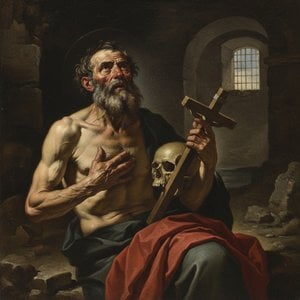
In this oil painting on canvas, Jusepe de Ribera presents us with a portrait of St. Peter. The subject, a central figure among the apostles of Jesus and recognized as the first Pope, is rendered with a profound sense of presence. Ribera focuses on the man himself, capturing the weight of his role and the character of his lived experience. There is a quiet intensity in the way the figure is presented, inviting a closer look at the weathered details of his countenance.
The work is a significant example of the Baroque style. Through this approach, the artist emphasizes the spiritual and human dimensions of the apostle. The depiction avoids idealization, opting instead for a directness that feels immediate. By focusing on the specific attributes of the saint, Ribera allows the subject to command the space, presenting a figure that is both a religious icon and a man of flesh and bone.
Composition and Visual Elements of the Portrait
The composition is built upon a stable pyramidal structure, with the head of St. Peter forming the apex of the form. He is presented from the waist up, his body turned slightly toward the viewer's left. In his right hand, he holds a book and a set of keys, objects that anchor the figure within the frame. This arrangement directs the eye upward toward his weathered features, creating a sense of quiet, grounded presence.
A strong light source enters from the left, illuminating his face and upper body while casting the rest of the figure into deep shadow. This light creates a sharp contrast against a background that is nearly black, pushing the subject forward into the viewer's space. The color palette is restrained, dominated by warm earth tones—ochre, brown, and gold—which emphasize the textures of his skin and the heavy folds of his clothing.
Technique and Artistic Style of the Work
The work is defined by a profound use of tenebrism, where the subject emerges from a nearly black background into a sharp, focused light. This dramatic chiaroscuro creates a sense of volume, pulling the figure forward and emphasizing the physical presence of the man. Such a heavy interplay of light and shadow reflects the influence of Caravaggio, grounding the religious subject in a palpable, earthly reality. The light source, positioned to the left, carves out the contours of the face and the weathered texture of the skin, casting deep shadows that heighten the emotional weight of the portrait.
Ribera’s approach to the medium is tactile and deliberate. He employs a technique of layering paint to build up depth, allowing the viewer to sense the physical weight of the drapery and the coarse nature of the beard. Visible brushstrokes are not hidden; instead, they contribute to the overall effect, lending a sense of immediacy to the rendering of the fabric and the aged features. Strong, defined lines delineate the eyes, nose, and mouth, providing a structural clarity that balances the more fluid, organic shapes of the figure. The result is a composition that feels both intensely personal and physically substantial.
Other Works by Jusepe de Ribera
The artist's exploration of this particular subject matter is reflected in several other significant pieces within our collection and major institutions. We hold St. Simeon 1 in our catalog, a work that speaks to the same profound human experience found in this portrait. Another notable piece in our collection is The Repentance of Saint Peter, which is currently housed in the Museum of Fine Arts, Lyon.
Beyond our own holdings, Ribera's preoccupation with the themes of remorse and spiritual weight is evident in other historical examples. The work known as Penitent St. Peter, dated about 1630, is held at the Kunsthistorisches Museum in Vienna. This piece shares a similar intensity in its depiction of the apostle's character. Additionally, The Tears of Saint Peter, which dates to 1612, is part of the collection at the Metropolitan Museum of Art in New York. These works collectively illustrate the artist's ability to capture the complexities of faith and the physical reality of the human condition through his characteristic use of light and shadow.
Where you can see St. Peter for real
Museo del Prado
Madrid, Spanien
Historien om Museo del Prado Rødderne til Museo del Prado er uløseligt knyttet til den spanske kongefamilies samlinger og strækker sig helt tilbage til det 18. århundrede. Det, der begyndte som en vision om et naturhistorisk kabinet under Ferdinand VII, udviklede sig gradvist til et dedikeret fristed for malerkunst og skulptur.


St. Peter, up close
A digital expert checks the colors against the original painting and retouches the file, faithful to the artist's brushwork.
Get the high-res imageThings people wonder about St. Peter
Hvor lys er "St. Peter" overordnet set?
Den oplevede lysstyrke i "St. Peter" af Jusepe de Ribera er deep_shadow. Den kan tilpasses lyset i det tiltænkte rum.
Kan man downloade "St. Peter"?
"St. Peter" af Jusepe de Ribera kan downloades fra værkets Download-side som et højopløseligt digitalt billeddownload.
Hvilken periode i Jusepe de Riberas karriere tilhører "St. Peter"?
Inden for Jusepe de Riberas karriere tilhører "St. Peter" perioden Mature Period, hvilket gør det muligt at sammenligne værket med kunstnerens øvrige værker.
Hvad er formatet på "St. Peter"?
"St. Peter" af Jusepe de Ribera er en Portrait komposition. Det er værd at tjekke proportionerne, før du vælger en printstørrelse.
Kan jeg undersøge "St. Peter" mere detaljeret?
"St. Peter" kan undersøges lag for lag på værkets Røntgenoptagelse-side, en interaktiv viewer inspireret af en konservators lysbænk med elleve optiske lag af billedet.
Hvilken kunstner tilskrives "St. Peter"?
"St. Peter" blev skabt af Jusepe de Ribera. Informationen på denne side beskriver Jusepe de Riberas originale værk.
Hvilket rum komplementerer farverne i "St. Peter" af Jusepe de Ribera?
Med sin Dark farvepalette anbefales "St. Peter" af Jusepe de Ribera til et Restaurant. Farverne er en del af årsagen til denne anbefaling.
Hvilken atmosfære ville en reproduktion af "St. Peter" af Jusepe de Ribera tilføre et rum?
Med sin Dramatic stemning foreslås "St. Peter" til et Restaurant.
Hvor harmoniske er farverne i "St. Peter" af Jusepe de Ribera?
"St. Peter" af Jusepe de Ribera fremviser en Strong Color Unity farveharmoni.
Meet Jusepe de Ribera

1591–1652, Spanien
Jusepe de Ribera
Jusepe de Ribera: En Skyggefuld Mester af Det Barokke Jusepe de Ribera, kendt som Lo Spagnoletto – “den spanske” – var en dominerende figur i det barokke æra, en kunstner hvis lærredsværk pulserede med dramatisk intensitet og uforfalsket realisme. Født i Xàtiva, Spanien, i 1591, blev hans rejse langt fra hans valencianske rødder og etablerede ham som en af de mest betydningsfulde malere i det 17. århundredes Napoli, en by under spansk styre. Riberas liv var ikke blot en kronik over kunstnerisk udvikling; det var en fortælling vævet med vanskeligheder, ambitioner og en urokkelig forpligtelse til at portrættere den menneskelige tilstand i al dens rå kompleksitet.
Complete collection Get to know Jusepe de Ribera The Jusepe de Ribera works everyone loves
More by Jusepe de Ribera you might love
 Magdalena Ventura med sin mand og søn1631
 The Clubfoot
 St. Onuphrius1637
 The Duel of Women (The Duel of Isabella de Carazzi and Diambra de Pettinella)1636
More to read about St. Peter
 The Geometry of Presence: Mastering Composition and Stance in Classical PortraitureMaster the secrets of classical portraiture through geometry and light. Explore the techniques of the Old Masters today.
 Jusepe de Ribera: Dramatic Realism & Spiritual Intensity in the Spanish Golden AgeExplore the powerful Baroque paintings of Jusepe de Ribera, master of tenebrism and dramatic realism. Discover his spiritual intensity, inf…
 25 Masterpieces by Francisco de Zurbarán: The King of Spanish Baroque TenebrismImmerse yourself in the dramatic world of Francisco de Zurbarán. Explore 25 iconic Spanish Baroque masterpieces defined by intense tenebris…