

 Se i fuld skala
 Del
Del Del
Del
 Detaljer

 Download
 Lignende værker
 Røntgenundersøgelse
 Diasshow
Ave Maria


 Se mere
Håndlavet oliereproduktion
Håndmalet olie på lærred i din valgte størrelse og ramme, udført efter bestilling af vores kunstnere. ( Køb print Køb billede)




P118B $10

P118H $10

P118W $10

P438Z $10

P508JH $12

P508YH $12

P805H $10

P805Z $10

P919BZ $10

P919G $10

P919XJ $10

P959ZH $10

P968JZ $12

W106C $8

W218G $10

W218JH $8

W218Y $10

W307PJ $10

W316G $10

W316PJ $8

W316Y $10

W398PJ $8

W4111J $10

W500HY $15

W500JH $15

W692G $12

W849H $8

W940BG $15

W953PJ $8




Vælg mellem vores forudindstillede størrelser, der matcher kunstværkets originale proportioner.

Du kan indtaste dine egne mål for at passe til en bestemt ramme eller plads. Hvis den valgte størrelse ikke stemmer overens med det originale billedes proportioner, vil vi enten beskære kunstværket eller udvide maleriet med yderligere håndmalede elementer. En digital skitse sendes til din godkendelse, før produktionen påbegyndes.
Bemærk venligst, at forhåndsvisningen på skærmen ikke afspejler den faktiske beskæring eller udvidelse. Kun skitsen vil nøjagtigt vise den endelige komposition.
Selvom specialmål er mulige, anbefaler vi at vælge en dimension fra den foruddefinerede liste for at bevare de originale proportioner.
Efter bestilling vil ArtsDot.com team sende en e-mail til kunden for at få instruktioner og levere et udkast til en skitse.
Levering i hele verden () på 3/4 uger i stedet for de standard 5 uger. (16 august). Ingen kompromiser med kvaliteten.

Gratis ekspresforsendelse til hele verden

Lærred af linned i høj kvalitet

Fuld transportforsikring

Garanti for refusion af told og importafgifter

Garanti for præcis farvegengivelse

60 dages returret (kun ved fabrikationsfejl)

100% Tilfredshedsgaranti

Mængderabat tilgængelig
 Glasmulighed er kun tilgængelig i størrelser under 110 cm

Ave Maria
Reproduktionsmetode
Størrelse på reproduktion
-


Samlet pris
$ 263
Beskrivelse af kunstværket
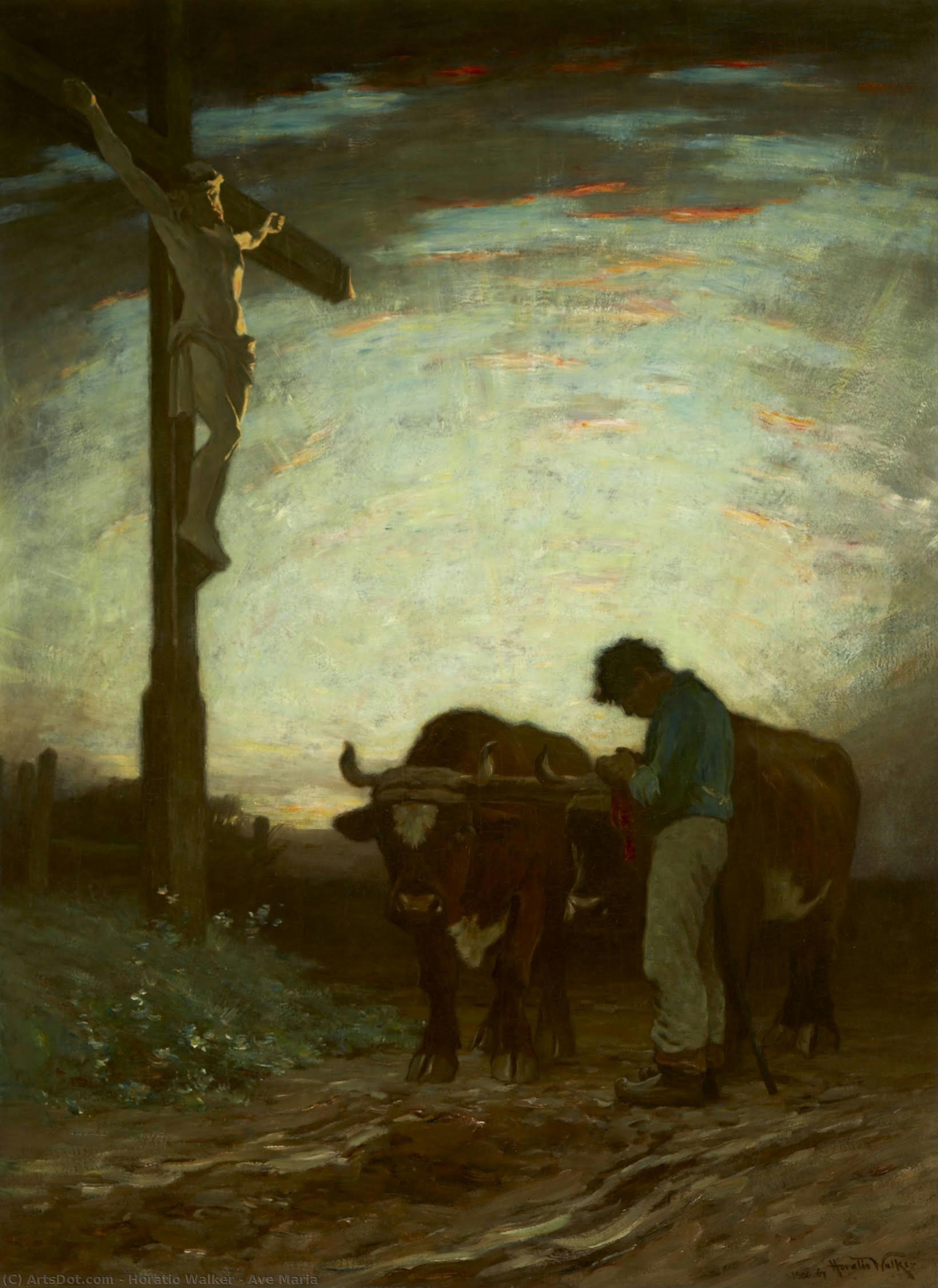
Horatio Walkers "Ave Maria": Et Symbolet af Tro og Natur
Horatio Walker var en dansk maler født i 1858, hvis kunstværker ofte prægede den danske landskabskunst omkring århundredeskiftet. Hans arbejde blev karakteriseret ved en dyb respekt for både klassiske principper og Barbizon-skolen – en fransk kunststil, der fokuserede på ærlige observationer af naturen og udførte med oliefarver på lærred. Denne stil var særlig præget af et ønske om at indfange essensen af det danske landskab og dets åndelige atmosfære. Walker fandt inspiration i Île d’Orléans, hvor han ofte malede idylliske scener af livet ved søen – en kontrast til den industrielle udvikling, der var begyndt at ændre Danmark på denne tid.- Tema og Symbolik: ”Ave Maria” udtrykker dyb religiøs følelse og henviser direkte til kristendommens centrale ritual. Walkers brug af lys og farve er særlig bemærkelsesværdig, hvor han forsøgte at efterligne Barbizon-skolens teknikker for at skabe en autentisk atmosfære. Kristusfigur og korset symboliserer håb og retfærdighed – temaer, der var centrale i dansk kunst og kultur omkring århundredeskiftet.
- Teknik og Stil: Walker anvendte oliefarver på lærred med præcision og finesse, hvilket gav hans værker en imponerende dybde og tekstur. Han efterlignede Barbizon-skolens metode om at male direkte fra naturen, hvilket krævede stor observationsevne og teknisk kunnen. Hans brug af perspektiv og komposition var særlig effektiv til at skabe følelsen af rum og atmosfære – elementer, der var vigtige for dansk kunsthistorie.
- Historisk Kontext: Maleriet blev udført i 1906, et år præget af både kulturel stabilitet og økonomisk vækst. Det repræsenterer en periode hvor dansk kunst var i højeste blomstring og hvor religiøse temaer fortsat havde stor betydning for offentligheden. ”Ave Maria” er derfor ikke blot et smukt kunstværk, men også et vidnesbyrd om dansk kultur og åndelighed omkring århundredeskiftet.
- Emotionel Effekt: Walkers mål var at vække følelser hos betragteren – både æstetiske og religiøse. Han ønskede at skabe en atmosfære af ro og refleksion, hvor publikum kunne engagere sig i kunstværket på et dybt niveau. Hans brug af lys og farve er særlig effektiv til at udtrykke følelser som håb og kærlighed – temaer, der var centrale for dansk kunst og kultur omkring århundredeskiftet.
Lignende kunstværker


Kunstnerens biografi
Early Life and Artistic Foundations
Horatio Walker, born in Listowel, Upper Canada, in 1858, emerged from a modest background where the seeds of artistic inclination were nonetheless carefully nurtured. His parents, Thomas and Jeanne Maurice Walker, instilled a value for education and creative expression that would profoundly shape his life’s path. Though his father pursued various trades – cabinetmaking, timber trading, and even dabbling in sculpture – he consistently encouraged young Horatio's burgeoning talent for drawing. Early trips with his father to the Quebec City region introduced him to Île d’Orléans, a landscape that would become inextricably linked with his artistic identity. This initial exposure sparked a lifelong fascination with rural life and the picturesque beauty of the Canadian countryside. In 1873, Walker moved to Toronto, beginning an apprenticeship at the renowned Notman & Fraser photographic studio. This formative experience proved invaluable, providing him not only with technical skills in composition and lighting but also exposing him to a vibrant artistic milieu. It was here he studied under Robert Ford Gagen and John Arthur Fraser, honing his abilities in watercolour and miniature portraiture.European Influences and the Shaping of a Style
Driven by an ambition to refine his skills and broaden his artistic horizons, Walker embarked on a journey to Europe in 1876. He immersed himself in the art world of France, studying the works of both the Barbizon painters and the emerging Impressionists. The Barbizon school’s emphasis on realism, their dedication to depicting rural scenes with honesty and sensitivity, resonated deeply with Walker's own artistic sensibilities. Simultaneously, he absorbed elements of Impressionist technique, particularly their innovative use of light and color, which began to subtly infuse his work. This period was crucial in solidifying his aesthetic direction, blending a commitment to realistic representation with an increasingly nuanced understanding of atmospheric effects. Upon returning to North America, Walker actively sought connection within the artistic community, joining organizations like the American Watercolor Society, fostering opportunities for exhibition and collaboration. His marriage to Jeanette Pretty in 1883 marked a period of personal stability, allowing him to further dedicate himself to his craft.Mature Period: Capturing the Essence of Rural Canada
The years following 1883 witnessed the full flowering of Walker’s distinctive style. He developed a remarkable ability to capture the beauty and tranquility of the Canadian landscape, particularly the agrarian scenes of Quebec. His paintings are characterized by meticulous attention to detail, a soft and harmonious color palette, and a profound sense of atmosphere. The influence of his early photographic training is evident in the carefully composed arrangements and sharp focus found in many of his works. However, it was his deep connection to Île d’Orléans that truly defined his artistic vision. He purchased a home there in 1888, establishing a permanent base from which to observe and document the rhythms of rural life. Walker's paintings weren’t merely depictions of scenery; they were celebrations of a way of life – the hard work, the quiet dignity, and the enduring connection between people and the land. His success grew steadily, with exhibitions throughout North America and Europe garnering critical acclaim and numerous awards. A significant milestone arrived in 1913 when he was elected a full member of the Royal Canadian Academy, solidifying his position as one of Canada’s leading artists.Legacy and Historical Significance
In 1928, Horatio Walker retired to Sainte-Pétronille, Quebec, but even in retirement, he continued to paint occasionally, remaining an active participant in the art community until his death in 1938. Though his fame waned somewhat after his passing, particularly during the shifts in artistic taste that followed the Quiet Revolution in Quebec, a renewed appreciation for his work emerged in recent decades. Walker is now recognized as a pivotal figure in Canadian art history – a master of landscape painting who captured the essence of rural Canada with unparalleled sensitivity and skill. He bridged the gap between European traditions like the Barbizon school and a uniquely Canadian artistic vision. His paintings offer not only beautiful depictions of the natural world but also valuable insights into the social and cultural life of French-Canadian communities in the late 19th and early 20th centuries. Oxen Drinking and Ploughing – The First Gleam, remain iconic representations of his artistic achievement, testaments to a talent that continues to resonate with audiences today. He is remembered as “the herald of Île d’Orléans,” an artist who dedicated his life to celebrating the beauty and dignity of rural Canada.
Horatio Walker
1858 - 1938 , Canada
Kort om kunstneren
- Artistic Movement Or Style: Barbizon School, Realism
- Artists Or Movements Influenced By This Artist: Canadian landscape painting
- Artists Who Influenced This Artist:
- Barbizon painters
- Jean-François Millet
- Gainsborough
- Constable
- Date Of Birth: May 12, 1858
- Date Of Death: September 27, 1938
- Full Name: Horatio Walker
- Nationality: Canadian
- Notable Artworks:
- Sheepyard, Moonlight
- Ave Maria
- Oxen Drinking
- Ploughing—The First Gleam
- Place Of Birth: Listowel, Canada
Relaterede artikler

George Agnew Reid: A Canadian Impressionist's Pursuit of Light, Colour, and National Identity
Explore the life & work of George Agnew Reid, a pivotal figure in Canadian Impressionism. Discover his genre paintings, mural commissions, and lasting influence on art education & national identity. A comprehensive guide for collectors & enthusiasts.

The Barbizon School: Pioneering Realism & the Pastoral Vision in 19th-Century French Painting
Explore the Barbizon School's pivotal role in 19th-century French painting. Discover how these artists revolutionized landscape art with their commitment to Realism and a profound connection to nature. Learn about key figures like Rousseau, Millet & Corot.

Arthur Lismer: A Pioneer of Canadian Modernism & the Group of Seven's Visionary Spirit
Explore the life & art of Arthur Lismer, a pivotal figure in Canadian Modernism and founding member of the Group of Seven. Discover his landscapes, teaching legacy & lasting influence on Canadian art history.

Echoes of Rural Life: Art's Enduring Representations of the Countryside
Explore the rich history of rural life in art! Discover masterpieces from Millet to Mauve & beyond. Learn about Realism, Barbizon School & find inspiration for your home with ArtsDot.

The Hague School: Realism, Atmosphere & the Dawn of Dutch Impressionism
Explore the Hague School's pivotal role in Dutch art history. Discover realism, atmospheric landscapes & its influence on Impressionism. Learn about key artists like Mauve & Maris with ArtsDot.


