

 Se i rummet
 Send
Send Del
Del
 Detaljer
 Studieguide til kunstværker

 Download
 Lignende værker
 Røntgenundersøgelse
 Se diasshow
 Statistik
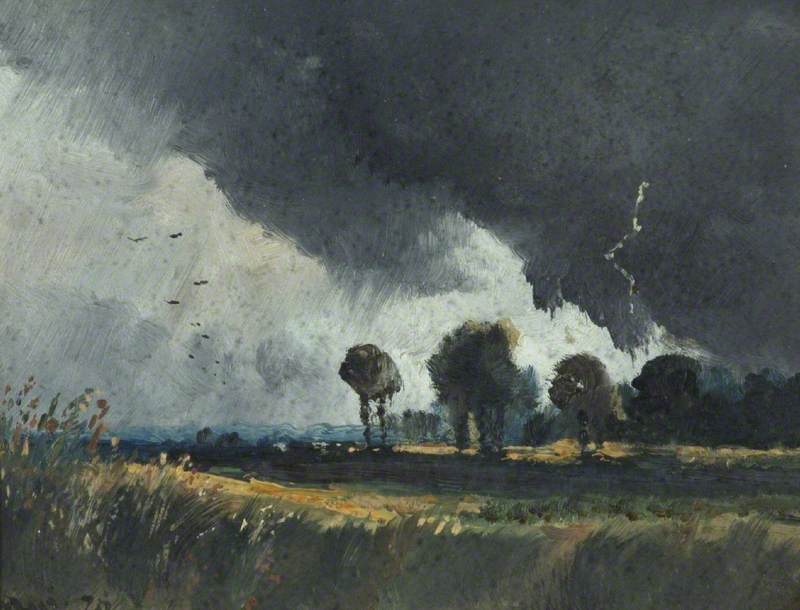
Stormy Landscape
 Romanticism
 1878
1878 18.0 x 22.0 cm
 Victoria Art Gallery
 Læs mere
Håndlavet oliereproduktion
Håndmalet olie på lærred i din valgte størrelse og ramme, udført efter bestilling af vores kunstnere. ( Skift til printversion Skift til digitalt billede)




































Vælg mellem vores forudindstillede størrelser, der matcher kunstværkets originale proportioner.

Indtast den bredde og højde, du har brug for, så det passer til din ramme eller din væg. Da dette er håndmalet, kan kunstneren ved en anden form på størrelsen male lidt mere rundt om billedet eller skære lidt væk — det er op til dig. Vi sender dig et digitalt mockup til godkendelse, før maleriet påbegyndes. Billedet, der vises på denne side, viser ikke det endelige resultat — det er kun mockuppet, der gør.
Efter bestilling vil ArtsDot.com team sende en e-mail til kunden for at indhente instruktioner og fremsende et udkast til gennemgang.
Levering i hele verden () på 3-4 uger i stedet for de standard 5 uger. (22 oktober). Ingen kompromiser med kvaliteten.

Gratis ekspresforsendelse til hele verden

Lærred af linned i høj kvalitet

Komplet transportforsikring

Garanti for refusion af told og importafgifter

Garanti for autentisk farvegengivelse

100 dages returret ved fabrikationsfejl

100% fuld returret

Mængderabat ved flere køb
 Glasmulighed er kun tilgængelig i størrelser under 110 cm

Stormy Landscape
Reproduktionsmateriale
Reproduktionsstørrelse
-


Samlet pris
Dkr 1724
Lignende kunstværker


Om kunstneren
A Romantic Vision of Coastal England
George Hornblower Simms, a British landscape painter born in 1818, remains a poignant voice from the Victorian era, capturing the sublime and often turbulent beauty of the English coastline. His artistic journey was deeply rooted in the burgeoning Romantic movement, a period defined by an intense fascination with the power of nature and the emotional resonance of the landscape. Through his meticulous observations, Simms did more than merely document scenery; he translated the fleeting atmospheric conditions of the British Isles into enduring, emotive compositions that speak to the soul of the viewer.
The foundations of Simms’ technique were laid in Newcastle upon Tyne, where his early training under the prominent Romantic painter William Henry Haydon provided him with a sophisticated understanding of tonal painting. From Haydon, he inherited an appreciation for the expressive potential of color and the ability to use subtle gradations to create depth and drama. This formative period instilled in him a lifelong pursuit of capturing light—whether it be the golden, tranquil glow of a seaside hamlet or the brooding, heavy shadows of an approaching tempest.
Mastery of Light and Atmosphere
As his career progressed, Simms moved from the industrial heart of Newcastle to the coastal serenity of Brighton in 1853, a transition that profoundly influenced his subject matter. His oeuvre, consisting of approximately 200 paintings, serves as a testament to his devotion to seascapes and rural landscapes. He became a master of the Luminist style, utilizing light not just as an illumination, but as a central protagonist in his narratives. In works such as “Beach with Village,” one can witness his ability to bathe a tranquil scene in a warmth that evokes a sense of peace and nostalgia.
Conversely, Simms was equally adept at portraying the more violent aspects of nature. His “Stormy Landscape” stands as a powerful example of his ability to convey turbulent energy through expressive brushwork and dramatic, silhouetted forms against heavy, churning skies. In these pieces, the boundaries between realism and impressionism begin to blur, as he uses impasto textures and vigorous strokes to mimic the raw power of wind and water. This duality—the ability to pivot from the serene to the catastrophic—is what defines his unique artistic identity.
Legacy and Artistic Significance
Throughout his life, Simms achieved significant recognition within the prestigious art circles of his time, exhibiting extensively at the Royal Academy and the Tate Gallery. His work resonated with a Victorian public that was increasingly captivated by the dramatic interplay between man and the natural world. By blending the precision of traditional landscape painting with the emotional depth of Romanticism, he carved out a niche that remains highly regarded by collectors of nineteenth-century British art.
The historical significance of George Hornblower Simms lies in his role as a chronicler of an era's aesthetic sensibilities. His paintings, such as “River with Windmill, Stormy Sky,” offer more than just visual beauty; they provide a window into the Victorian fascination with the sublime. Through his mastery of tonal gradations and atmospheric perspective, Simms ensured that the fleeting moments of the English coast—the shifting clouds, the rising tides, and the play of light upon the waves—would be preserved in a state of eternal, evocative grace.

George Hornblower Simms
1818 - 1889
Hurtige fakta
- Full Name: George Hornblower Simms
- Nationality: British
- Date Of Birth: 1818
- Date Of Death: 1889
- Place Of Birth: London, England
- Notable Artworks:
- Beach with Village
- Stormy Landscape
- Artistic Movement Or Style: Romantic/Luminist
- Artists Who Influenced This Artist: ['Turner']
- Artists Or Movements Influenced By This Artist: ['Hudson River School']
Relaterede artikler

Romantikkens Landskaber: Top 10 Malerier der Definerede En Æra | ArtsDot
Oplev romantikkens storhedstid! Dyk ned i top 10 landskabsmalerier af Caspar David Friedrich, Turner & Constable. Historiske fortællinger og museumskvalitets reproduktioner på ArtsDot.com – find din inspiration til væggen her!

Georges Braques Mesterværker: Top 25 Kunstværker til Din Bolig
Oplev Georges Braques 25 mest ikoniske kunstværker! Dyk ned i kubismens verden, fra stilleben til analyse af form og farve. Find inspiration & køb eksklusive reproduktioner på ArtsDot.com – museumskvalitet til dit hjem.

The Sublime and the Picturesque: Exploring Emotion & Nature in Romantic Landscape Painting
Explore the emotional power of Romantic landscape painting! Discover the sublime & picturesque traditions, key artists like Friedrich & Cole, and find your perfect artwork at ArtsDot.

Evocations of Place: A Historical Journey Through Landscape Art
Explore the rich history of landscape art with ArtsDot. Discover renowned artists, movements like Impressionism & Romanticism, and expert guidance for collecting timeless pieces. Find your perfect serene escape today!

Georges Seurat: Top 25 Kunstværker – Impressionisme & Pointillism til Dit Hjem
Oplev Georges Seurats 25 mest ikoniske værker! Fordyb dig i impressionismens og pointillismens verden. Find inspiration til din boligindretning med museumskvalitets kunsttryk på ArtsDot.com. Udforsk samlingen online.