
- Hjem

- Tryk på lærred
- david alison
- Self Portrait

 Bestil maleri Køb højopløseligt billede
 Del
Del
 Del
Del
 Detaljer
 Tilføj til favoritter

 Download
 Lignende værker
 Røntgenundersøgelse
 Diasshow
Self Portrait
 Contemporary Realism
 62.0 x 51.0 cm
 Se mere
Giclée / Kunsttryk
Giclée- eller lærredstryk i museumskvalitet med hurtig produktion og fleksible muligheder for finish.




































Vælg mellem vores forudindstillede størrelser, der matcher kunstværkets originale proportioner.

Du kan indtaste dine egne mål for at passe til en specifik ramme eller et bestemt område. Hvis den valgte størrelse ikke stemmer overens med det originale billedes proportioner, vil vi enten beskære kunstværket eller udvide billedet med en spejlet eller ensfarvet kant. En digital mockup vil blive sendt til din godkendelse, før produktionen påbegyndes.
Bemærk venligst, at forhåndsvisningen på skærmen ikke afspejler den faktiske beskæring eller udvidelse. Kun mockuppen vil nøjagtigt vise den endelige komposition.
Selvom specialmål er tilgængelige, anbefaler vi at vælge et mål fra den foruddefinerede liste for at bevare de originale proportioner.
Verdensomspændende levering () på 2 uger i stedet for de sædvanlige 4/5 uger. (16 juli)

Gratis ekspresforsendelse til hele verden

Lærred af linned i høj kvalitet

Fuld transportforsikring

Garanti for refusion af told og importafgifter

Garanti for præcis farvegengivelse

60 dages returret (kun ved fabrikationsfejl)

100% Tilfredshedsgaranti

Mængderabat tilgængelig
 Glasmulighed er kun tilgængelig i størrelser under 110 cm

Self Portrait
Giclée / Kunsttryk
Størrelse på reproduktion
-


Samlet pris
-
Lignende kunstværker


Kunstnerens biografi
David Alison (1882 – 1955): A Scottish Painter Bridging Tradition and Impression
David Alison was a Scottish painter who emerged during the late Victorian era and continued to produce work into the early years of the 20th century, establishing himself as a respected figure within the British art landscape. Though his output wasn’t prolific compared to some contemporaries, Alison's distinctive style—characterized by meticulous detail combined with subtle tonal shifts—secured him a place in art history as an artist who skillfully blended classical influences with emerging Impressionistic tendencies.Early Life and Training
Born in Edinburgh in 1882, Alison’s artistic inclinations were nurtured from a young age. Details about his family background remain somewhat elusive, but he received formal training at the Glasgow School of Art (GSA), where he studied under John Maxwell Audubon III, a prominent Scottish painter known for his landscapes and portraits. This formative period instilled in him a foundational understanding of academic painting techniques—particularly chiaroscuro—a technique championed by artists like Rembrandt and Caravaggio, which emphasizes dramatic contrasts between light and dark to create depth and mood.Influences and Artistic Style
Alison’s artistic vision was profoundly shaped by the masters of the Renaissance and Baroque periods. Specifically, he drew inspiration from Velázquez and Goya, whose masterful use of observation and tonal gradation served as models for his own approach. Like Velázquez, Alison meticulously rendered subjects with remarkable accuracy, capturing subtle nuances of expression and gesture. Similarly, Goya’s expressive brushstrokes and emotionally charged compositions encouraged Alison to infuse his paintings with a palpable sense of atmosphere—a characteristic that would become a hallmark of his oeuvre.Notable Works and Career Development
Alison's artistic career spanned several decades, during which he produced a substantial body of work primarily focused on portraiture and genre scenes depicting Scottish life. Among his most celebrated pieces are portraits of prominent figures from Edinburgh society, showcasing his technical prowess and ability to convey psychological depth. He also created evocative depictions of rural landscapes—particularly those featuring Highland scenery—demonstrating an appreciation for the beauty of Scotland’s natural environment. His paintings frequently employed a muted palette dominated by earthy tones, reflecting the influence of Impressionism while maintaining a grounding in traditional artistic conventions. Alison's work gained recognition throughout his lifetime and continued to be exhibited in prestigious galleries across Britain. He was awarded honorary degrees from several universities recognizing his contribution to Scottish art and culture. Although he didn’t achieve widespread fame during his time, Alison’s legacy persists as an artist who successfully synthesized disparate artistic traditions—resulting in a distinctive visual language that speaks to the spirit of its era. His paintings remain treasured examples of British art history, offering insights into the aesthetic sensibilities of the Victorian and Edwardian periods.Legacy and Historical Significance
David Alison's enduring influence can be seen in subsequent generations of Scottish painters who embraced Impressionistic techniques while retaining a respect for classical artistic principles. He stands as a testament to the power of artistic dialogue—demonstrating how artists can draw inspiration from diverse sources to forge their own unique creative identities. Alison’s meticulous observation and masterful execution solidified his place within British art history, securing him a position among those who skillfully navigated the shifting currents of artistic innovation during a pivotal moment in European culture.
david alison
1882 - 1955
Kort om kunstneren
- Artistic Movement Or Style: Classical Style
- Artists Or Movements Influenced By This Artist: ['Renaissance Art']
- Artists Who Influenced This Artist:
- Velázquez
- Goya
- Date Of Birth: 1882
- Date Of Death: 1955
- Full Name: David Alison
- Nationality: Scottish
- Notable Artworks: ['Portrait of Lady Hamilton']
- Place Of Birth: Glasgow, Scotland
Relaterede artikler

Dada: A Revolution of Anti-Art & the Rejection of Reason in Early 20th Century Aesthetics
Explore the revolutionary Dada art movement! Discover its origins, key artists like Duchamp & Arp, and lasting impact on modern art. A deep dive into anti-art & challenging conventions.

Brian Hatton: A Study in Early 20th-Century British Landscape Painting & Rural Identity
Explore the captivating landscapes & portraits of Brian Hatton (1887-1916), a promising British artist lost too soon. Discover his unique style, Herefordshire roots, and lasting legacy in early 20th-century art.
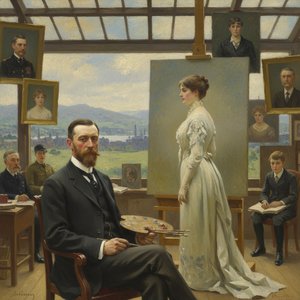
Sir John Lavery: A Study in Scottish Impressionism & the Portraiture of a Generation
Explore the life & art of Sir John Lavery, a master of Scottish Impressionism and renowned portraitist. Discover his captivating works, Irish heritage, and lasting legacy with ArtsDot.
Daniel Macnee: A Study in Early 20th-Century British Illustration & Style Evolution
Explore the life & work of Sir Daniel Macnee, a leading Scottish portrait and landscape painter. Discover his artistic evolution, influences, and legacy in 19th-century British art. Learn more at ArtsDot.

Echoes of Modernity: Exploring Artistic Transformations in Early 20th-Century Painting
Explore the revolutionary artistic transformations of early 20th-century painting – Fauvism, Cubism & more. Discover key artists and movements shaping modern art history with ArtsDot.

