


 Send
Send Del
Del
 Detaljer
 Guide
Guide

 Download
 Lignende værker
 Se diasshow
 Statistik
Shaft and Circle


 Læs mere
Giclée / Kunsttryk
Giclée- eller lærredstryk i museumskvalitet med hurtig produktion og fleksible muligheder for finish. ( Bestil håndmalet reproduktion Skift til digitalt billede)




































Vælg mellem vores forudindstillede størrelser, der matcher kunstværkets originale proportioner.

Du kan indtaste dine egne mål for at passe til en specifik ramme eller et bestemt område. Hvis den valgte størrelse ikke stemmer overens med det originale billedes proportioner, vil vi enten beskære kunstværket eller udvide billedet med en spejlet eller ensfarvet kant. En digital mockup vil blive sendt til din godkendelse, før produktionen påbegyndes.
Bemærk venligst, at forhåndsvisningen på skærmen ikke afspejler den faktiske beskæring eller udvidelse. Kun mockuppen vil nøjagtigt vise den endelige komposition.
Selvom specialmål er tilgængelige, anbefaler vi at vælge et mål fra den foruddefinerede liste for at bevare de originale proportioner.
Verdensomspændende levering () på 2 uger i stedet for de sædvanlige 4/5 uger. (24 september)

Gratis ekspresforsendelse til hele verden

Lærred af linned i høj kvalitet

Komplet transportforsikring

Garanti for refusion af told og importafgifter

Garanti for autentisk farvegengivelse

100 dages returret ved fabrikationsfejl

100% fuld returret

Mængderabat ved flere køb
 Glasmulighed er kun tilgængelig i størrelser under 110 cm

Shaft and Circle
Giclée / Kunsttryk
Reproduktionsstørrelse
-


Samlet pris
$ 63
A Vertical Echo: Barbara Hepworth’s “Shaft and Circle”
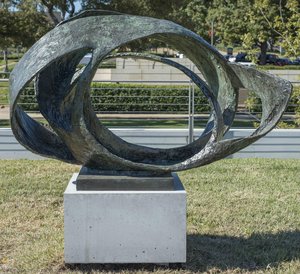
Barbara Hepworth's "Shaft and Circle," created in 1972, isn’t merely a sculpture; it’s an invitation to quiet contemplation. Standing before this arresting form – a towering shaft of polished concrete punctuated by a perfectly circular aperture – is akin to entering a sacred space. The piece immediately commands attention with its stark simplicity and the profound sense of upward movement it evokes. Hepworth, a pivotal figure in 20th-century British sculpture, masterfully distilled her signature style into this work: an exploration of form’s inherent qualities, divorced from representational concerns. It's a testament to her belief that sculpture could be experienced not just visually, but through touch and the subtle shifts in light and shadow.
The material itself – likely cast concrete, though Hepworth often worked with stone as well – is treated with an almost reverent attention. The surface is flawlessly smooth, reflecting the surrounding environment while simultaneously maintaining a sense of contained solidity. This deliberate contrast between smoothness and mass speaks to the core of Hepworth’s philosophy: she sought to capture the essence of materials themselves, revealing their inherent textures and geometries. The scale of the sculpture – approximately six feet tall – further amplifies this effect, drawing the viewer upwards into its embrace.
Roots in Epirus and Mycenaean Tradition
To fully appreciate “Shaft and Circle,” it’s crucial to understand Hepworth's artistic lineage. Her early influences stemmed from her travels through Italy and Greece, particularly a deep immersion in the archaeological sites of Mycenae. The shaft tomb tradition prevalent in Bronze Age Greece – elaborate burial chambers dug vertically into the earth, often containing grave goods – provided a foundational inspiration for her work. These tombs, built by elite societies, weren’t simply markers of death; they were statements of power and belief, reflecting a complex cosmology centered around ancestry and the afterlife. Hepworth's sculpture echoes this spirit, suggesting an upward journey towards something beyond the material world.
Interestingly, similar shaft tombs have been found in Bronze Age China, demonstrating a surprisingly widespread cultural practice across Eurasia. This shared heritage underscores the universal human impulse to create enduring monuments and explore questions of mortality and transcendence. Hepworth’s work can be seen as a contemporary reimagining of these ancient traditions, translated into the language of abstract form.
The Language of Form: Circularity and Verticality
The composition of “Shaft and Circle” is meticulously balanced between two fundamental principles: verticality and circularity. The shaft itself rises directly upwards, creating a powerful sense of momentum and aspiration. This upward thrust is counterbalanced by the perfectly formed circle cut into its midsection – an element that introduces ambiguity and invites interpretation. The circle can be seen as representing wholeness, continuity, or perhaps even a portal to another dimension. It’s a subtle yet potent symbol that adds layers of meaning to the sculpture's overall impact.
Hepworth was deeply interested in exploring the relationship between form and space. She believed that sculpture should not simply occupy physical space but also create an emotional resonance within the viewer. “Shaft and Circle” achieves this beautifully, prompting a sense of stillness and introspection. The negative space created by the circular aperture is just as important as the solid mass of the shaft itself, contributing to the sculpture’s dynamic balance.
A Legacy of Minimalism and Emotional Resonance
“Shaft and Circle” exemplifies Hepworth's commitment to minimalism and her profound understanding of materials. It’s a work that rewards careful observation and invites repeated contemplation. Her sculptures, often described as “non-objective,” are nonetheless deeply expressive, communicating complex ideas about form, space, and the human condition. Today, "Shaft and Circle" remains a powerful testament to Hepworth's artistic vision – a timeless exploration of fundamental geometric principles and their capacity to evoke profound emotional responses.
Lignende kunstværker



Om kunstneren
tidligt liv og uddannelse
Dame Barbara Hepworth, en anerkendt engelsk kunstner og billedhugger, blev født den 10. januar 1903 i Wakefield, Yorkshire. Hun studerede ved Leeds School of Art fra 1920 og vandt senere et amtligt legat til at studere ved Royal College of Art (RCA) i London fra 1921, indtil hun modtog sit diplom i 1924.kunstnerisk karriere
- Dame Barbara Hepworths arbejde er et eksemplar på modernismen, især inden for moderne skulptur. Hun var en af de få kvindelige kunstnere, der opnåede international berømmelse.
- I 1933 var hun med til at grundlægge kunstbevægelsen Unit One sammen med Ben Nicholson, Paul Nash og andre, med det mål at forene surrealisme og abstraktion i britisk kunst.
- Hepworths tidlige arbejde var præget af abstraktion og hendes involvering i den parisiske kunstbevægelse Abstraction-Création.
bemærkelsesværdige værker og udstillinger
- Oval Form (Trezion), en bronzeskulptur, er en del af samlingen på Kimbell Art Museum i Fort Worth, USA. (se på ArtsDot)
- Two Forms, en skulptur, udstilles på The Hepworth Wakefield i Wakefield, Storbritannien. (se på AllPaintings_Store)
- Totem, en marmorskulptur, er også en del af samlingen på The Hepworth Wakefield. (se på ArtsDot)
eftermæle og museumsamlinger
Barbara Hepworths arbejde er vidt anerkendt, og hendes skulpturer og malerier indgår i forskellige museumsamlinger verden over. The Hepworth Wakefield, opkaldt efter kunstneren, huser talrige mesterværker fra berømte kunstnere, herunder Hepworths egne værker. (opdag mere om The Hepworth Wakefield på ArtsDot)konklusion
Dame Barbara Hepworths banebrydende arbejde inden for moderne britisk skulptur har sat et uudsletteligt præg på kunstverdenen. Hendes eftermæle fortsætter med at inspirere både kunstnere og kunstelskere, og hendes værker står som et vidnesbyrd om hendes innovative ånd og kunstneriske geni. læs mere om Barbara Hepworth på Wikipedia
Barbara Hepworth
1903 - 1975 , Storbritannien
Hurtige fakta
- Artistic Movement Or Style: Modernisme
- Artists Or Movements Influenced By This Artist: ['Unit One']
- Artists Who Influenced This Artist: ['Henry Moore']
- Date Of Birth: 10 januar 1903
- Full Name: Jocelyn Barbara Hepworth
- Nationality: britisk
- Notable Artworks:
- Oval Form
- Two Forms
- Totem
- Place Of Birth: Wakefield, Yorkshire
Relaterede artikler

Barbara Hepworth: A Sculptural Dialogue with Form, Space & the Human Condition
Explore the profound world of Barbara Hepworth's sculpture. Discover her artistic evolution, iconic forms, and lasting influence on modern art. A guide for collectors & enthusiasts.

Beyond Form & Color: Geometric Abstraction's Evolution in 20th/21st Century Art
Explore the evolution of geometric abstraction from Cubism to contemporary art. Discover key artists like Malevich & Mondrian, investment insights, and expert collecting advice at ArtsDot.

Geometrisk Abstraktion: Top 10 Kunstværker der Definerede Bevægelsen | ArtsDot.dk
Oplev de 10 mest ikoniske værker inden for geometrisk abstraktion! Fra Kandinsky til Mondrian – lær historierne bag disse banebrydende kunstnere og deres farverige malerier. Find museumskvalitets reproduktioner & inspiration til din indretning på ArtsDot.dk.

Fernand Léger: Top 25 Kunstværker – En Hyldest til Maskinens Æra | ArtsDot
Oplev Fernand Légers 25 mest ikoniske kunstværker! Dyk ned i kubismens verden, maskinæraen og hans farverige malerier. Find inspiration til din boligindretning & køb reproduktioner af højeste kvalitet på ArtsDot.com.

Kandinskys 25 Mesterværker: En Rejse Ind i Abstrakt Kunst | ArtsDot.com
Oplev Kandinskys 25 mest ikoniske værker! Dyk ned i abstrakt kunst, ekspressionisme og farvernes sprog. Find luksus reproduktioner af berømte malerier som 'Komposition VIII' på ArtsDot.com – inspiration til din vægkunst & indretning.


