

 Se i fuld skala
 Del
Del Del
Del
 Detaljer

 Download
 Lignende værker
 Røntgenundersøgelse
 Diasshow
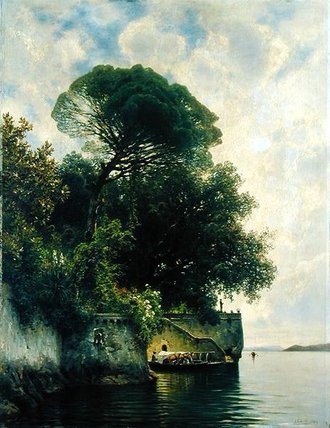
Isola Bella
 Se mere
Håndlavet oliereproduktion
Håndmalet olie på lærred i din valgte størrelse og ramme, udført efter bestilling af vores kunstnere. ( Køb print Køb billede)




































Vælg mellem vores forudindstillede størrelser, der matcher kunstværkets originale proportioner.

Du kan indtaste dine egne mål for at passe til en bestemt ramme eller plads. Hvis den valgte størrelse ikke stemmer overens med det originale billedes proportioner, vil vi enten beskære kunstværket eller udvide maleriet med yderligere håndmalede elementer. En digital skitse sendes til din godkendelse, før produktionen påbegyndes.
Bemærk venligst, at forhåndsvisningen på skærmen ikke afspejler den faktiske beskæring eller udvidelse. Kun skitsen vil nøjagtigt vise den endelige komposition.
Selvom specialmål er mulige, anbefaler vi at vælge en dimension fra den foruddefinerede liste for at bevare de originale proportioner.
Efter bestilling vil ArtsDot.com team sende en e-mail til kunden for at få instruktioner og levere et udkast til en skitse.
Levering i hele verden () på 3/4 uger i stedet for de standard 5 uger. (21 august). Ingen kompromiser med kvaliteten.

Gratis ekspresforsendelse til hele verden

Lærred af linned i høj kvalitet

Fuld transportforsikring

Garanti for refusion af told og importafgifter

Garanti for præcis farvegengivelse

60 dages returret (kun ved fabrikationsfejl)

100% Tilfredshedsgaranti

Mængderabat tilgængelig
 Glasmulighed er kun tilgængelig i størrelser under 110 cm

Isola Bella
Reproduktionsmetode
Størrelse på reproduktion
-


Samlet pris
$ 263
Lignende kunstværker


Kunstnerens biografi
The Soul of the Landscape: The Life and Art of Ascan Lutteroth
In the golden age of German Romanticism, few artists captured the quiet majesty of the natural world with as much technical precision and emotional resonance as Ascan Lutteroth. Born in the vibrant maritime city of Hamburg in 1842, Lutteroth was a child of tradition and intellect. His lineage was one of civic duty and commercial stability; his grandfather, Ascan Wilhelm Lutteroth, had navigated the complexities of the Hamburg Parliament as a Senator, while his father, Christian Alexander Ascan Lutteroth, stood as a prominent figure in the banking sector. This foundation of discipline and analytical thought would later manifest in the meticulous detail and structural integrity of his canvases, allowing him to translate the fleeting light of the outdoors into permanent, breathtaking oil paintings.
Lutteroth’s artistic journey was shaped by the prestigious corridors of Europe's most renowned academies. His formal education began in Geneva under the watchful eye of Alexandre Calame, a master whose influence instilled in Lutter andoth a profound respect for plein air painting. From Calame, he learned to observe the subtle shifts in atmospheric light and the delicate textures of the earth. This pursuit of naturalism led him to the legendary Kunstakademie Düsseldorf, where he studied under Oswald Achenbach. Within the influential circle of the Düsseldorfer Malerschule, Lutteroth absorbed the movement's signature blend of Romantic idealism and psychological depth, learning to infuse his landscapes with a sense of the sublime that transcended mere topographical recording.
A Journey Through Light and Place
The true breadth of Lutteroth’s vision was revealed through his travels, which acted as a continuous dialogue between his German roots and the Mediterranean sun. Between 1868 and 1870, his sojourn in Italy—specifically on the sun-drenched island of Capri—provided him with a new palette of warmth and brilliance. These years allowed him to experiment with the interplay of azure waters and rugged cliffs, themes that would become hallmarks of his Mediterranean period. Later, his travels took him to San Remo in 1879, where he even served as a tutor for the amateur painter Crown Princess Victoria, further cementing his connection to the cultural elite of Europe.
Despite his wanderlust, Lutteroth maintained a profound connection to his beloved Hamburg. His work often returned to the atmospheric harbor vistas and the rugged beauty of the German landscape, such as the Lüneburg Heath. This duality—the ability to capture both the exotic light of Italy and the moody, mist-laden scenes of Northern Germany—is what defines his unique contribution to 19th-century art. His technical mastery was recognized by his peers and patrons alike; notably, he was commissioned to create three monumental paintings for the Hamburg Town Hall, a testament to his status as a painter of civic importance.
The legacy of Ascan Lutteroth remains etched in the quiet moments of his landscapes:
- Technical Precision: A seamless blend of Calame’s naturalism and Achenbach’s expressive brushwork.
- Atmospheric Mastery: An unparalleled ability to depict the changing qualities of light, from the Mediterranean noon to the German twilight.
- Historical Significance: A vital representative of the Düsseldorf School who bridged the gap between Romanticism and a more modern, observational realism.
Though history occasionally focuses on his more famous contemporaries, Lutteroth’s work endures as a window into a vanished era of European elegance. His paintings are not merely depictions of scenery; they are emotional landscapes that invite the viewer to experience the stillness, the grandeur, and the eternal beauty of the natural world.

ascan lutteroth
1842 - 1823 , Germany
Kort om kunstneren
- Artistic Movement Or Style: Romanticism
- Artists Who Influenced This Artist:
- Alexandre Calame
- Oswald Achenbach
- Date Of Birth: 1842
- Full Name: Ascan Wilhelm Lutteroth
- Nationality: German
- Notable Artworks:
- On the Lagoon, Venice
- Villa D’Este, Tivoli
- The caves at Posillipo
- Place Of Birth: Hamburg, Germany

