
Surrealism · 1947
Leda (André Masson, 1947)
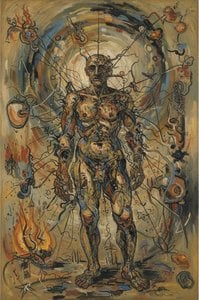
Leda is a work by André Masson (1896–1987). It dates from 1947. It belongs to the Surrealism movement.
- 1947

 Se i rummet

 Print
 Del som kort
 Del
 Guide


 Download
 Lignende værker
 Røntgenundersøgelse
 Diasshow
 Spørgsmål og svar

 Statistikker
Leda in a nutshell
- Title
- Leda
- Artist
- André Masson (1896–1987)
- Artist born in
- Balagny-sur-Thérain, Frankrig
- Date
- 1947
- Movement
- Surrealism
- Subject
- mythology, surrealism, expressionism, leda, swan, emotion
What's going on in Leda
A Descent into Myth: Exploring Masson's "Leda"
André Masson’s 1947 work, “Leda,” is far more than a depiction of a classical myth; it's an intensely personal and psychologically charged exploration of desire, transformation, and the unsettling power dynamics inherent in the story of Leda and Zeus. The Greek myth recounts how Zeus, disguised as a swan, seduced or raped Leda, resulting in the birth of Helen of Troy and other children. Masson doesn’t offer a literal representation of this narrative. Instead, he channels the myth's emotional core through a powerful visual language rooted in Surrealism and Abstract Expressionism. This piece invites viewers to confront not just the story itself, but also the complex feelings it evokes – vulnerability, powerlessness, and the unsettling beauty that can emerge from chaos.Style & Technique: Automatic Drawing and Surrealist Expression
Masson was a pivotal figure in the Surrealist movement, deeply involved with its exploration of the unconscious mind. “Leda” exemplifies his embrace of *automatic drawing*, a technique championed by André Breton and other Surrealists aimed at bypassing conscious control to access raw, unfiltered creativity. The artwork is rendered entirely in shades of gray and black ink on paper, creating a striking monochromatic effect that amplifies the intensity of the swirling lines. The dense, scribbled application of these lines isn’t merely decorative; it's integral to the work's expressive power. It creates a palpable texture, almost as if one could feel the artist's hand moving across the surface. The style blends Surrealism’s dreamlike imagery with Abstract Expressionism’s emphasis on spontaneous gesture and emotional expression, resulting in a unique visual language that is both unsettling and captivating.Symbolism & Emotional Impact
The distorted forms of Leda and the swan are key to understanding the artwork's symbolic weight. The intertwining figures lack clear boundaries, suggesting a blurring of identities and a loss of control – central themes within the myth itself. The chaotic lines evoke feelings of anxiety, desire, and transformation. The absence of a defined background further intensifies this sense of disorientation, drawing the viewer into the swirling emotional vortex at the heart of the piece. While the swan traditionally represents beauty and grace, in Masson’s hands, it becomes an instrument of unsettling power, its form distorted and integrated with Leda's own, creating a complex visual metaphor for vulnerability and violation. The monochromatic palette reinforces this sense of unease, stripping away any potential for comforting color or light.Historical Context & Masson's Artistic Journey
Created in 1947, “Leda” reflects the post-war climate of existential questioning and psychological exploration that characterized much of Abstract Expressionism. Having witnessed the horrors of World War II, many artists sought to express profound emotional truths beyond traditional representational forms. Masson’s work, deeply rooted in Surrealist principles, aligns with this impulse. His early training encompassed Cubism, but his association with Surrealism led him to experiment extensively with automatic techniques and altered states of consciousness – all evident in the raw energy and psychological depth of “Leda.” His exploration of mythology wasn't merely academic; it was a means of delving into universal human experiences like desire, power, and transformation.Leda, up close
Things people wonder about Leda
Hvilke farver dominerer i "Leda" af André Masson?
"Leda" af André Masson benytter en Neutrals farvepalet, hvor Celadon (#b6b3b7) er den dominerende farve.
Hvilke andre navne eller pseudonymer bruger André Masson?
André Masson optræder under de alternative navne Andre Masson, Masson.
Hvilken farvepalette benytter "Leda"?
Farvepaletten i "Leda" af André Masson beskrives som Neutrals. Det er en kortfattet beskrivelse af værkets farver.
Hvordan kan jeg få et tryk af "Leda" af André Masson?
Et print af "Leda" af André Masson kan bestilles direkte på siden for Kunstprint i høj kvalitet: et fine art-print på bomuldscanvas eller arkivbestandigt lærredspapir.
Kan jeg se "Leda" af André Masson under forskellig belysning?
Røntgenvisningen af "Leda" af André Masson findes på værkets Røntgenoptagelse-side: en interaktiv undersøgelse af billedet gennem elleve optiske lag.
Findes der en guide til "Leda" af André Masson?
Elevguide-siden for "Leda" af André Masson tilbyder et printbart faktablad på to sider: kunstværket med dets identitetstabel, en tidslinje der placerer det i kunstnerens levetid, andre værker af kunstneren, den målte farvepalette og citater klar til kopiering i fire forskellige stilarter.
Hvor gammel var André Masson, da "Leda" blev skabt i 1947?
André Masson var 51 år gammel, da vedkommende skabte "Leda" i 1947. Alderen er beregnet ud fra kunstnerens fødselsår, 1896.
Hvilken stilart tilhører "Leda"?
"Leda" er et værk fra Surrealism. Denne stilart angiver den kunstneriske tradition, som værket indgår i.
Hvordan passer "Leda" ind i André Massons temaer og stil?
"Leda" deler med André Massons øvrige værker sin Surrealism-stil og de gennemgående temaer: surrealism’s dreamlike imagery, abstract expressionism gestures, automatic drawing techniques, cubist fragmentation influence, represents masson’s surrealist phase, demonstrates automatic drawing skill, explores recurring mythological motifs, part of a larger exploration of eros.
Meet André Masson

1896–1987, Frankrig
André Masson
André Masson: En Pioner i Surrealismens og Abstraktes Verden André Masson, født den 4. januar 1896 i Balagny-sur-Thérain nær Paris, var en af de mest markante figurer i det 20. århundredes kunstliv. Hans karriere spændte over næsten et århundrede og omfatter en unik kombination af surrealistisk intuition, eksperimenterende teknikker og en dyb fascination for menneskets psyke.
Get to know André Masson The André Masson works everyone loves
More by André Masson you might love
 Goethe or the metamorphosis of plants1940
 Massacre1932
 Children of the Islands1926
 Portrait of Emily Brontë1945
More to read about Leda
 André Masson: Automatism, Surrealism & Primal Expression in 20th-Century ArtExplore the revolutionary art of André Masson – pioneer of automatism & Surrealist expression. Discover his powerful imagery, innovative te…
 Sanselige Dimensioner i Abstrakt Maleri: Berøringens Kraft og Lysets Spil på OverfladenUdforsk den sanselige verden af abstrakt maleri! Lær om berøringens kraft, lysets spil og de store mestre som Pollock & Rothko. Ekspertvide…
 Beyond Reality's Grasp: Exploring the Philosophical Foundations of SurrealismExplore the philosophical roots & artistic innovations of Surrealism with ArtsDot. Discover Dalí, Ernst, Delvaux & Freud's influence on thi…