


 Se i rummet
 Send
Send Del
Del
 Detaljer
 Studieguide til kunstværker

 Download
 Lignende værker
 Røntgenundersøgelse
 Se diasshow
 Statistik
Object (Dinge)
 Neo-Expressionism
 1987
1987 50.0 x 50.0 cm
 Læs mere
Kunstværket vist på denne side er beskyttet af ophavsretsloven, hvilket betyder, at vi ikke lovligt kan skabe eller sælge en identisk reproduktion. Denne beskyttelse håndhæves i henhold til internationale aftaler som f.eks. den Bernerkonventionen og af nationale love, herunder de bestemmelser, der er fastlagt i Amerikansk ophavsretslov - Titel 17.
Som et respektfuldt og lovligt alternativ tilbyder vi skræddersyede, håndmalede kunstværker inspireret af originalen. Vores dygtige og professionelle kunstnere studerer omhyggeligt originalens stil, stemning og kunstneriske essens for at skabe et nyt, unikt værk, der fremkalder den samme følelse – samtidig med at det forbliver en original skabelse i egen ret.
Denne metode overholder fuldt ud ophavsretsreglerne, da den ikke indebærer kopiering eller duplikering af det beskyttede kunstværk. I stedet er der tale om en kreativ nytolkning – et nyt maleri, som er inspireret af det oprindelige, men ikke identisk med det.
Håndlavet oliereproduktion
Håndmalet olie på lærred i din valgte størrelse og ramme, udført efter bestilling af vores kunstnere. ( Skift til printversion Skift til digitalt billede)




































Vælg mellem vores forudindstillede størrelser, der matcher kunstværkets originale proportioner.

Indtast den bredde og højde, du har brug for, så det passer til din ramme eller din væg. Da dette er håndmalet, kan kunstneren ved en anden form på størrelsen male lidt mere rundt om billedet eller skære lidt væk — det er op til dig. Vi sender dig et digitalt mockup til godkendelse, før maleriet påbegyndes. Billedet, der vises på denne side, viser ikke det endelige resultat — det er kun mockuppet, der gør.
Efter bestilling vil ArtsDot.com team sende en e-mail til kunden for at indhente instruktioner og fremsende et udkast til gennemgang.
Levering i hele verden () på 3-4 uger i stedet for de standard 5 uger. (18 oktober). Ingen kompromiser med kvaliteten.

Gratis ekspresforsendelse til hele verden

Lærred af linned i høj kvalitet

Komplet transportforsikring

Garanti for refusion af told og importafgifter

Garanti for autentisk farvegengivelse

100 dages returret ved fabrikationsfejl

100% fuld returret

Mængderabat ved flere køb
 Glasmulighed er kun tilgængelig i størrelser under 110 cm

Object (Dinge)
Reproduktionsmateriale
Reproduktionsstørrelse
-


Samlet pris
Dkr 1714
Lignende kunstværker


Om kunstneren
The Radical Alchemy of Albert Oehlen
In the turbulent landscape of late twentieth-century German art, few figures command as much intellectual and visual authority as Albert Oehlen. Born in Krefeld in 1954, Oehlen emerged not merely as a painter, but as a provocateur who sought to dismantle the very sanctity of the canvas. His journey is one of deliberate disruption, a career defined by a refusal to settle into any single movement or aesthetic certainty. While his contemporaries often leaned into the emotional weight of Neo-Expressionism, Oehlen embarked on a more cerebral and rebellious path, treating the act of painting as a site of experimental collision where abstraction and figuration engage in a perpetual, restless struggle.
Oehlen’s formative years were steeped in the avant-garde energy of Berlin and Hamburg. Studying at the Hochschule für bildende Künste Hamburg between 1978 and 1981 under the legendary Sigmar Polke, he inherited a legacy of questioning the boundaries of medium and meaning. This period of academic rigor was balanced by a gritty, hands-on engagement with the art scene, where he worked as a decorator and waiter, absorbing the raw textures of urban life. Alongside figures like Martin Kippenberger and Georg Herold, Oehlen became a central pillar of the Neue Wilde movement, yet he always maintained a distance from its more predictable tropes, preferring instead to explore what he termed the "failures" of painting—finding beauty in discordance, error, and the breakdown of traditional composition.
A Symphony of Chaos and Control
The evolution of Oehlen’s technique is a testament to his fascination with the tension between the handmade and the mechanical. His oeuvre is famously categorized by several distinct, yet overlapping, stylistic phases that showcase an incredible breadth of vision. In the 1980s, he gained notoriety for his "Bad Paintings," works that intentionally embraced a sense of amateurism and aesthetic friction to challenge the polished standards of the art world. These pieces utilized brash juxtapositions of color and discordant symbols, suggesting that true innovation lies in the ability to break fundamental rules.
As his practice matured, Oehlen introduced even more complex layers of complexity through several groundbreaking series:
- The Gray Paintings: A period characterized by a more restrained, premeditated use of tone and texture, where form was explored within strict, almost architectural parameters.
- The Bionic/Computer Paintings: An era where Oehlen bridged the gap between the organic and the digital, incorporating computer-generated elements and electronic aesthetics into his canvases to explore the intersection of human gesture and machinic precision.
- The Fn Series: A collection that functions as a "footnote" to the history of painting, utilizing layered mixed media to create spatially complex works that act as annotations to the grander narrative of Western art.
In works such as Object (Dinge), one can witness his mastery of visual density, where elements of Dada and Constructivism are woven together with vibrant greens and geometric forms to create a provocative commentary on identity. His ability to blend the surrealist gesture with expressionist brushwork allows him to push the essential components of color, motion, and time to their absolute extremes.
Legacy and the Reimagined Canvas
Today, Albert Oehlen stands as a monumental figure whose influence stretches far beyond the borders of Germany. His significance lies in his ability to keep the medium of painting perpetually relevant by treating it as an evolving language rather than a static tradition. By embracing collage, digital motifs, and even "deliberate amateurism," he has provided a blueprint for how contemporary artists can engage with history without being imprisoned by it. His recent exhibitions, such as those at the Serpentine Galleries, continue to demonstrate his capacity to remix the past—appropriating elements from Modernist masters like John Graham to create something entirely new and startlingly contemporary.
Ultimately, Oehlen’s work is a celebration of process over product. He invites the viewer into a space where the collision of figuration and abstraction serves as a powerful reminder of the many forces that drive the resurgence of art in an increasingly digital age. Through his radical embrace of the unexpected, he has ensured that the act of painting remains a vital, breathing, and profoundly unpredictable force in the global art dialogue.

Albert Oehlen
1954 - , Germany
Hurtige fakta
- Artistic Movement Or Style: Neue Wilde
- Artists Or Movements Influenced By This Artist: ['Berlin Neue Wilde']
- Artists Who Influenced This Artist:
- Georg Baselitz
- Sigmar Polke
- Gerhard Richter
- Date Of Birth: 1954
- Full Name: Albert Oehlen
- Nationality: German
- Notable Artworks:
- Loa
- Object (Dinge)
- Untitled (Albert himself with horse)
- Place Of Birth: Krefeld, Germany
Relaterede artikler

The Magic of Collage: How to Layer Texture and Story into Your Home Decor
Elevate your interiors with the magic of collage. Discover expert tips on layering texture, 3D elements, and personal narratives through mixed media art to create a soulful, sophisticated home decor experience.

Anton von Werner: Imperial Painter, Historical Witness & Shifting German Identity
Explore the life & work of Anton von Werner, Imperial Germany's leading painter. Discover his dramatic depictions of war, unification, and court life – a fascinating insight into 19th-century German history & art.
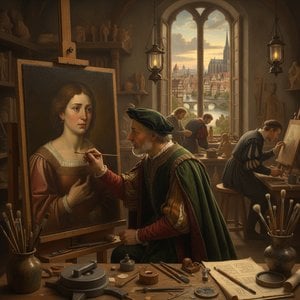
The Northern Awakening: Artistic Innovation & Cultural Transformation in the German Renaissance
Explore the artistic innovation of the German Renaissance! Discover Dürer, the Danube School & Reformation art. Learn about techniques, materials & lasting influence. Find museum-quality reproductions at ArtsDot.

Albert Kretschmer: Capturing 19th-Century Costume & the Seeds of Expressionism
Explore the exquisite costume studies of Albert Kretschmer (1825-1891). Discover his detailed illustrations, influence on art history & connection to early Expressionism. Learn about collecting this remarkable artist's work.

Tysk Ekspressionisme: 10 Mesterværker der Definerede en Æra – Kunst til Dit Hjem
Oplev de 10 mest ikoniske værker fra Tysk Ekspressionisme! Lær historierne bag Kirchner, Nolde & Kandinsky. Find museumskvalitets kunsttryk og inspiration til din indretning på ArtsDot.com – udforsk samlingen online.