

 Se i rummet
 Del som kort
 Del
Del
 Detaljer
 Guide
Guide

 Download
 Lignende værker
 Røntgenundersøgelse
 Diasshow
 Spørgsmål og svar
 Statistikker
Emancipation Proclamation


 Vis mere
Giclée / Kunsttryk
Giclée- eller lærredstryk i museumskvalitet med hurtig produktion og fleksible muligheder for finish. ( Køb håndmalet maleri Skift til digitalt billede)




































Vælg mellem vores forudindstillede størrelser, der matcher kunstværkets originale proportioner.

Indtast den bredde og højde, du har brug for, så det passer til din ramme eller din væg. Et print kan kun beskæres, aldrig gøres større end selve billedet, så en størrelse med et andet format vil medføre, at dele af motivet går tabt. Vi sender dig en digital mockup til godkendelse, før vi printer noget. Billedet vist på denne side viser ikke den faktiske beskæring — det er kun mockuppen, der gør.
Verdensomspændende levering () på 2 uger i stedet for de sædvanlige 4/5 uger. (10 november)

Gratis ekspresforsendelse til hele verden

Lærred af linned i høj kvalitet

Fuld transportforsikring

Garanti for refusion af told og importafgifter

Garanti for præcis farvegengivelse

100 dages returret ved fabrikationsfejl

100% fuld returret

Mængderabat ved flere køb
 Glasmulighed er kun tilgængelig i størrelser under 110 cm

Emancipation Proclamation
Giclée / Kunsttryk
Størrelse på reproduktion
-


Samlet pris
Dkr 420
Spørgsmål og svar
Er farverne i "Emancipation Proclamation" kraftige eller dæmpede?
"Emancipation Proclamation" af Abraham Lincoln er gengivet med en Muted mætning og en Monochromatic intensitet.
Hvordan kan jeg købe en digital fil af "Emancipation Proclamation" af Abraham Lincoln?
Et digitalt billede af "Emancipation Proclamation" af Abraham Lincoln kan købes på siden for Digitalt billede: et højopløseligt digitalt billeddownload.
Hvordan passer "Emancipation Proclamation" ind i Abraham Lincolns temaer og stil?
"Emancipation Proclamation" er et værk fra Abraham Lincolns Historical Painting-periode, hvis gennemgående temaer inkluderer lincoln's leadership, historical weight, union victory, abolition ideals, civil war era, national identity, documentary art, civic duty".
Lignende kunstværker


Kunstnerbiografi
Abraham Lincoln: A Portrait of Resilience and Leadership
Abraham Lincoln (1809 – 1865), the sixteenth President of the United States, remains an enduring icon of American history—a figure synonymous with courage, compassion, and unwavering dedication to preserving the Union during its most tumultuous period. His legacy transcends mere political leadership; it embodies a profound moral conviction that shaped the nation’s trajectory toward equality and justice. To look upon the many artistic representations of Lincoln is to witness more than just a historical record; it is to encounter a visual narrative of a man whose very countenance became a symbol of a fractured nation seeking reunification.
Born in Hodgens ville, Kentucky, Abraham Lincoln emerged from humble beginnings—a family struggling to make ends meet on the frontier. Despite limited formal schooling, Lincoln possessed an extraordinary intellect and cultivated self-education through voracious reading and independent study. This formative experience instilled within him a deep appreciation for reason and logic, qualities that would serve as cornerstones of his legal career and political thought. His early life was marked by hardship—the loss of his father at a young age and the challenges faced by a family attempting to establish themselves in a new territory—experiences which undoubtedly contributed to Lincoln’s empathy for the common man and fueled his determination to champion social justice.
Lincoln pursued legal studies at Illinois Wesleyan University and subsequently enrolled at Law School in New Salem, Illinois. He quickly gained recognition as a skilled orator and lawyer, specializing in circuit court litigation—a profession that honed his persuasive abilities and exposed him to the realities of frontier life. His return to Springfield solidified his reputation as a respected citizen and propelled him into local politics, culminating in his election to the Illinois State Legislature. As he ascended the political stage, his presence began to be captured by the burgeoning medium of photography and the fine brushes of portraitists, creating a visual canon that would immortalize his transition from a frontier lawyer to a global statesman.
The Visual Legacy: Artistry and Iconography
The artistic depictions of Abraham Lincoln serve as a profound window into the psyche of the 19th century. Throughout his presidency, various artists sought to capture the duality of his character: the weary leader burdened by the weight of the Civil War and the resolute emancipator driven by moral imperative. The works of masters such as George Peter Alexander Healy offer a glimpse into this era through portraits that emphasize a thoughtful, contemplative demeanor. These paintings do not merely record a likeness; they utilize light and shadow to evoke the gravity of his decision-making during the nation's darkest hours.
Beyond the canvas, the sculptural dimension of Lincoln's legacy provides a monumental sense of permanence. The works of Daniel Chester French, particularly the iconic Head of Abraham Lincoln, embody the President’s wisdom and solemnity through stone, translating his historical significance into a physical presence that commands reverence. Similarly, the sculptures by Jakob Otto Schweizer capture specific, poignant moments, such as the delivery of the Gettysburg Address, allowing viewers to feel the weight of his words in a three-dimensional space.
The era's visual history is further enriched by the following artistic contributions:
- Portraiture and Realism: The works of George Peter Alexander Healy, which captured the President's thoughtful gaze with classic American realism.
- Sculptural Grandeur: The monumental achievements of Daniel Chester French and Jakob Otto Schweizer that transformed Lincoln into a permanent fixture of American landscape and memory.
- Early Photography: The pioneering daguerreotypes and portraits by Alexander Hesler, which provided the raw, unvarnished truth of his likeness to a growing nation.
- Miniaturism and Detail: The delicate work of John Henry Brown, whose detailed depictions brought the presence of Lincoln into the intimate spaces of Victorian homes.
Ultimately, the art surrounding Abraham Lincoln is inseparable from his historical impact. Whether through the striking 1881 portrait by George Bucher Ayres or the early photographic captures that bridged the gap between art and reality, these works ensure that his face remains a mirror for the American spirit—reflecting both the scars of conflict and the enduring hope for a more perfect union.

Abraham Lincoln
1809 - 1865 , United States of America
Kort om kunstneren
- Full Name: Abraham Lincoln
- Nationality: American
- Date Of Birth: 1809
- Date Of Death: 1865
- Place Of Birth: Hodgensville, United States of America
- Notable Artworks: ['Portrait of Abraham Lincoln']
Relaterede artikler

The Enduring Legacy of Woodblock Printmaking: Technique, History & Artistic Expression
Explore the rich history of woodblock printmaking – from ancient techniques to Ukiyo-e masterpieces. Discover expert insights on collecting, preserving & appreciating this enduring art form.

Giclée Prints: Archival Quality & Aesthetic Nuances for the Discerning Collector
Explore the world of giclée prints with ArtsDot. Learn about archival quality, aesthetic nuances & investment potential. Expert guidance for discerning art collectors seeking museum-quality reproductions and lasting value.
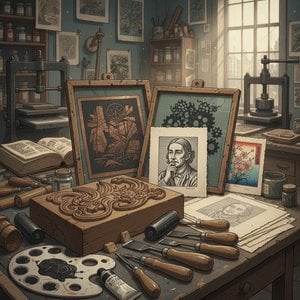
The Enduring Legacy of Printmaking: Techniques, Themes & Artistic Innovation Across Centuries
Explore the rich history of printmaking with ArtsDot. Discover techniques from intaglio to lithography, learn about collecting valuable prints & find museum-quality reproductions. Expert insights for art enthusiasts and collectors.

Echoes of Time: Exploring the Enduring Appeal & Historical Context of Vintage Art Prints
Explore the captivating world of vintage art prints! Discover their history, collecting tips & enduring appeal. Expert insights on chromolithography and building a legacy collection with ArtsDot.

The Enduring Legacy of Fine Art Prints: Technique, History & Aesthetic Impact
Explore the rich history & techniques of fine art prints. Discover investment potential, assess authenticity, and learn how to preserve your collection with expert guidance. Trusted insights for discerning collectors.