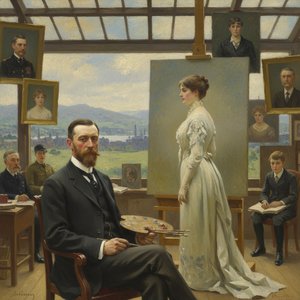
Walter Shirlaw: Bridging Scotland and America Through Landscape Painting
Walter Shirlaw (1838 – 1909) stands as a testament to the artistic exchange between Scotland and America during the late nineteenth century, achieving renown as both a painter and illustrator. Born in Paisley, Scotland, his family emigrated to the United States shortly after his birth, establishing roots in Covington, Kentucky—a formative experience that profoundly shaped his artistic vision. Initially pursuing a career as a bank note engraver, Shirlaw’s passion for art quickly superseded practical considerations, propelling him toward formal training and ultimately securing a distinguished place within the burgeoning American art landscape.- Early Influences & Training: Shirlaw's artistic journey commenced in 1861 with his debut exhibition at the National Academy of Design in New York City, marking an auspicious beginning. Recognizing the importance of broadening his horizons, he embarked on a comprehensive European education, studying under luminaries like Johann Leonard Raab, Alexander von Wagner, Arthur von Ramberg, and Wilhelm Lindenschmidt in Munich between 1870 and 1877. This immersion fostered an appreciation for German Romanticism and Impressionism, influencing his stylistic choices.
- Munich & Artistic Breakthroughs: The toning of “The Bell” (1874) represents Shirlaw’s initial foray into artistic exploration, demonstrating a meticulous attention to detail and capturing the essence of Bavarian craftsmanship. However, it was “Sheep-Shearing in the Bavarian Highlands” (1876), arguably his magnum opus, that garnered significant acclaim at the Paris Exposition of 1878—a pivotal moment cementing Shirlaw’s reputation as a master of landscape painting.
Style & Technique: Impressionistic Realism
Shirlaw's artistic style can be characterized as Impressionistic realism. He skillfully blended the tenets of Impressionism—particularly capturing fleeting atmospheric effects and utilizing broken color palettes—with a grounding in meticulous observation and accurate depiction of natural subjects. His canvases often depict rural scenes, particularly pastoral landscapes populated by animals—sheep, cows, birds—rendered with remarkable precision and imbued with palpable emotion. Critics like S.G.W. Benjamin noted Shirlaw’s unwavering commitment to color harmony and line clarity, highlighting his ability to convey the spirit of a place while adhering to rigorous artistic standards.- Notable Works: Among Shirlaw's celebrated compositions are “Good Morning” (1878), housed in the Buffalo Academy; “Indian Girl and Very Old” (1880); “Gossip” (1884); and “Jealousy” (1886)—the latter residing in the Academy of Design, New York City. His monumental frieze for Darius O. Mills’ dining room exemplifies his ambition and technical prowess.
- Illustrator & Educator: Beyond painting, Shirlaw excelled as an illustrator, notably contributing to publications featuring Japanese art—demonstrating a fascination with Eastern aesthetics and artistic traditions. He founded the Society of American Artists and served as its inaugural president, nurturing talent and fostering artistic discourse. Furthermore, he taught composition at the Art Students League for several years, shaping generations of aspiring artists.
Legacy & Historical Significance
Walter Shirlaw’s contribution to American art history extends beyond his individual achievements; he established a foundational role in fostering artistic dialogue between Scotland and America. His unwavering dedication to Impressionistic realism—combined with his profound understanding of Japanese aesthetics—established him as an influential figure within the broader European art scene. Today, Shirlaw's paintings continue to resonate with viewers captivated by their serene beauty and evocative portrayal of rural life, securing his place as a significant voice in the artistic landscape of the late nineteenth century.Otázky a odpovědi
Kde mohu najít statistiky o dílech umělce Walter Shirlaw?
Pro umělce Walter Shirlaw je k dispozici stránka Statistiky, která zobrazuje statistiky o jeho dílech na tato webová stránka.
Mohu navštívit virtuální muzeum děl umělce Walter Shirlaw?
Možná je i virtuální prohlídka: na stránce 3D galerie umělce Walter Shirlaw můžete obdivovat jeho díla v trojrozměrné galerii.
Kolik děl umělce Walter Shirlaw je možné si prohlédnout?
Na stránce Všechná umělecká díla si můžete prohlédnout 20 uměleckých děl děl autora Walter Shirlaw.