Zobrazit v interiéru
 Odeslat
 Sdílet
 Podrobnosti
 Průvodce

 Stáhnout obrázek
 Podobné kousky
 Rentgenové snímky
 Slideshow
 Statistiky
MIrage


 Přečíst si více
Ručně malovaná olejová reprodukce
Ručně malované olejné plátno v libovolném rozměru i s rámem, vyrobené našimi umělci na zakázku. ( Přepnout na tiskové verze Přepnout na digitální verzi obrazu)




P118B $10

P118H $10

P118W $10

P438Z $10

P508JH $12

P508YH $12

P805H $10

P805Z $10

P919BZ $10

P919G $10

P919XJ $10

P959ZH $10

P968JZ $12

W106C $8

W218G $10

W218JH $8

W218Y $10

W307PJ $10

W316G $10

W316PJ $8

W316Y $10

W398PJ $8

W4111J $10

W500HY $15

W500JH $15

W692G $12

W849H $8

W940BG $15

W953PJ $8




Vyberte si z našich přednastavených velikostí, které odpovídají původním proporcím díla.

Můžete zadat vlastní rozměry pro konkrétní rám nebo prostor. Pokud se vámi vybraná velikost neshoduje s proporcemi původního obrazu, dílo buď ořízneme, nebo jej doplníme ručně malovanými prvky. Před zahájením výroby vám bude zaslán digitální náhled ke schválení.
Upozorňujeme, že náhled na obrazovce neodpovídá skutečnému ořezu ani rozšíření. Pouze digitální náhled přesně zobrazí finální kompozici.
Ačkoliv je možné zvolit vlastní velikost, pro zachování původních proporcí doporučujeme vybrat rozměr z předdefinovaného seznamu.
Po přijetí objednávky vám tým ArtsDot.com zašle e-mail s pokyny a poskytne náhledovou verzi.
Celosvětová doprava () za 3–4 týdny namísto standardních 5 týdnů. (22 září). Bez kompromisů v kvalitě.

Zdarma celosvětová expresní doprava

Vysoce kvalitní lněné plátno

Úplné pojištění přepravy

Záruka vrácení celního poplatku

Záruka věrného barevného shodu

100dení lhůta pro vrácení zboží (pouze při vadách výroby)

100% garance vrácení peněz

Sleva při více objednávkách
 Skleněná varianta je dostupná pouze u rozměrů menších než 110 cm

MIrage
Technika provedení
Velikost reprodukce
-


Celková cena
$ 263
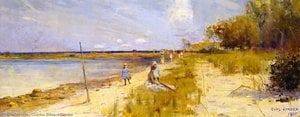
A Mirage of Light and Leisure: Charles Edward Conder’s “Mirage”
Charles Edward Conder's "Mirage," painted in 1889, isn’t merely a depiction of a landscape; it’s an invitation into a realm where reality subtly bends, inviting contemplation on the ephemeral nature of perception and the allure of the Australian outback. Born in Tottenham, London, Conder’s journey led him to Australia, where he became a pivotal figure within the Heidelberg School – a movement that championed a distinctly Australian artistic voice, rejecting European academic traditions in favor of capturing the light, color, and spirit of the continent.
The painting immediately draws the eye with its vibrant palette. Warm ochres dominate the foreground, punctuated by the cool blues and greens of distant trees and sky. Conder masterfully employs an Impressionistic technique, utilizing loose brushstrokes and broken colors to capture the shimmering heat haze that defines the Australian landscape. This isn’t a photographic representation; rather, it's a subjective experience translated onto canvas – a distillation of light, color, and atmosphere. The composition itself is deceptively simple: a woman holding a ball in her hand, positioned beside a solitary tree against a backdrop of rolling hills. Yet, within this apparent stillness lies a subtle dynamism, a sense of movement created by the play of light and shadow.
The Symbolism of Leisure and Illusion
While superficially appearing as a charming pastoral scene, “Mirage” is rich in symbolic meaning. The woman holding the ball evokes a sense of carefree leisure – a quintessential image of Australian summer. It speaks to a time of relaxation, social gatherings, and the simple pleasures of life. However, the presence of the ball itself introduces an element of illusion. Balls are often associated with games, entertainment, and even fleeting moments of joy. In this context, it suggests that these experiences, like the mirage itself, can be deceptive – beautiful but ultimately transient.
The solitary tree further amplifies this theme. Trees represent resilience, strength, and connection to the earth. Yet, its isolation within the vast landscape hints at a sense of loneliness or detachment. The woman’s position beside it suggests a moment of quiet contemplation, perhaps questioning the nature of her own place in this world.
A Window into the Heidelberg School
"Mirage" exemplifies the core tenets of the Heidelberg School – a group of Australian artists who sought to capture the unique character of their homeland. Unlike their European counterparts, they were deeply interested in portraying the light and color of the Australian landscape, often focusing on scenes of rural life and leisure. Conder’s work is characterized by its vibrant colors, loose brushstrokes, and emphasis on capturing the fleeting effects of light and atmosphere. His use of local pigments and his rejection of academic conventions firmly established him as a key figure in shaping Australian art.
Capturing the Essence of an Illusion
Conder’s skill lies not just in depicting a scene, but in conveying its *feeling*. The painting isn't about literal accuracy; it’s about capturing the subjective experience of being immersed in the heat haze of the Australian outback. The shimmering quality of the landscape, the sense of distance and ambiguity, all contribute to a powerful emotional impact. “Mirage” invites us to question our perceptions, to appreciate the beauty of illusion, and to contemplate the transient nature of life itself. It remains a captivating testament to Conder’s artistic vision and his profound connection to the Australian landscape.
Související díla


Biografie umělce
Early Life and Artistic Journey
Charles Edward Conder (1868 – 1909) byl anglický malíř, grafický umělec a návrhář. Narodil se v Tottenhamu, Middlesex, druhým synem z šesti dětí, Jamese Condora, civilního inženýra a Mary Ann Ayresové. Jeho rané roky byly poznamenány smrtí matky v Indii krátce po narození, kdy byl jen čtyři letý. Umělecká cesta v Austrálii
V roce 1884 se přestěhovala do Sydney, Austrálie, kde pracovala pro svého příbuzného jako zeměměřičský technik pro Novou Gallii Britskou. Nicméně nezaujal ho tento druh práce a mnohem více si oblíbil kreslení krajiny než zeměřování. Už roku 1886 opustil zaměstnání a stal se umělcem pro „Illustrated Sydney News“, kde působil společně s dalšími významnými umělci jako Albert Henry Fullwood, Frank Mahony a Benjamin Edwin Minns. Studoval také na Akademii Julian v Paříži a byl součástí kruhu umělců včetně Henriho Toulouse-Lautrece.
The Heidelberg School and Notable Works
Conderův největší dílo, Odjezd Orientu – Kružnice Quay (1888), ukázalo jeho nové mistrovství ve formě a štětcem. Tato dokonalá výstava přístavu v Sydney Cove byla rychle prodána galerii Orientální v Sydney a Conder tak získal první své dílo, které vstoupilo do veřejné sbírky.
Výstavu „9 x 5 impresionistické výstavy“ v Melbourne společně s Tom Robertem a Arthurem Streetonem si Conder vybudoval pozici ve školském hnutí Heidelberg. Jeho práce byly prezentovány na mnoha výstavách, včetně samostatných výstav.
Legacy and Later Life
Conderovy pozdější roky byly poznamenány nemocí, včetně ochranného nervového systému a epizod děsivé třeskotavosti. Přesto pokračoval v malování a zanechal si dědictví klíčové osoby ve školském hnutí Heidelberg. Jeho dílo bylo lépe přijato v Anglii než ve Francii, kde byl jeho portrét namalován Henri de Toulouse-Lautrecem v roce 1892.

Charles Edward Conder
1868 - 1909 , Spojené království
Rychlé informace
- Artistic Movement Or Style: Heidelberg School
- Artists Who Influenced This Artist:
- Alfred Daplyn
- Victor Mann
- Julian Ashton
- Date Of Birth: October 24, 1868
- Date Of Death: February 9, 1909
- Full Name: Charles Edward Conder
- Nationality: British
- Notable Artworks:
- Departure of the Orient – Circular Quay
- A holiday at Mentone
- Under The Southern Sun
- Place Of Birth: Tottenham, United Kingdom
Související články

Top 10 impresionistických mistrovských děl, která změnila svět umění | ArtsDot
Prozkoumejte 10 ikonických děl impresionismu od Monet, Renoir a dalších. Objevte příběhy za slavnými obrazy, techniky malby a inspiraci pro váš interiér. Reprodukce umění nejvyšší kvality na ArtsDot.com.

Beyond Impressionism: Exploring the Emotional Depth of Post-Impressionist Painting
Explore the profound emotional depth & innovative techniques of Post-Impressionism with ArtsDot. Discover Cézanne, Van Gogh, Gauguin & more – and their lasting impact on modern art.

Paul Cézanne: 25 mistrovských děl a revoluce v moderním umění | ArtsDot.cz
Prozkoumejte 25 ikonických děl Paula Cézanna – průkopníka moderního umění a impresionismu. Obdivujte jeho still life, krajiny a portréty. Reprodukce obrazů v nejvyšší kvalitě na ArtsDot.com. Inspirace pro váš interiér!

Za hranicemi světla a barvy: Impresionismus versus Postimpresionismus pro náročného sběratele
Prozkoumejte svět impresionismu a postimpresionismu s . Průvodce pro náročné sběratele, investiční potenciál a rady od odborníků. Objevte mistrovská díla Cézannea, Van Gogha a Gauguina.

Impresionismus v obrazech: Top 10 děl, které definují tento revoluční styl
Prozkoumejte 10 ikonických děl impresionismu od Monet, Renoir a dalších. Objevte příběhy za obrazy plnými světla a barev. Reprodukce nejvyšší kvality pro váš interiér na ArtsDot.com