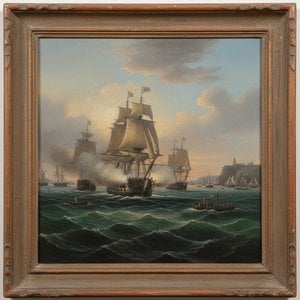
A Life Defined by the Sea and Service
Woolwich, 1798. The air near the naval dockyards carries the scent of salt and timber. This is where William Stuart enters the world, a place where the mechanics of maritime power are a daily reality. He does not merely observe the sea; he becomes a chronicler of its most heavy and consequential moments. His life is anchored in the visual language of the British naval tradition, a world of rigging, heavy hulls, and the immense weight of history unfolding on the waves.
By the mid-19th century, Stuart has established himself within a dedicated artistic household. His marriage to Amelia McGuire in 1826 marks the beginning of a domestic sphere where art is the primary occupation. The house is a workshop of talent, populated by children who would follow his lead into the professional art world. His son, William Evans Dutton Stuart, and his daughter, Teresa, both take up the brush, ensuring the family name remains etched in the annals of British painting.
The Weight of History on Canvas
Stuart’s focus remains fixed on the intersection of military might and maritime movement. He does not seek the abstract; he seeks the specific, the tangible reality of a ship under sail or a vessel in distress. His work often captures the aftermath of conflict, the quiet, heavy labor of recovery that follows the thunder of cannon fire. He finds his subject matter in the grand narratives of the Royal Navy, translating the chaos of battle into the structured tension of a maritime scene.
His technical focus is defined by several key areas of interest:
- Marine subjects involving the intricate details of naval architecture and rigging.
- Military scenes that document the movements of significant historical fleets.
- Still-life studies of fruit and flowers, a departure from his primary naval focus.
In 1855, he produces a significant work depicting the HMS 'Victory' being towed into Gibraltar. It is a scene of immense gravity, capturing the vessel following the Battle of Trafalgar. The painting reflects a specific historical moment, showing the 'Victory' under tow by the 'Neptune' on 3 November 1805. This work, later held by the National Maritime Museum, serves as a primary record of his ability to handle the scale and technicality of naval history.
Later Years and Legacy
The later decades of the 19th century see Stuart moving toward a quieter existence. By 1871, he has relocated to Gravesend, largely retired from the active pursuit of major commissions. The intensity of his earlier maritime documentation gives way to a more settled life. He remains a figure of the professional art class, a man whose identity is inseparable from the visual history of the United Kingdom's naval supremacy.
His death, occurring around 1874 in London or 1879 in Brighton, marks the end of a career spent documenting the heavy, salt-stained reality of the sea. He leaves behind a lineage of painters and a body of work that preserves the physical presence of the great ships of his era.
问答详情
在哪里可以按氛围浏览 William Stuart 的作品?
您可以在艺术家 William Stuart 的 情境空间 页面上按心情浏览其作品,该页面已根据作品所传达的情绪进行了分类整理。
在哪里可以浏览 William Stuart 的全部作品?
您可以在 William Stuart 的 全部作品 页面上浏览其在 本站 上的所有作品。
是否有William Stuart作品的时间线?
William Stuart 的作品时间轴现已上线:在艺术家的 作品时间轴 页面中,所有作品均按创作日期排序。
在哪里可以参观William Stuart作品的3D虚拟展厅?
您可以在William Stuart的3D 艺术展厅页面中,通过3D展厅欣赏其艺术作品。