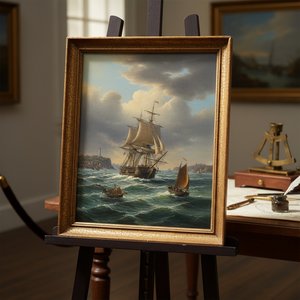
A Life Dedicated to the Sea: The World of William Leask
William Leask, a name synonymous with the romantic allure of maritime painting, occupies a unique position in 19th-century British art. While biographical details remain somewhat elusive – a testament perhaps to his dedication to observation and depiction rather than self-promotion – his canvases speak volumes about a life intimately connected to the sea. Born into an era captivated by naval power, exploration, and the sheer drama of ocean voyages, Leask channeled this collective fascination into works that are both historically evocative and emotionally resonant. He is not merely a recorder of ships; he’s a storyteller, capturing fleeting moments of light, weather, and human endeavor against the vast backdrop of the marine world. His paintings offer a window into a bygone age, a time when sail dominated the waves and the Royal Navy projected British influence across the globe. Leask's enduring appeal lies in his ability to blend meticulous detail with an atmospheric quality that transports viewers directly onto the decks of these historic vessels.Early Influences & Artistic Development
The precise details of Leask’s early training are not fully documented, but it is clear he benefited from a strong grounding in traditional artistic techniques. The prevailing aesthetic climate of his formative years was heavily influenced by the Romantic movement, with artists like J.M.W. Turner and William Clarkson Stanley prioritizing emotional impact and dramatic landscapes over strict realism. While Leask’s style diverges significantly from Turner's ethereal abstractions, he shares a similar fascination with the power of nature – specifically, the sea in all its moods. It is likely that early exposure to maritime life itself played a crucial role in his development. Unlike many naval painters who worked primarily from sketches and secondhand accounts, Leask appears to have spent considerable time observing ships at sea, meticulously studying their rigging, sails, and behavior in varying conditions. This dedication to direct observation distinguishes his work and lends it an authenticity that resonates with both maritime enthusiasts and art collectors alike. His early works often depict smaller vessels – coastal trading schooners, fishing boats – gradually evolving towards larger, more complex compositions featuring warships and passenger liners.A Master of Maritime Detail: Key Themes & Techniques
Leask’s oeuvre is dominated by depictions of sailing ships, particularly those associated with the British Royal Navy and the commercial shipping routes that connected Britain to its empire. He possessed an extraordinary ability to render the intricate details of naval architecture – the complex network of ropes and sails, the polished brass fittings, the flags fluttering in the breeze. However, his paintings are not simply technical exercises; they’re imbued with a sense of atmosphere and narrative. He masterfully captures the play of light on water, the subtle gradations of color in the sky, and the feeling of movement as ships glide through the waves. A recurring theme in Leask's work is the depiction of historical events or specific vessels. His painting of the SS St Sunniva, a passenger steamer lost off the Norwegian coast in 1904, exemplifies his ability to convey both the grandeur and vulnerability of maritime life. The scene is rendered with painstaking accuracy, yet it’s also deeply moving, evoking a sense of tragedy and loss. He frequently portrays ships under full sail, harnessing the wind, symbolizing power, progress, and the adventurous spirit of the age.Historical Significance & Enduring Legacy
William Leask's work provides invaluable insights into the maritime world of the 19th and early 20th centuries. His paintings serve as visual records of ship designs, naval practices, and the daily lives of sailors.- His meticulous attention to detail makes his works particularly valuable for historians and researchers.
- Beyond their historical significance, Leask’s paintings are admired for their artistic merit – their skillful use of light and color, their atmospheric quality, and their ability to evoke a sense of drama and emotion.
- He successfully captured the spirit of an era defined by naval dominance and global exploration.
问答详情
William Leask 最常使用的色彩有哪些?
William Leask 作品的色彩特征展示在艺术家的 色彩基因 页面上。
是否有William Leask作品的时间线?
您可以在William Leask的作品时间轴页面上按时间顺序查看其作品。
William Leask 的艺术生涯是如何划分为不同时期的?
William Leask 的艺术生涯在 艺术编年史 页面上按时期逐一展开:以横向时间轴的形式呈现作品,并按创作时期划分为不同的篇章。