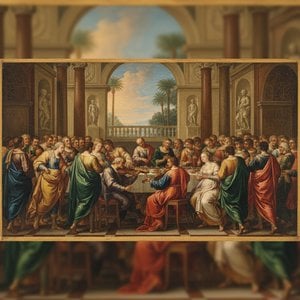
A Life Immersed in Light: The World of Theodoros Poulakis
Theodoros Poulakis, a name resonating through the annals of Greek Renaissance art, was born into the vibrant artistic milieu of Crete around 1622. His life unfolded during a period of immense upheaval and transition for the island, then under Venetian rule, and his work beautifully encapsulates this era’s complex interplay of Byzantine tradition and burgeoning Western influences. While precise details of his early training remain somewhat elusive, it is known he studied under Elias Moskos in Zakynthos, laying the foundation for a career that would ultimately see him become a pivotal figure—a “father,” as some scholars have termed him—of the Heptanese school of painting. Crete at this time was a crucible of artistic innovation, and Poulakis emerged from it not merely as a skilled craftsman but as a visionary who dared to blend established iconographic styles with new perspectives on form, color, and narrative depth. His family life, though documented through Venetian records—marriage and the births of his children Vittirous and Eleni—remains largely overshadowed by the sheer volume and impact of his artistic output.Venice, Corfu, and a Shifting Artistic Landscape
Poulakis’s journey wasn't confined to Crete. A significant portion of his life was spent in Venice, beginning around 1644 and punctuated by returns throughout the mid-17th century. This exposure to the heart of the Venetian Renaissance proved transformative. He became a member of the influential Quaranta council, immersing himself not only in the artistic community but also in the political currents of the time. The city’s vibrant art scene—populated by contemporaries like Philotheos Skoufos, Emmanuel Tzanes, and Konstantinos Tzanes—provided fertile ground for experimentation and exchange. However, the looming shadow of conflict with the Ottoman Empire cast a long pall over Crete. As Candia (modern Heraklion) endured a twenty-year siege culminating in its fall in 1669, Poulakis made the pivotal decision to settle on the island of Corfu. This relocation wasn’t simply a geographical shift; it marked a turning point in his artistic development and solidified his role as a leading force in the burgeoning Heptanese school. He established a workshop, taking on students like Marinos Damistras's son Tzorzi under a formal six-year contract that even stipulated following Poulakis back to Venice if necessary—a testament to his sought-after expertise.The Fusion of Traditions: A Unique Artistic Voice
Poulakis’s artistic style is characterized by a remarkable synthesis of Byzantine icon painting and the emerging trends of Venetian art, particularly the influence of Flemish engravings. He didn't abandon the *maniera greca*, the traditional Greek style, but he subtly infused it with a newfound sense of realism, volume, and emotional intensity. His compositions often feature crowded scenes brimming with figures, echoing the works of Andreas Pavias and Georgios Klontzas, yet his use of color is notably more vibrant and nuanced. The impact of Flemish prints is particularly evident in his attention to detail and the dynamic energy he brings to his narratives. Works like “Hymn to the Virgin” demonstrate this fusion beautifully—a traditional subject rendered with a heightened sense of physicality and dramatic flair. This ability to seamlessly blend disparate influences set him apart from his contemporaries and established a distinctive artistic voice that would come to define the Heptanese school. Over 130 attributed paintings, scattered across Greece and beyond, stand as enduring testaments to his prolific output and innovative spirit.Biblical Narratives and Religious Devotion
The core of Poulakis’s oeuvre lies in his depictions of biblical scenes and religious subjects. His “Nativity of Christ” and “Archangel Michael” are prime examples of his dramatic storytelling, imbued with a sense of spiritual fervor and emotional resonance. He wasn't merely illustrating scripture; he was inviting viewers into the heart of these sacred narratives, fostering a deeper connection to their faith. “St Spyridon and scenes from his life” exemplifies his ability to portray local saints with reverence and detail, reflecting the deep religious devotion prevalent in Crete and the Ionian Islands. His paintings weren’t simply objects of beauty; they were integral components of liturgical practice, adorning church walls and altars, serving as focal points for prayer and contemplation. The artist's skill lay not only in his technical mastery but also in his ability to convey profound theological meaning through visual language.Legacy and Historical Significance
Theodoros Poulakis died on Corfu in 1692, leaving behind a legacy that continues to inspire awe and admiration. His influence extended far beyond his immediate circle of students, shaping the course of Greek Renaissance painting for generations to come. He is rightly regarded as a pivotal figure in bridging the gap between the Byzantine tradition and the Western artistic innovations of the 17th century. His work represents a unique moment in art history—a synthesis of cultures, styles, and beliefs that reflects the complex identity of Crete during a period of profound change. Poulakis’s paintings are not merely historical artifacts; they are windows into a world steeped in faith, artistry, and the enduring power of human creativity. His contribution to the development of the Heptanese school cemented his place as one of the most important Greek painters of his time, and his works continue to captivate audiences with their beauty, drama, and spiritual depth.问答详情
是否有关于 Theodore Poulakis 的生平年表?
您可以在艺术家的 艺术历程 页面上查阅 Theodore Poulakis 作品的编年史,其作品按创作顺序分章节依次呈现。
在哪里可以按氛围浏览 Theodore Poulakis 的作品?
您可以在艺术家 Theodore Poulakis 的 情境空间 页面上按心情浏览其作品,该页面已根据作品所传达的情绪进行了分类整理。
在哪里可以按关键词浏览 Theodore Poulakis 的作品?
若要按特定主题查找 Theodore Poulakis 的作品,请访问艺术家的 关键词分类 页面,该页面通过关键词对作品进行了分类整理。