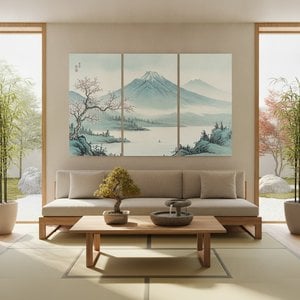
The Brush of Enlightenment
Sokuhi Nyoitsu, also known by his Chinese name Jifei Ruyi, was far more than a mere painter; he was a profound figure of the seventeenth century, a Buddhist monk of the Ōb)
sect whose life and spirit were inextricably linked to the flow of ink and the discipline of Zen. Born in Fuzhou, Fujian, in Southeast China, he emerged from a declining Confucian scholar gentry family of the Chen clan. His early path was shaped by spiritual devotion, having been ordained at the age of seventeen by Feiyin Tongrong. This foundation of monastic rigor would later define his approach to the arts, as he became a master of calligraphy and poetry, embodying the literati ideal where religious practice and aesthetic expression are one.
His journey was marked by moments of intense spiritual transformation. In 1651, while fighting a forest fire near his temple, Sokuhi nearly perished from asphyxiation, an experience that led to a sudden and profound enlightenment. This spiritual awakening deepened his connection to the teachings of his mentors, most notably Ingen Ryūki. Alongside his colleagues Mokuan Shōtō and Ingen, Sokuhi became part of the celebrated Three Brushes of Ōbaku, or Ōbaku no Sanpitsu, a group of calligraphers whose mastery of the brush brought the vibrant culture of Ming-dynasty China to the shores of Japan.
A Bridge Between Cultures
The movement of Sokuhi Nyoitsu from China to Japan represents a vital chapter in the cultural history of the Edo period. Following his teacher Ingen to Nagasaki in 1657, he became a central figure in the establishment of the Ōbaku Zen school in Japan. His presence in Nagasaki—a rare gateway for Chinese learning under the Tokugawa government—allowed him to facilitate a profound exchange of Confucian and Zen ideas. Whether serving as the abbot of Sōfuku-ji or later establishing the temple Fukuju-ji on Mount Kujū, his life was dedicated to the transmission of dharma and the cultivation of a syncretic religious practice that blended Linji Chan style with deep Confucian kinship.
His artistic legacy is found in the delicate interplay of ink and meaning. His works, such as the evocative Reading a Sutra by Moonlight, reflect the quiet, quotidian devotion of Zen monastic life. In these pieces, the brushwork is often deftly executed, capturing the essence of an arhat or monk lost in contemplation. His poetry and inscriptions frequently explore the paradoxes of existence, using imagery where the moon and white paper are indistinguishable, or where the pupil of the eye and the ink are both black, illustrating a marvelous meaning that resides within the circle but remains beyond human comprehension.
Legacy of the Three Brushes
Though he eventually returned to China to retire at Sōfuku-ji, his influence remained etched in the temples of Japan. The historical significance of Sokuhi Nyoitsu lies in his ability to weave together the threads of religious authority, poetic grace, and calligraphic skill. He did not merely create art; he lived it as an extension of his monastic vows. His remains, placed at both Fukuju-ji and Sōfuku-ji, serve as a final testament to a life that bridged two nations and two worlds through the singular, transformative power of the brush.
问答详情
我可以通过色调来浏览 Sokuhi Nyoitsu 的作品吗?
按色调分类 页面按色调将 Sokuhi Nyoitsu 的艺术作品进行了分类。
Sokuhi Nyoitsu 的出生地和出生年份是?
Sokuhi Nyoitsu 于 1616 出生于 Beijing。
Sokuhi Nyoitsu 出生于哪个城市和国家?
Sokuhi Nyoitsu 出生于 China 的 Beijing。