The Weight of Expressionism
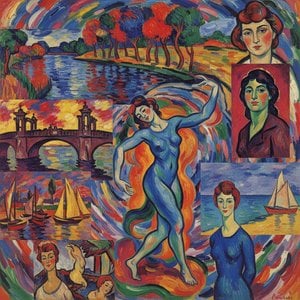
Robert Freysz remains a figure of specific, localized importance within the Belgian-French artistic landscape. His work does not rely on grandiosity but on a direct, expressionist application of oil on canvas. To look at his output is to see a painter who prioritized the physical presence of the subject over decorative artifice. He moved through the Belgian art scene with a focused intent, settling in Ghent in 1933 after his formative years in the Academy of Antwerp. His presence in the historical record is confirmed by his inclusion in significant Belgian art registries, marking him as a professional of substance rather than a peripheral hobbyist.
His technical development followed a rigorous path through the Academy of Antwerp between 1933 and 1939. This training provided the foundation for a style that eventually drifted into late animistic tendencies. He was not a painter of mere likeness; he was a painter of form and energy. His ability to translate the essence of a subject into a structured, expressive language is evident in his surviving works held in major collections like the Royal Museum of Fine Arts Antwerp.
Technical Foundations and Stylistic Shifts
The evolution of Freysz's hand is visible in the transition from academic discipline to a more visceral, animistic approach. His work is characterized by several distinct elements:
- The use of oil on canvas to create textured, heavy-bodied surfaces.
- An expressionist approach to landscape and portraiture.
- A shift toward animistic qualities in his later compositions.
- A focus on the structural integrity of the subject through light and shadow.
His portraiture, such as the Portrait of a Woman, demonstrates a command over the medium that avoids the pitfalls of sentimentality. He approached the human form with a certain bluntness, using the brush to define character rather than to polish it. This refusal to over-refine the subject is what gives his work its lasting, grounded quality.
Historical Presence and Legacy
Freysz's career was defined by a steady, professional trajectory from his birth in Mulhouse to his death in Limoges. He was a working artist who participated in the vital art markets of his time, with his works being acquired by museums as early as 1938. This early institutional recognition speaks to the immediate impact of his visual language. He was not a painter of fleeting trends but one who established a permanent place within the Belgian canon.
Today, his significance is found in the specific way he handled the tension between form and emotion. He did not seek to change the course of art history, but he mastered the tools of his era to produce work that remains physically and visually assertive. His legacy is one of technical competence and a refusal to compromise the raw, expressive power of the medium.
问答详情
Robert Freysz 的创作时期属于哪个历史阶段?
Robert Freysz 的创作活跃于 Modern 时期,这一时期确立了艺术家在艺术史上的地位。
在哪里可以按关键词浏览 Robert Freysz 的作品?
Robert Freysz 的 关键词分类 页面通过关键词对艺术家的作品进行了分类。
Robert Freysz 的艺术风格是如何随时间演变的?
Robert Freysz 的 艺术历程 是一个随滚动条变化的艺术时间轴,按创作时期进行章节划分,并按时间顺序呈现艺术家的作品。
Robert Freysz 出生于哪个国家和城市?
Robert Freysz 出生于 France 的 Mulhouse。