Early Life, Family and Training
Robert Annand entered the world on November 5, 1923, in the town of Truro, Nova Scotia. He was born to Clifford Arthur Annand and Marjory Britton (McCully) Annand, growing up in a landscape that would eventually inform his sense of place. His early years were shaped by the quiet rhythms of central Nova Scotia, yet a restless spirit soon drew him toward the study of form and color.
His formal training began at Mount Allison University, where he sought to master the nuances of the brush. It was there that he studied under the English landscape painter Stanley Royle, absorbing the lessons of a man dedicated to the depiction of the natural world. This period of academic pursuit, however, was interrupted by the heavy demands of history. Robert Annand answered the call of duty during the Second World War, serving as a paratrooper in the Canadian Army. He saw the realities of conflict firsthand when he participated in Operation Varsity, an experience that would surely leave its mark upon his perspective.
Once the tumult of war had subsided, he returned to his calling with a renewed sense of purpose. He moved to Toronto to resume his training at the Ontario College of Art. In the classrooms of the city, he continued to refine his hand, transitioning from the youthful studies of his university days toward a more mature command of his chosen mediums. This period of study in Toronto laid the foundation for a life spent translating the essence of figures and nature onto canvas.
Technique and Artistic Style
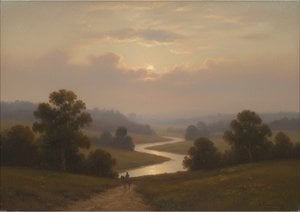
Annand sought a way to translate the internal spirit onto the canvas, often prioritizing his own feelings over the mere accuracy of the eye. He found a particular joy in working with lines and a fluid paint effect, allowing the medium to move with a certain looseness. This approach gave his studies of figures, landscapes, and nature an expressionistic quality, where the essence of the subject matter took precedence over strict anatomical or topographical precision. He once remarked that a composition might emerge from a sudden impulse to capture a specific detail, such as the curve of a back or the shape of an ear, rather than a rigid adherence to a preconceived plan.
His time spent in Guadalajara, Mexico, to study the art of mural painting, left a profound mark on his professional development. This experience helped shape the way he handled his subjects, lending a sense of weight and purpose to his compositions. Whether working in oil or acrylic, he maintained a focus on the tactile nature of the paint itself. His hands moved with a sense of purpose, seeking to capture the movement of the natural world and the human form through a lens of personal perception rather than photographic imitation.
Exhibitions and Major Collections
The recognition of his talent grew steadily through the decades, finding a significant place within the national conversation of Canadian art. In 1955, his work was selected for inclusion in the first Biennial of Canadian Painting at the National Gallery of Canada. This period marked a time when his presence in the galleries began to solidify, moving from individual study into the public eye. His ability to capture the essence of a subject through fluid lines and expressionistic handling ensured that his paintings would find a permanent home in many important institutions.
As his career progressed, his contributions were celebrated through major retrospectives that allowed the public to see the breadth of his vision. In 1983, the Art Gallery of Nova Scotia organized a significant exhibition titled "Robert Annand: A Retrospective," which traveled to share his perspective with the Maritimes. These exhibitions helped cement his legacy, ensuring that his depictions of figures and landscapes remained part of the regional and national consciousness.
Today, his legacy is preserved within several esteemed collections that hold his oils and acrylics. His works are held in the National Gallery of Canada and the Canada Council Art Bank. Furthermore, his presence is felt in the Art Gallery of Nova Scotia, the Acadia University Art Gallery, and the Nova Scotia Art Bank. His paintings remain accessible to those studying the development of Canadian expressionism through these various public repositories.
- Family Group, about 1954
Later Years and Death
In his final years, the quiet rhythms of creativity continued to sustain him. While residing at the Rideau Veterans Residence, he found solace and connection through the music and painting programs offered there. These activities allowed him to maintain a vital link to the expressive impulses that had guided his hand for decades. He remained a man of simple, enduring interests, finding joy in the communal spirit of the arts even as his physical strength waned.
The end of his long life came on May 20, 2023, at Perley Health in Ottawa, Ontario. He left behind a family that held his memory close, including his wife, Penny (Chambers) Annand, and his children, Thomas and Sarah. He was preceded in death by his siblings, Pat Pyne, Florence Endall, and Charles. Through his family and the many public collections that hold his works, his presence remains a part of the Canadian landscape he so carefully observed.
问答详情
在哪里可以按色调浏览 Robert Annand 的作品?
按色调浏览 页面按色调将 Robert Annand 的艺术作品进行了分类。
在哪里可以找到关于Robert Annand作品的相关统计数据?
有关 Robert Annand 作品的统计数据,请参阅艺术家的 统计数据 页面。
在哪里可以按氛围浏览 Robert Annand 的作品?
艺术家的 情境空间 页面按氛围分类展示了 Robert Annand 的艺术作品。
在哪里可以按技法分类浏览 Robert Annand 的作品?
您可以在Robert Annand的所有媒介页面上按媒介浏览其作品。