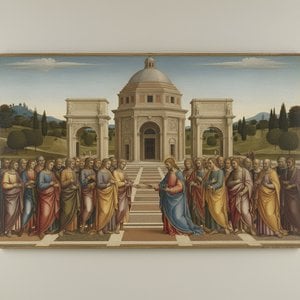
The Identity of Pseudo-Bles
The name Pseudo-Bles belongs to an anonymous painter from Antwerp who was active between 1510 and 1530. While the person behind the brush remains a mystery to history, the life attributed to this figure spans from 1450 to 1550. This long timeline suggests a presence that bridged different eras of the Northern Renaissance, even if the artist's true identity was never recorded in the way we might expect for a person of such influence.
Tracing the legacy of Pseudo-Bles requires looking across borders. Their presence is felt in five different museums, spread throughout four cities and four countries. These works have traveled far from their origins, finding homes in places like Germany, Belgium, and Poland. In the Netherlands, the largest collection of these works can be found at Museum Flehite in Amersfoort.
Because the artist remains anonymous, we often find their hand in works that reflect the specific atmosphere of the early sixteenth century. Their output is scattered, making each piece a quiet piece of a larger, unsolved puzzle. We see their influence in:
- The Adoration of the Magi
Where to See the Works Today
Finding the traces of this artist requires a bit of traveling across Europe, as their presence is scattered through several different countries. You can find their handiwork in the Netherlands, Germany, Belgium, and Poland. It is a quiet trail left behind, spread across four nations, waiting for those who look closely at the museum walls.
In Germany, the collection is most concentrated, with two pieces held in Munich. If you find yourself in the Netherlands, you might encounter a single work in Amersfoort. The artist's reach extends into Belgium, where the Museum of Fine Arts Ghent holds one piece, and into Poland, where the National Museum in Warsaw preserves another. These scattered locations offer a way to see how the work has been kept through the centuries.
- The Adoration of the Magi, about 1510
Key Works of the Artist
One of the most significant pieces associated with this artist is The Adoration of the Magi. Created between 1510 and 1520, this work offers a glimpse into the visual language used during that period. The painting measures 0.61m x 0.78m and is currently held in the collection of the National Museum in Warsaw.
The presence of this work in Poland allows viewers to see the scale and detail of the artist's hand. It remains a primary reference for understanding the output of this anonymous painter active in the early sixteenth century.
问答详情
在哪里可以按主题查看Pseudo-Bles的作品分布?
Pseudo-Bles 的 主题索引 旨在通过主题对艺术家的作品进行分类索引。
Pseudo-Bles 是否还有其他别名或曾用名?
Pseudo-Bles 也以 Pseudo-Blesius, Master of the Munich Adoration 等其他名称为人所知。
Pseudo-Bles 的艺术风格是如何随时间演变的?
您可以在艺术家的 艺术历程 页面上查阅 Pseudo-Bles 作品的编年史,其作品按创作顺序分章节依次呈现。