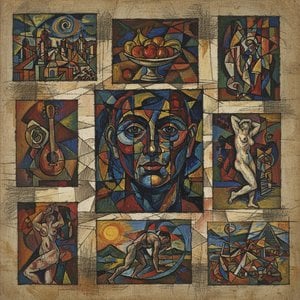
The Soul of the Plains: The Visionary Journey of Oscar Howe
Born into the quiet strength of the Crow Creek Sioux Reservation in 1915, Oscar Howe—known in his native Yanktonai Nakota tongue as Mazuha Hokshina or "Trader Boy"—carried within him a visual language far older than the modern era. His early years were shaped by the profound spiritual and aesthetic traditions of his people, most notably through the teachings of his maternal grandmother, Shell Face. It was from her that he inherited a deep reverence for the sacred symbols and intricate geometric patterns of the Sioux tribes, elements that would later serve as the foundational DNA of his revolutionary paintings. Though his youth was marked by the hardships of poverty and the physical struggle against tuberculosis, these early trials only served to sharpen his focus, eventually leading him to the Santa Fe Indian School where his destiny as a pioneer of Native American modernism began to take shape.
The evolution of Howe’s artistry is a breathtaking narrative of cultural synthesis. Under the mentorship of Dorothy Dunn at the Studio School, he mastered formal painting techniques, yet he refused to be confined by the era's expectations of "authentic" Indigenous art. While many contemporaries felt pressured to produce representational, static depictions of traditional life to satisfy Western collectors, Howe looked toward the global avant-garde. His exposure to Cubism and Surrealism—further refined during his service in the U.S. Army during World War II—allowed him to fracture and reconstruct reality. He began to weave the ancestral motifs of the Black Hills and ceremonial belts into a dynamic, abstract framework, creating a style that utilized planar space and bold, rhythmic lines to evoke the very essence of Dakota cosmology.
A Revolution in Color and Form
To look upon a Howe masterpiece is to witness a dance of energy and motion. His technique was characterized by an extraordinary use of casein and tempera, mediums that allowed for the vibrant, saturated colors and pristine, sharp lines that became his signature. He moved away from the literal depiction of Sioux dances and ceremonies, choosing instead to capture their spiritual vibration through geometric abstraction. In his work, a single line could represent the movement of a dancer or the flow of a sacred wind; a jagged shape might echo the rugged landscape of South Dakota. This approach was not merely an aesthetic choice but a profound political statement—a rejection of the "primitive" label and an assertion that Native American art could be contemporary, experimental, and intellectually rigorous.
His contributions to the art world extended far beyond the canvas. As an educator at the University of South Dakota, Howe mentored generations of artists, instilling in them the courage to pursue individual expression over cultural conformity. His legacy is defined by several monumental achievements:
- Breaking Stereotypes: He successfully challenged the Western art establishment's tendency to categorize Indigenous work as static or "antimodern," proving that tradition and innovation are not mutually exclusive.
- Mastery of Abstraction: By integrating Sioux symbolism with the principles of modernism, he created a unique visual dialect that bridged the gap between ancestral heritage and the global contemporary art movement.
- Cultural Advocacy: Through his murals and teaching, he acted as a vital bridge, ensuring that the spiritual depth of the Yanktonai Sioux remained visible within the broader American art canon.
Today, the name Oscar Howe resonates as a symbol of artistic independence. He remains a towering figure whose work continues to inspire a global dialogue on identity, much of which is celebrated in major exhibitions from the Smithsonian’s National Museum of the American Indian to the Portland Art Museum. His life's work stands as a testament to the power of perseverance, proving that even when faced with the pressures of assimilation, the spirit of one's heritage can be transformed into a universal language of beauty and truth.
问答详情
如何按特定主题查找 Oscar Howe 的作品?
您可以通过艺术家关键词分类页面,按关键词探索Oscar Howe的作品。每个关键词都汇集了相关的艺术品。
我可以在虚拟博物馆中参观Oscar Howe的作品吗?
您可以在Oscar Howe的3D 艺术展厅页面中,通过3D展厅欣赏其艺术作品。
是否有Oscar Howe作品的时间线?
艺术家的 作品时间轴 页面按年份顺序展示了 Oscar Howe 的作品。
我可以通过色谱来探索 Oscar Howe 的作品吗?
色彩索引 页面按色彩对 Oscar Howe 的作品进行了分类整理。