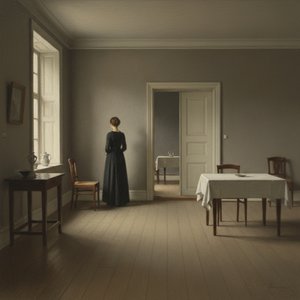
A Life Captured in Light and Shadow
The story of Moritz Unna is one of profound transition, a life lived between the delicate strokes of a paintbrush and the emerging magic of the photographic lens. Born in Copenhagen on the final day of 1811, Unna’s early years were marked by the shifting landscapes of Northern Europe. Following the untimely death of his father, a prominent furniture dealer, the family moved to Gothenburg, an environment that would later serve as a rich tapestry for his artistic explorations. Though he initially sought stability in the structured world of commerce as a clerk, the call of the aesthetic was too potent to ignore. By 1830, Unna had returned to his roots in Copenhagen, enrolling in the prestigious Royal Danish Academy of Fine Arts, where his talent began to garner formal recognition through silver medals and early exhibitions.
His artistic journey was never a linear path but rather a wandering pursuit of capturing truth. In the late 1830s, Unna’s spirit led him toward Munich, a vibrant hub of European art, where he immersed himself in the local Kunstverein and honed his skills as a portraitist. This period of international exposure allowed him to refine a technique characterized by precision and an intimate understanding of human character. Whether painting the dignified features of a statesman or the quiet labor of a blacksmith, Unna possessed a rare ability to imbue his subjects with a sense of lived experience, making the mundane feel monumental.
The Intersection of Genre and Photography
As the mid-19th century approached, Unna’s creative focus underwent a fascinating evolution. Returning to Sweden, he found himself deeply moved by the rustic charm of folk life. He began to dedicate much of his energy to creating scenes of Swedish peasantry, capturing the rhythmic toil of rural existence with an empathetic eye. His works from this era, such as Woman with Handwork outside a Fisherman's Hut, serve as poignant windows into a vanishing way of life, where the textures of canvas and oil mirror the ruggedness of the landscape itself.
However, it was perhaps his embrace of the burgeoning medium of photography that truly defined his later years. Driven by both necessity and a fascination with the new science of light, Unna opened a photographic studio in 1854. This transition from painter to photographer represents a significant moment in art history, as he bridged the gap between traditional fine art and the modern era of mechanical reproduction. His studio work allowed him to document the faces of his time with a level of fidelity that painting alone could not achieve, effectively blending his trained eye for composition with the stark reality of the camera.
Legacy and the Final Frame
Despite his immense versatility, Unna’s later life was shadowed by the hardships common to many artists of his era. Financial instability and declining health eventually forced him back to Copenhagen, where he struggled through a period of near poverty. Yet, even in these difficult years, his contribution to the Danish and Swedish artistic landscapes remained indelible. His ability to navigate between the roles of portrait painter, genre artist, and pioneer photographer marks him as a figure of great historical significance.
Today, we remember Moritz Unna not merely for the subjects he depicted, but for the way he saw the world. His legacy is found in:
- The preservation of folk culture: Through his genre paintings, he immortalized the traditions and daily struggles of the Scandinavian people.
- Artistic versatility: He stood at the crossroads of tradition and innovation, mastering both the brush and the camera.
- Emotional depth: His portraits remain enduring studies of human dignity, capturing the essence of his subjects long after the pigments have dried or the silver plates have faded.
When he passed away in Copenhagen in 1871, Unna left behind a body of work that serves as a vital bridge between the classical traditions of the Academy and the modern photographic revolution, ensuring his place in the annals of Northern European art history.
问答详情
如何浏览 Moritz Unna 的全部作品?
您可以在 Moritz Unna 的 全部作品 页面上浏览其在 本站 上的所有作品。
Moritz Unna 出生于何时何地?
Moritz Unna 于 1811 出生于 Copenhagen。
Moritz Unna 来自哪里?
Moritz Unna 出生于 Denmark。
我可以通过关键词来探索 Moritz Unna 的作品吗?
您可以通过艺术家关键词分类页面,按关键词探索Moritz Unna的作品。每个关键词都汇集了相关的艺术品。