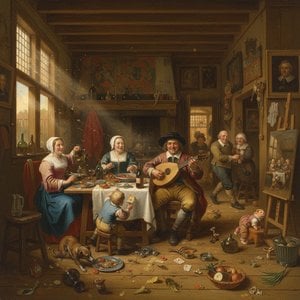
The Spirit of the Merry Company
In the bustling streets of Rotterdam, where the air often carried the salt of the sea and the scent of commerce, Marten Stoop began his life's work. He was a man of the Dutch Golden Age, a period when the canvas became a stage for the very essence of human conviviality and the sudden, sharp intrusions of conflict. As the younger brother of Dirck Stoop, he moved within a circle of creators who sought to capture the pulse of their era. His hands were trained to translate the movement of life onto a flat surface, often finding his way to the city of Utrecht, where his presence was noted in the records of the time.
Stoop possessed a particular talent for the animated landscape, often populating his scenes with riders that moved with a sense of purpose and energy. These were not merely static figures but participants in a larger, unfolding drama. His brushwork captured the weight of a horse's stride and the tension in a rider's posture, much like the works of his brother. He understood that a landscape was never truly empty; it was always inhabited by the ambitions and the movements of men.
Scenes of Revelry and Ruin
The heart of Stoop's output lay in the intimate, often boisterous, interiors of the Dutch home and tavern. He had a keen eye for the human countenance, frequently painting figures with full, rounded faces that suggested the indulgence of a well-lived life. His subjects were often groups of merry drinkers, where soldiers and women shared space in a delicate dance of social interaction. These scenes, sometimes titled as a Joyeuse compagnie, offered a glimpse into the private celebrations of his contemporaries.
Yet, his vision was not limited to the joy of the feast. He was equally capable of depicting the darker, more chaotic side of human existence. His work often touched upon the following themes:
- The lively, often crowded, interior scenes of soldiers and women in social gatherings.
- The spirited and animated landscapes featuring riders and horses.
- The sudden, violent disruptions of domestic peace, such as the plundering of a village.
- The quiet, perhaps more moralistic, depictions of charity and social duty.
In works like Pillage d'un village, the atmosphere shifts from the warmth of a tavern to the cold reality of upheaval. He did not shy away from the friction between the soldier and the civilian, a theme that echoed through the many works of his peers. His ability to pivot from the laughter of a Conversation galante to the tension of a soldier in billeted quarters shows a painter deeply attuned to the dualities of his age.
A Legacy in Utrecht
By the time he reached the end of his days in Utrecht, Stoop had established himself as a painter who could navigate the complexities of both the peaceful and the profane. He left behind a body of work that captured the textures of Dutch life, from the fine details of a soldier's uniform to the messy, unscripted moments of a drinking party. His paintings remain as windows into a world of movement, whether that movement was the steady trot of a horse or the sudden, frantic rush of a village under siege.
问答详情
Marten Stoop 的创作时期属于哪个历史阶段?
Marten Stoop 的创作活跃于 Early Modern 时期,这一时期确立了艺术家在艺术史上的地位。
是否有Marten Stoop作品的3D虚拟展厅巡览?
Marten Stoop 的 3D 艺术展厅 可以在虚拟三维展厅中欣赏到艺术家的作品。
可以按颜色对Marten Stoop的作品进行排序吗?
Marten Stoop 的 色彩索引 页面按色彩对艺术家的作品进行了分类整理。
是否有Marten Stoop作品的时间线?
Marten Stoop 的作品时间轴现已上线:在艺术家的 作品时间轴 页面中,所有作品均按创作日期排序。