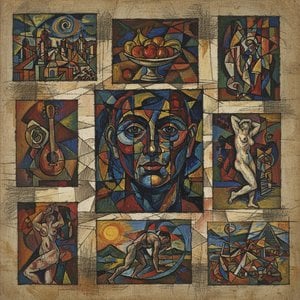
A Life Painted in Slovak Soil
Born in the quiet town of Dubnica nad Váhom, Karol Ondreička entered a world that would later become the very soul of his canvases. His early years were shaped by the landscapes of his homeland, a place where the light and the earth seemed to whisper stories of tradition and struggle. As he matured, his brush began to capture more than just scenery; it sought to document the pulse of Slovak life through a modern lens.
His path was not one of solitary isolation but of connection to the broader currents of European art. In 1942, his work reached the prestigious halls of the 23rd Venice Biennale, an achievement that brought his particular vision to an international stage. This moment in Venice marked a significant chapter where his local sensibilities met the wider gaze of the art world.
The Language of the Canvas
Ondreička’s work often turned toward the human condition and the quiet dignity found in rural existence. He possessed a particular talent for rendering scenes that felt deeply rooted in their specific geography, such as his depictions of life near Starhrad. In pieces like Pltníci pod Starhradom, one can sense the weight of the atmosphere and the presence of the people within it.
His compositions frequently explored themes of community and hardship. The painting Opitá dedina, created in 1939, reflects a period of profound change and tension, showing how he used his art to respond to the era's gravity. Even in more spiritual or gentle subjects, such as Slovenská madona, there is a groundedness that avoids mere sentimentality, favoring instead a sincere observation of form and feeling.
Legacy and Presence
Throughout his later years, which concluded in Bratislava, Ondreička remained a figure of importance within the Slovak art scene. His presence was felt in galleries from Banská Bystrica to Martin, where his works were held in esteem by those who understood the depth of his modern approach. He shared the stage with other notable figures of his time, including Koloman Sokol and Peter Matejka, contributing to a collective movement that defined a generation.
The enduring nature of his work is seen in the way it continues to appear in exhibitions long after his passing. From the Central Slovakian Gallery to more recent displays in Bratislava, his paintings remain as physical links to a vanished era. His ability to translate the essence of his people onto canvas ensures that his vision remains accessible to those who seek to understand the history written in paint.
问答详情
在哪里可以找到关于Karol Ondreička作品的相关统计数据?
有关 Karol Ondreička 作品的统计数据,请参阅艺术家的 统计数据 页面。
Karol Ondreička 出生于哪个国家和城市?
Karol Ondreička 出生于 Slovakia 的 Dubnica nad Váhom。
可以按媒介类型浏览 Karol Ondreička 的作品吗?
您可以在Karol Ondreička的所有媒介页面上按媒介浏览其作品。
我可以在虚拟博物馆中参观Karol Ondreička的作品吗?
您可以进行虚拟参观:在 Karol Ondreička 的 3D 艺术展厅 页面中,您可以在三维画廊里欣赏艺术家的作品。