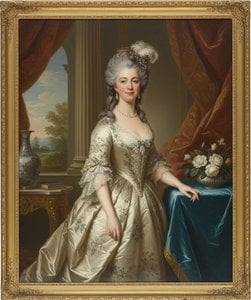
The Life and Art of John Russell
Born in Guildford, Surrey, John Russell was the son of a book and print seller. He showed an early inclination for art and trained under Francis Cotes RA, an early pioneer of English pastel painting. Russell's technical approach was influenced by the pastel drawings of Rosalba Carriera, specifically her methods of "sweetening." He established his own studio in London in 1767 and became an associate of the Royal Academy in 1771, eventually being elected a royal academician in 1788. His skill in portraiture earned him significant patronage, including the appointment as Crayon Painter to King George III, Queen Charlotte, the Prince of Wales, and the Duke of York.
Beyond his portraiture in oils and pastels, Russell was a man of deep religious conviction. A devout follower of George Whitefield, he maintained an elaborate introspective diary in John Byrom's shorthand, which he kept from 1766 until his death. His religious devotion influenced his daily life; for instance, he would not work on Sundays and would not allow anyone to enter his painting-room on those days. He also held a profound interest in astronomy, working with his daughter to create a lunar map and an apparatus called "Selenographia" to exhibit the phenomena of the Moon.
Notable Works and Legacy
Russell's artistic output was extensive, with 330 works exhibited at the Royal Academy between 1769 and his death. His subjects included prominent figures such as George James Bruere, the naturalist Sir Joseph Banks, and the scientist William Herschel. Some of his notable works include:
His detailed pastel drawing, The Face of the Moon, created between 1793 and 1797, is noted as a faithful early representation of the lunar sphere. Russell died in Hull after contracting typhus.
问答详情
可以按媒介类型浏览 John Russell 的作品吗?
所有媒介 页面按媒介分类展示了 John Russell 的作品。
在哪里可以浏览 John Russell 的全部作品?
您可以在 John Russell 的 全部作品 页面上浏览其在 本站 上的所有作品。
在哪里可以找到关于John Russell作品的相关统计数据?
John Russell 拥有一个 统计数据 页面,其中展示了该艺术家在 本站 上的作品统计数据。