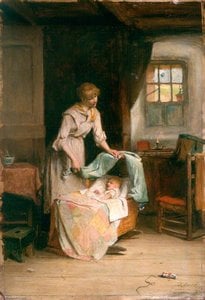
A Life Captured in Light and Sentiment
The story of John Burr is one deeply intertwined with the heart of the Victorian era, a period where the boundaries between domestic intimacy and grand public exhibition were beautifully blurred. Born in Edinburgh in 1831, Burr’s artistic sensibilities were shaped by the quiet, dignified landscapes and the genteel social structures of Scotland. Even as a young boy of fourteen, he possessed a precocious talent, finding his first subjects among the well-to-do residents of small Scottish towns. These early forays into portraiture—capturing the essence of affluent individuals with a sensitive eye—laid the foundational stones for a career that would eventually command the attention of the most prestigious art institutions in London.
His formal education at the Trustees' Academy in Edinburgh provided him with the technical rigor necessary to transition from a gifted provincial painter to a master of his craft. This period of academic refinement allowed Burr to develop a versatile command over both oil and watercolour, mediums that would serve him as he navigated the shifting tides of nineteenth-century art. By 1861, seeking broader horizons, Burr moved to London, a transition that marked a significant evolution in his professional trajectory. It was here, amidst the bustling energy of the British capital, that his artistry began to flourish on an international scale.
The Synergy of Brotherhood and the London Scene
One of the most compelling chapters in Burr’s life was his artistic partnership with his younger brother, Alexander Hohenlohe Burr. Together, they formed a formidable duo that navigated the competitive London art scene with remarkable success. This collaboration was more than a mere familial bond; it was a shared pursuit of capturing the delicate nuances of life. While John focused on the narrative depth of genre scenes and the psychological weight of portraiture, the brothers collectively established a presence that resonated through the most celebrated galleries of the age.
Burr’s ascent within the London art establishment was nothing short of illustrious. His debut at the Royal Academy in 1862 signaled the arrival of a significant new voice in British painting. Throughout his decades-long career, he became a mainstay of the Royal Academy, exhibiting eighteen works that showcased his ability to blend realism with a certain Romantic tenderness. His influence and reach extended far beyond a single institution; he was a prolific contributor to the Society of British Artists, where he eventually rose to the prestigious position of President from 1881 until 1886. His presence in the halls of the British Institution, the Grosvenor Gallery, and the Royal Water Colour Society cemented his status as a versatile and indispensable figure in the Victorian art world.
Mastery of Genre and the Art of Observation
The true magic of John Burr’s oeuvre lies in his ability to transform the mundane into the monumental. He was a master of genre painting, a style that sought to depict everyday life with a sense of narrative drama and emotional resonance. In works such as “The Peepshow,” Burr invites the viewer into a captivating tableau of social interaction, where every glance and gesture tells a story of human connection. Similarly, his piece “The Fifth of November” demonstrates his capacity to handle historical and thematic weight through a lens of meticulous detail.
Beyond the grander narratives, Burr possessed a profound ability to capture the ephemeral beauty of childhood and domesticity. His paintings often feature:
- Luminous Lighting: A technique that breathes life into his subjects, creating an atmosphere of warmth and nostalgia.
- Intimate Subject Matter: From the quiet tension in “Anxious Moments” to the idyllic innocence found in “Love’s Young Dream,” he explored the full spectrum of human emotion.
- Technical Precision: A mastery of texture and form that allowed him to move seamlessly between the delicate precision of watercolour and the rich, impasto depth of oil on canvas.
As his career progressed, Burr’s work became a mirror for the Victorian soul—reflecting both the era's fascination with social order and its deep-seated romanticism. Though he passed away in London in 1893, his legacy remains etched in the canvases that continue to evoke the spirit of a bygone age, reminding us of a time when art was a window into the very essence of the human experience.