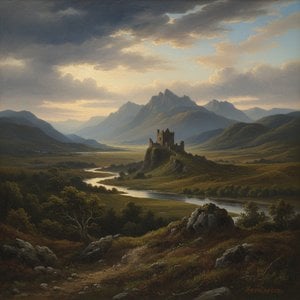
A Life of Color and Paper
Born in Leith, Scotland, Hans Jacob Hansen lived a life defined by the fluid boundaries of his medium. As a painter of Danish descent, he found his footing in Edinburgh, studying under R. B. Nisbet and J. Ross. His approach to the canvas was far from traditional. He favored a technique where colors were allowed to run together upon wet paper, a method that required both a steady hand and an acceptance of chance. Details emerged only as the paper dried, leaving behind scenes that felt as much like captured moments as they did deliberate compositions.
His interests led him far from the Scottish coast. Hansen traveled extensively through the Middle East, North Africa, and Spain. These travels provided the subject matter for his most noted works, which focused on the atmosphere of Eastern markets, the quietude of harems, and the intensity of bullfighting scenes. He possessed a particular talent for capturing the light and movement of these distant locales.
Recognition and Membership
The progress of his career was marked by steady institutional recognition. His work reached audiences at the Royal Academy and the Royal Scottish Academy, places where his specific style could be observed by his peers. In 1906, he achieved a significant milestone when he was elected a member of the Royal Scottish Watercolour Society.
His ability to translate foreign landscapes into watercolor earned him honors on the international stage as well. At the Salzburg International Exhibition, he was awarded a silver medal, a distinction that reflected the technical skill required for his wet-paper method. His life eventually brought him to Southend-on-Sea, England, where he passed away in 1947.
问答详情
可以按心情浏览 Hans Hansen 的作品吗?
您可以在艺术家 Hans Hansen 的 情境空间 页面上按心情浏览其作品,该页面已根据作品所传达的情绪进行了分类整理。
在哪里可以查看 Hans Hansen 作品的色彩风格?
Hans Hansen 的 色彩基因 展示了该艺术家作品的色彩特征。
Hans Hansen 的创作时期属于哪个历史阶段?
Hans Hansen 的创作活跃于 Early Modern 时期,这一时期确立了艺术家在艺术史上的地位。