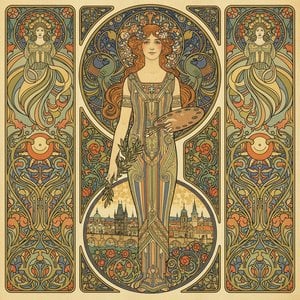
The Visionary of the Symbolist Riviera
Gustav Adolf Mossa (1883-1971) stands as a singular figure in French Symbolism, an artist whose oeuvre transcends mere visual representation to embody the profound anxieties and soaring aspirations of his era. Born in Nice, France, to an Italian mother and an artist father—Alexis Mossa—he inherited both a remarkable artistic talent and a deep-seated engagement with cultural heritage. His formative years were steeped in the vibrant, sun-drenched atmosphere of the French Riviera, where his father served as the founding curator of the Musée des Beaux-Arts de Nice. This familial environment fostered an early, intimate appreciation for art history and aesthetic experimentation, providing the fertile soil from which Mossa’s unique creative vision would grow.
Mossa's artistic journey was shaped by a transition from the decorative elegance of Art Nouveau to the psychological depths of the Symbolist movement. After receiving initial training under his father's watchful eye, he studied at the School of Decorative Arts in Nice, where he first encountered the flowing lines of the Belle Élampe era. However, it was a transformative visit to the 1900 Exposition Universelle in Paris that fundamentally altered his trajectory. There, he was introduced to the haunting, mythic worlds of Gustave Moreau. The influence of Moreau became a cornerstone of Mossa's vision, inspiring him to move beyond surface beauty toward an exploration of mythic themes, spiritual contemplation, and the darker, more enigmatic layers of the human psyche.
A Tapestry of Decadence and Satire
The heart of Mossa’s artistic output lies in his ability to channel the societal shifts of the turn of the century into evocative imagery. His most prolific period, spanning roughly from 1900 to 1911, served as a poignant reaction against the burgeoning materialism of the Belle Époque. Drawing literary inspiration from the decadent masters such as Charles Baudelaire, Stéphane Mallarmé, and Joris-Karl Huysmans, Mossa crafted works that were often thick with symbolism and social commentary. He frequently utilized the figure of the femme fatale to explore themes of danger and desire, often satirizing or condemning what he perceived as the increasingly materialistic nature of the Riviera's high society and the perceived social disruptions brought by the emerging "New Woman."
Technically, Mossa was a master of precision and atmosphere. His primary medium, watercolor, allowed him to achieve a delicate translucency that contrasted sharply with his strong, decisive ink lines. This technique enabled him to navigate a diverse range of subjects, from:
- Mythological Narratives: Reimagining ancient legends through a lens of modern psychological depth.
- Carnival and Spectacle: Collaborating with his father to design magnificent floats and posters for the Nice Carnival, blending fine art with public celebration.
- Landscape and Portraiture: Capturing the melancholic beauty of the Mediterranean coast and the intricate details of human character.
- Literary Illustration: Creating evocative drawings for significant works, including a series dedicated to the music of Robert Schumann.
Legacy of a Multidisciplinary Master
Beyond the canvas, Mossa was a true polymath of the arts. His creative spirit extended into the realms of playwriting, essay writing, and theatre design, proving that his interest in symbolism was not merely a stylistic choice but a fundamental way of perceiving the world. Whether he was designing intricate wooden reliefs or composing literary critiques, his work remained tethered to the idea of art as a vessel for deeper meaning. His contributions to the prestige of the Nice Carnival helped transform the event into a global cultural landmark, demonstrating his ability to bridge the gap between high-brow Symbolism and popular public engagement.
Today, Gustav Adolf Mossa is remembered not just as a painter of the Riviera, but as a chronicler of a vanishing world. His works remain vital testaments to a period of intense transition, capturing the tension between tradition and modernity, beauty and decay. Through his meticulous watercolors and biting satires, Mossa ensured that the spiritual and psychological complexities of the late 19th and early 20th centuries would continue to haunt and inspire generations of art lovers.
问答详情
Gustave Mossa 出生于哪个国家和城市?
Gustave Mossa 出生于 France 的 Nice。
在哪里可以按主题查看Gustave Mossa的作品分布?
Gustave Mossa 的 主题索引 旨在通过主题对艺术家的作品进行分类索引。
Gustave Mossa 的作品受欢迎程度如何?
Gustave Mossa 的 统计数据 页面展示了基于 本站 上列出的艺术家作品所计算出的统计数据。
在哪里可以按技法分类浏览 Gustave Mossa 的作品?
您可以在Gustave Mossa的所有媒介页面上按媒介浏览其作品。