A Journey Through Modernism
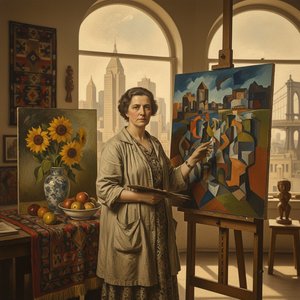
Born in New South Wales, Australia, Grace Crowley began her artistic exploration by drawing the subjects of her family's homestead, including cats, dogs, kookaburras, and a prize-winning bullock. Her formal training commenced at the Sydney Art School under Julian Ashton, where she eventually served as his assistant. Seeking to expand her horizons, she moved to France in 1925, studying at the Académie Colarossi and under Louis Roger. Her European travels led her to study with Amédée Ozenfant and Albert Gleizes before she returned to Australia in 1930. Upon her return, she emerged as an experienced modernist with a sophisticated understanding of Cubism, later participating in the development of the second phase of the modern movement in Australian art.
Evolution of Style and Legacy
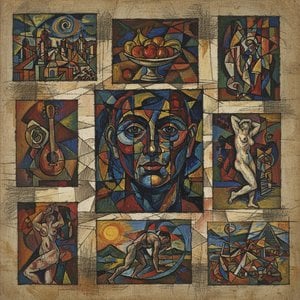
Crowley's career was marked by a significant stylistic evolution. While she is widely recognized for her cubist paintings of the 1920s and 1930s, she was among the first Australians to transition into pure abstraction in the early 1940s. Her practice underwent further transformations, including a shift from geometric forms to gestural brushwork, and eventually a period of pouring paint during travels in England, France, and America. Her contributions to the arts were formally recognized when she was made a Member of the Order of Australia. Her work is held in several significant collections, including:
问答详情
Grace Crowley 还有哪些别名?
Grace Crowley 也以 Grace Adela Williams Crowley, غريس كرولي 等其他名称为人所知。
是否有关于 Grace Crowley 的生平年表?
您可以在艺术家的 艺术历程 页面上查阅 Grace Crowley 作品的编年史,其作品按创作顺序分章节依次呈现。
Grace Crowley 的创作时期属于哪个历史阶段?
Grace Crowley 的创作活跃于 Modern 时期,这一时期确立了艺术家在艺术史上的地位。
在哪里可以按主题查看Grace Crowley的作品分布?
您可以在Grace Crowley的主题索引页面上,按主题探索其作品。