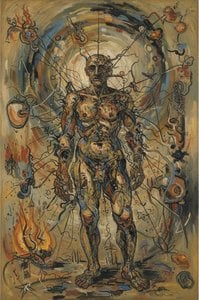
The Evolution of an Abstract Expressionist
Gordon Rayner was a Canadian abstract expressionist painter whose creative process was defined by constant innovation and a frequent transformation of his medium. His early training began under his father, a commercial artist, and Jack Bush. Following a period of working in commercial art, Rayner’s direction shifted toward abstraction, influenced by the work of artists such as Willem de Kooning and the exhibitions of Painters Eleven. During the late 1950s and the first half of the 1960s, he began to incorporate found materials into his paintings, a practice influenced by the neo-Dada movement.
In 1966, Rayner entered a period focused on the Magnetawan area, located north of Toronto. These works served as a space for experimentation with technique and materials, allowing him to refer to nature through oblique references and a thick, expressionist technique. His work was exhibited with Toronto's Isaacs Gallery, leading to his association with the Isaacs Group of artists.
Later Shifts and Subject Matter
By the 1980s, Rayner’s artistic focus shifted toward the figure. He explored realism in the context of the body, often painting himself in inventive scenes that addressed the spiritual self. This period included the Oaxaca Suite, inspired by his time living in Oaxaca, Mexico, in 1993 and 1994.
Throughout his career, Rayner received various public commissions, including the porcelain enamel on steel mural Tempo for the Toronto Transit Commission's St. Clair Station in 1977. His legacy is held in numerous institutions, including:
问答详情
是否有Gordon Rayner作品的时间线?
艺术家的 作品时间轴 页面按年份顺序展示了 Gordon Rayner 的作品。
Gordon Rayner 出生于何时何地?
Gordon Rayner 于 1935 出生于 Toronto。
在哪里可以按氛围浏览 Gordon Rayner 的作品?
您可以在艺术家 Gordon Rayner 的 情境空间 页面上按心情浏览其作品,该页面已根据作品所传达的情绪进行了分类整理。
Gordon Rayner 出生于哪个国家和城市?
Gordon Rayner 出生于 Canada 的 Toronto。