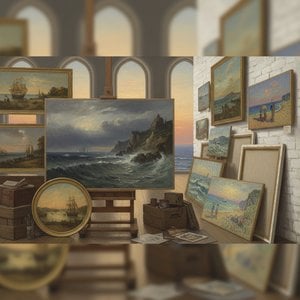
The Serene Vision of George Henry Jenkins
In the quiet, salt-sprayed corners of West Country England, where the rugged cliffs of Devon meet the shifting tides of Cornwall, the works of George Henry Jenkins (1843–1911) continue to breathe with a soft, enduring light. A master of the landscape, Jenkins possessed a rare ability to translate the topographical reality of the British coastline into something deeply poetic and contemplative. His paintings do not shout with dramatic, tempestuous energy; instead, they whisper of the subtle transitions of dawn, the rhythmic pulse of the sea against Mount Batten, and the vast, heather-clad stillness of Dartmoor. Through his meticulous use of oil and watercolor, he captured a world that felt both intimately familiar and timelessly ethereal.
Born in Bedminster, Bristol, on September 21st, 1843, Jenkins was raised in an environment that valued the precision of observation. The son of a schoolteacher, his early life was steeped in a culture of learning and detail—traits that would later define his artistic rigor. His formal journey into the heart of the British art scene led him to the prestigious Slade School of Fine Art in London during the late 1860s and early 1870s. It was within these hallowed studios that Jenkins refined his technical command, learning to balance the structural integrity of a composition with the delicate, atmospheric nuances required to render light as it dances upon water or settles over a misty moor.
A Mastery of Light and Atmosphere
The true soul of Jenkins’ oeuvre lies in his relationship with luminism. He was an artist profoundly moved by the way light could transform a mundane landscape into a spiritual experience. His canvases often feature a soft, diffused glow that blurs the edges between sea and sky, creating a sense of infinite depth. This technique allowed him to achieve a remarkable level of realism while imbuing his subjects with an emotional resonance that transcends mere documentation. Whether he was painting the bustling activity of fishing boats at the Barbican in Plymouth or the lonely grandeur of Lantern Hill in Ilfracombe, there is always a palpable sense of atmosphere—a feeling of the damp sea air and the warmth of a fading sun.
His stylistic development was marked by an avoidance of the overly theatrical. While many of his contemporaries sought to capture the violent drama of nature, Jenkins found beauty in the understated. His compositions are characterized by:
- Tonal Gradation: A sophisticated use of subtle shifts in color to suggest distance and depth within coastal vistas.
- Atmospheric Subtlety: The skillful rendering of mist, haze, and light to evoke the specific weather of the West Country.
- Topographical Fidelity: A deep respect for the actual geography of Devon and Cornwall, ensuring that his landscapes remained grounded in truth.
Legacy of the West Country Landscape
As the Victorian era transitioned into the Edwardian age, Jenkins’ work stood as a testament to a particular kind of British sensibility—one that found profound meaning in the local and the pastoral. His ability to capture the essence of rural life, from the industriousness of coastal harbors to the quietude of inland moors, has secured his place in the annals of regional art history. Though he may not have sought the global fame of the great landscape titans, his influence remains etched into the visual identity of the South West.
Today, collectors and historians look to Jenkins not just as a chronicler of Devon and Cornwall, but as an artist who understood the emotional weight of a landscape. His paintings serve as windows into a bygone era, offering a sense of peace and a reminder of the quiet majesty found in the natural world. Through his enduring legacy, the light of Mount Batten and the shadows of Dartmoor continue to flicker on the canvases of those who cherish the beauty of the English coast.
问答详情
是否有关于 George Henry Jenkins 的生平年表?
George Henry Jenkins 的艺术生涯在 艺术历程 页面上按时期逐一展开:以横向时间轴的形式呈现作品,并按创作时期划分为不同的篇章。
我可以通过主题来探索 George Henry Jenkins 的作品吗?
主题索引 页面按主题对 George Henry Jenkins 的作品进行了分类索引。
可以按媒介类型浏览 George Henry Jenkins 的作品吗?
若要查找George Henry Jenkins在特定媒介下的所有作品,请访问艺术家的所有媒介页面。