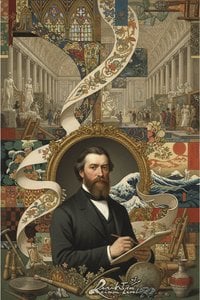
A Life Shaped by the Academy
Born in Quebec City on October 10, 1845, Joseph-Eugène-Arthur Hamel entered a world of commerce as the son of a prosperous merchant. His early years were defined by a disciplined pursuit of draftsmanship, beginning with an apprenticeship under his uncle, Théophile Hamel, a respected portraitist. This foundational period provided him with the technical rigor that would later define his professional output. After completing his training in 1867, he sought the broader horizons of Europe, traveling to study at the Antwerp Royal Academy of Fine Arts in Belgium and later in Brussels under Jan Frans Portaels.
The pursuit of excellence led him further south to the heart of classical tradition. In Rome, he studied at the Academy of St Luke and spent time in Florence, refining his command of anatomy and composition. These European stays were not merely academic exercises but periods of deep immersion in the Roman school of painting. He returned to Quebec in 1870, bringing with him a refined sensibility that allowed him to occupy a significant position within the local artistic community.
The Portraitist of the Elite
Upon his return to Canada, Hamel established himself in the former studio of his uncle on Rue Saint-Jean. He quickly became a preferred hand for the socio-political elite, the clergy, and the rising middle class of Quebec. His ability to capture the likeness and character of his subjects earned him prestigious commissions, including the portraits of the speakers of both the Legislative Assembly and the Legislative Council. These works were intended to document the leadership of his era, though many were tragically lost to the fire that consumed the Parliament Hotel in 1883.
His repertoire was not limited to secular figures. Hamel also engaged deeply with religious subject matter, producing large-scale works for various churches, such as those destined for the parish of Saint-Édouard. His technical skill allowed him to navigate between the formal requirements of portraiture and the spiritual demands of religious painting. While his career saw periods of great success and various awards from the Provincial Exhibition of Quebec, it was also marked by the quiet realities of a professional life shared with duties as a teacher and a civil servant.
A Legacy in Ink and Oil
Beyond the canvas, Hamel contributed to the institutional fabric of Quebec's art scene. He was a founding member of the Royal Canadian Academy of Arts in 1880 and served as the director of the École des arts et métiers de Québec. His role as an educator allowed him to pass on the principles of ornamentation and drawing to a new generation, ensuring that the technical standards he learned in Antwerp and Rome would persist locally.
His life concluded in Quebec City on July 20, 1932. Though much of his religious work was lost to time and fire, his surviving portraits and drawings remain held in significant collections, including the National Gallery of Canada and the Musée national des beaux-arts du Québec. He remains a figure who bridged the gap between European academic tradition and the developing identity of Canadian art.
问答详情
Eugène Hamel 的创作时期属于哪个历史阶段?
Eugène Hamel 的创作活跃于 19th Century 时期,这一时期确立了艺术家在艺术史上的地位。
是否有关于 Eugène Hamel 的生平年表?
您可以在艺术家的 艺术历程 页面上查阅 Eugène Hamel 作品的编年史,其作品按创作顺序分章节依次呈现。
可以按心情浏览 Eugène Hamel 的作品吗?
艺术家的 情境空间 页面按氛围分类展示了 Eugène Hamel 的艺术作品。
Eugène Hamel 是否还有其他别名或曾用名?
Eugène Hamel 也以 Eugene Marie Joseph Arthur Hamel, ウジェーヌ・アメル 等其他名称为人所知。